Saturday, March 15, 2025

Sounds pretty good

Grasping, in the Buddhist sense, has two forms: grasping for something, as in consumerism, which is the sort of thing we usually think of when we use the term "greed," but also aversion -- seeking another outcome than the one currently presenting itself to us as likely, unless we intervene in some way. I think of Kurt Lewin's approach/avoidance theory here.

That which we feel will benefit us or those whom we value (provide negentropy, mainly), we approach; that which we feel will harm us (speed up our entropy), we avoid. We also tend to evaluate our coping mechanisms and decide if they are up to the approach or avoidance task; and we may also decide whether approach or avoiding is the right choice in such an instance.

When the author of the Xin Xin Ming advises we have no preferences, this may be simply a shorthand way of recommending Buddha's Middle Way.

Where there are no preferences, there is wu-wei. Less is more, here.

Consider a practice of restraint. What might such a practice entail (without, of course, straying into extreme asceticism)?

Perhaps I might realize I do not need air travel, or, indeed much in the way of travel and tourism at all. Also, I might not need to subject myself to television commercials and all the forms of advertising. Perhaps I do not need sports fandom, fashion, or events at crowded venues. Perhaps I decide I do not need pesticides, herbicides, and complex household chemicals and beauty products. Expensive furniture may be unnecessary, along with shelter with a very large footprint. Perhaps I can get along without a large lawn, a riding lawnmower, gasoline-powered tools, "natural" gas. One winter coat might suffice, rather than, say, five. And I hardly need a motorboat or jet ski.

It can be a useful exercise to go to the big box store with a clipboard (perhaps several times, to avoid raising the eyebrows of employees) and make a list of all the things we do not need. It might be a very long list; or we could simply say with Socrates, “How many things I can do without!” He was famous for his simplicity of lifestyle, as was Diogenes who took up abode in an abandoned jar and is said to have tossed away his cup on realizing he could drink well enough from his hands. 

This accords with what is told of Xu You, an ancient Chinese hermit who drank from his hands and, when offered a drinking gourd, used it once, hung it on a tree, and walked away. That story is referenced in hundreds of works by poets and essayists of simplicity, from Tao Yuanming to Chomei.

Xu You lived long enough ago that it's clear Buddha has no corner on simplicity, yet Buddha's (and many in his wake) take on it has a certain ring to it. Look at the rules in the Vinaya to get a sense of what he regarded as necessary to a fulfilling life ... not many possessions, eh? Three robes and three bowls, or maybe just one, and pillow your head on your arm. Mind you, nights are relatively warm in India, but still. There's some kind of principle here.

As a teenager, I had some sense that freedom consisted in freedom from possessions as well as freedom from being possessed, and was known to "run away" from home (with tacit permission, leaving a note of duration and location) and live for days at a time in the woods with some jerky, a hatchet and some matches. 

I was fascinated by this kind of reductionism, and upon discovering Thoreau, read my copy until it disintegrated, and have never been without one since.

Yet Buddhist advice on simplicity goes far beyond Thoreau. Aside from having only a tiny cabin with fireplace cookery and one table and two chairs (one for the visitor) and a bean patch, there is the simplicity of sitting very still, eyes half closed, "non thinking." Such practice is, at least while one is doing it, the ultimate in poverty -- it does without the radio and television and cell phone, does without even food and drink and "did I pay the taxes" for the duration of the sit, and can serve as a baseline for kindness, compassion, shared joy, and equanimity, none of which require one to own a single thing. 

Practice leads to practical applications of that which has been practiced, as a rule. What you have not needed during shikantaza, zazenkai or sesshin you may not need ever. There are limits to this, of course. To live, eat food ("not too much, mostly plants," as Michael Pollan says), drink clean water (who needs sugary pop, really?) and breathe clean air if you can get it. The rest as applicable.

We had here in Eugene back in the last century a well-to-do man, Charles Gray, who, after donating his way out of the embarrassment of money, lived for a number of years on what he called the World Equity Budget, which was the average income of humans -- which was low enough that to do this in Eugene  confined him to a rented room, cooking on a hot plate, and getting about on a bicycle (with a bike trailer as needed). It was, he said, the happiest time of his life. 

If everyone did it, ... "Gracious, that would be wonderful. It would all be green. There would still be fish in the sea; there would be trees on the mountains." [Source]

I'm not him; he devoted much of a lifetime to the standard he set for himself, whereas I was that poor by choice maybe from age twenty-one to about thirty at most. I'm seventy-six now, living on a fixed income, but by World Equity Budget standards it's certainly easy street. Philanthropy helps, but I feel in my diseased bones that simple is better. 

Fish and trees; sounds pretty good.

  --shonin


Friday, March 14, 2025

Dharma

(Continued from The "thusness" zone)
 
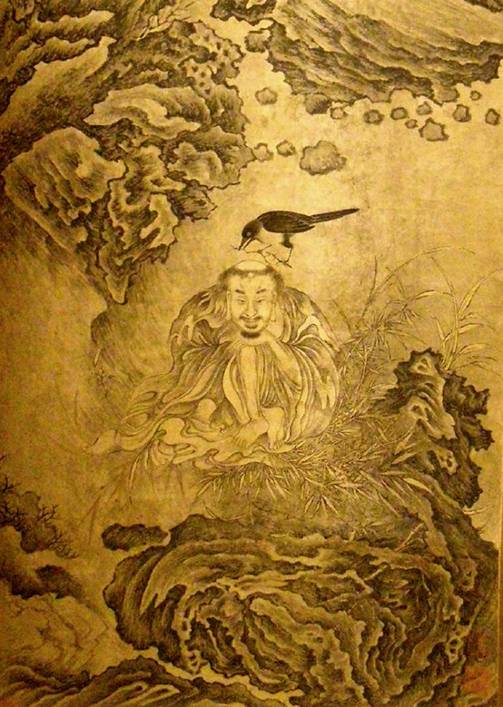
【鸟窠道林禅师圆寂纪念日】南宋佛画珍品:刘国用绘《鹊巢禅师图》赏析 

Niaoge Daolin climbed a gnarled pine tree and made his abode there. The famous poet and respected administrator Bai Juyi came to see him. "Isn't it dangerous up there?" "Much more dangerous where you are!" [This referred to the perils of imperial officialdom, especially for intellectuals.] Bai Juyi understood.

[Bai Juyi] asked another question: “What is the great insight of Buddhism?” The master replied: “Don't do anything bad, and do everything that's good.” Baijuyi replied: “A three-year-old child understands that kind of talk.” The master said: “A three year old child may be able to say it, but an eighty year old can't put it into practice.” 

Here we have the least verbose set of instructions I've seen. "Do good, not bad." We can argue over what constitutes good or bad, and Bodhidharma among others cautions against regarding Dharma as being about "good" and "bad." These teachers don't mean one should behave badly; they do mean that when you behave well you should not expect to be seen as "good" or even see yourself as "good." Just do the "good" thing and then down tools until the next "good thing."

Dharma is both seeing reality clearly and acting accordingly. That's all, folks. 

-- shonin

Thursday, March 13, 2025

The "thusness" zone

(Continued from Just Fail)

In response to the four sights, Buddha formulates four truths, the first three being about the first three sights, and the fourth being a critical response to the fourth sight. Rather than be a self-punishing sadhu, just join the sangha -- the community of those embodying the dharma, that is responding to reality realistically. He details the ways of doing this: see rightly, resolve thoroughly, speak sense, behave, work honorably, see it all through to an honorable conclusion, bear in mind those things that matter, and sit, stand, walk, and lie down with a centered stillness.

These are mutually supporting and overlapping activities, the positives that are later joined by prohibitions that arose as needed because human nature, embedded within the ongoing system of greed, anger and ignorance, finds these positives difficult to apply to all of one's life.

Chinese monks and nuns found that it helped to go and spend some time alone, and so adapted some of Taoism's hermetic culture -- "leaving behind the rest dust (of the cities)" -- for years or even decades in many cases. But the eight practices were intended to be carried out in the midst of society, as the point of behaving well is to behave well toward others.

Bodhidharma is said to have similar instructions in a document know as the "Two Entrances and Four Practices."

In it, he notes that an intellectual appreciation of Dharma, combined with zazen, can serve as a way into the life of thusness, but he seems to prefer the other Entrance: four recommended practices of what could be called applied Dharma. These are: acceptance of suffering, such as from injustices, acceptance of circumstances as we find them, ignoring cravings, and according with Dharma, that is to say, practicing the six perfections. Those are: giving, ethics, patience, effort, meditation, wisdom.

I sometimes think all these instruction, especially if one throws in the Vinaya or at least the precepts, amount to busywork to stave off the three poisons.

Buddha's early instructions, and Bodhidharma's instructions, if followed, certainly seem to be capable of bringing one's life away from the worst effects of these poisons and into the "thusness" zone.

If we need to put it in less verbose form, though, I think that can be done.

 -- shonin 

(To be continued)


Wednesday, March 12, 2025

Just fail

We face a world which is threatened not only with disorganization of many kinds, but also with the destruction of its environment, and we, today, are still unable to think clearly about the relations between an organism and its environment. What sort of a thing is this, which we call ‘organism plus environment?'   -- Gregory Bateson

Since the question was asked in the 1960s, evidence has continued to accrue that organisms are dissipative structures ("me") made up of dissipative structures (organs, tissues, cells, biosyntheses, gut bacteria)  and also constitutive of dissipative structures (families, tribes, cities, nation-states, ecosystems, biospheres). 

All these accumulate matter and energy for reproduction at their constrained scales (negentropy), and all continually drop crumbs down their shirt fronts (entropy).

You can "rewind" a video or movie but you can't rewind life; there are no prior frames except in the form of constructs in your brain, running on the electrical potential between synapses. 

Likewise, you can't fast-forward. There's no "there" to jump to.

Everyone you meet is already, in a sense, dying; you encounter them in the now on an arc of motion: the energy they accumulate, perhaps while having lunch with you, also dissipates; and it's eventually going to dissipate at a greater rate than their capacity to maintain stasis. 

And then there's a corpse, and it too begins immediately to disincorporate.

We have, to a greater or lesser degree, an impulse to live forever; but DNA's brief does not support that. 

It jumps to new substrate, beginning from a single conjoined cell in each instance, and leaves prior generations like so many bugs on a windshield. 

Looking at it this way, we might conclude that DNA, not us as organisms, is what's alive. 

Carl Sagan
was inclined to suspect so, though in summarizing the available evidence he left the question open in a way that suggests it can be tested:

 It is not known whether open-system thermodynamic processes in the absence of replication are capable of leading to the sorts of complexity that characterize biological systems.

That said, here we are, replicating, accumulating, dissipating, and, while doing these things, possibly mostly hallucinating. 

The hallucinating appears to be built in, one of DNA's strategies for protecting itself by giving us consciousness, an interplay of hormones and synaptical storage that statistically safeguards our reproduction rate.

If we find all this disheartening, well, it's where we are in the game, so to speak. Religions in general tend to deny all of the above, by doubling down on the hallucinating: play the game this way (insert doctrines and commandments) and thermodynamics will no longer apply to you (insert version of Heaven). 

Or don't, and we'll ply your ghost with clubs and matches (Hell).

Sagan's job was to prepare us to defend scientific method, the ground of the Renaissance and the Enlightenment, against profiteers who, while themselves beneficiaries of the "modern miracles" of flight and laser surgery, nevertheless would, in search of bigger profit margins, upend the ballot boxes in favor of a return to medieval hierarchy -- God, angels, masculine rich men, and the rest of us, who can look forward to bullying maybe the family dog at best -- a hierarchy threatened by the discovery, which science could hardly eventually shirk, that everything is exactly equal in "intrinsic" value and utility to everything else in an interpenetrating and cyclical universe.

And Sagan was among those who had noted that neo-Darwinism, propped up as the justification of sociopathic rich men in their hyper-accumulative and hyper-dissipative activities, was flawed. 

Lynn Margulis
, who was married to him at one time, had found evidence of symbiosis as the origin of eukaryotic cells, work that was resisted for decades within the scientific community, much of which had fallen under the spell of the rugged individualism of neo-Darwinists and their boosters among the profit-minded. 

If every living thing is made up of tiny cooperatives, what implications might that have for the model we are now living under, of maximized exploitation within a finite ecosystem?

Even the not-very-rich, embedded in economic structures created by and for the very rich, defend the structures vociferously when nature's networks are shown to be at least as cooperative as competitive. When Suzanne Simard merely found that birch and Douglas firs were sending carbon back and forth, it was enough to end her career with the governmental agency that employed her at the time. 

It is easy at this point for us, contemplating the effects of the activities of the very rich, to become angry at the state of the world and angry with those we have identified as the principal actors. Motivated by such anger, many become active in seeking out and applying strategems for opposing the rich, from boycotts to revolutions.

We can see from the history of applied Marxism in the twentieth century that the cure can be equivalent to or worse than the disease, taking into consideration the usual measures of human misery and environmental degradation. One might cogently observe that these revolutions and their subsequent political evolutions show evidence of a reversion to authoritarianism linked to the protected well-being of the authoritarians and their families and friends, much the same as the conditions that had engendered the revolutions. 

Greed, anger and delusion are not the peculiar province of the rich. They are endemic to all, and come to a boil when we too, impelled by impulses instinctive to us, subsequently become the rich, or at least those ensnared by the leavings of the rich.. 

I have some sympathy for us all. We're born dupes -- The process of replication that we call life has, in all living beings, its own project, and requires of us that we cooperate by being deluded as to our individual aims in life, reaching greedily for resources to further those aims, and angrily defending those resources from others who appear to be reaching for them. We're mightily stressed by all this. Is there a way out of what we may reasonably describe as our plight?

This is where Buddha comes in. Having seen the old, the sick and the dying, he gives up his possessions, his relationships and his United Health Insurance policy and heads for the hills, making his clothing from rags pilfered from a dump in a cemetery. Correctly surmising that the fourth sight -- a self-denying sadhu -- harbors a clue to a cogent reaction to his distress, he nearly starves himself to death, and then realizes one cogent reaction need not be the only cogent reaction. There's no need to stop eating. There's only a need to stop eating greedily. There's no need to snub society. There's only a need not to react to the foibles of others angrily. There's no need to tilt at the windmills of delusion. There's only a need to refrain from behaving in a deluded manner.

"The Way is actually very easy," declares the author of the Xinxin Ming. "Just fail to have any preferences." 

Ha-ha-ha, we reply and skip down to the, mostly, to us, incomprehensible verses that follow, looking for an out.

-- shonin

(To be continued)