Showing posts with label Red Pine. Show all posts

Tuesday, September 30, 2025

In dewdrops

I'm a sucker for anything by Bill Porter, who seems to me an especially salty reincarnation of Layman Pang, and am happiest reading him as he visits Chinese poets' graves and offers them Kentucky whiskey.

That he translated the Diamond Sutra at first surprised me, as I'm sure he finds it redundant to the whiskey offerings, but, as a Quaker acquaintance once explained to me, for them Quakerism wasn't everything they looked for in Christianity as they understood it, but it was "the only game in town."

When I was in my teens and twenties, I read everything I could get my hands on about Zen, which means I had stuffed myself full of the kinds of things bookstores and libraries had on the subject in the 1960s and 70s, very little of seemed to come from Soto.

However, at some point I came across Heinrich Dumoulin's history, such as it was, of Zen, and he did devote part of it to Dogen, though I felt he did so under a sense of obligation -- seemed to regard Dogen as a bit of an aberration. 

Dumoulin included one of Dogen's last poems.

It really got my full attention.

Here it is, in Steven Heine's translation:

To what shall
I liken the world?
Moonlight, reflected
In dewdrops,
Shaken from a crane's bill.

This is the Diamond Sutra in full. Its immediacy has no past, no future, no accumulation of karma or merit, also both no thought of accumulation of karma or merit and no thought of no accumulation of karma or merit.

 -- shonin 

Tuesday, September 23, 2025

Cut Cabbage


I’m a poor but happy follower of the Way
whatever happens takes care of my needs
last night the west wind blew down an old tree
at daybreak firewood covered the ground
windblown white silk wreathed the red scarps
dewdrop pearls adorned the green cliffs
my survival has always depended on what’s present
why should I tire myself out making plans

-- Stonehouse, tr. Red Pine 

I'm interested in the traces I feel I can sense of the effect of the word "Way" in various minds. Ask the average Taoist or Zennist about it, and you can hear some overlap in their replies, but it's not a matchup, the way their image of "noodles" or "ocean" might be. This leaves me wondering what idiot came up with the word "Way" in the first place. Trying to confuse us, eh?

The more I muse on all this, the more I feel like candles and chants risk more hindrance than help. When it's time to cut up some cabbage, just pick up the knife and cut cabbage.

-- shonin

Monday, August 25, 2025

Reality gives me cold toes


Chiyono’s No Water, No Moon. Hidden Lamp, p. 37. Chiyono was a servant in a Zen convent who wanted to practice zazen. One day she approached an elderly nun and asked, “I’m of humble birth. I can’t read or write and must work all the time. Is there any possibility that I could attain the way of Buddha even though I have no skills?”

The nun answered her, “This is wonderful, my dear. In Buddhism there are no distinctions between people. There is only this – each person must hold fast to the desire to awaken and cultivate a heart of great compassion. People are complete as they are. If you don’t fall into delusive thoughts, there is no Buddha and no sentient being; there is only one complete nature. If you want to know your true nature you need to turn toward the source of your delusive thoughts. This is called zazen.”

Chiyono said, with happiness, “With this practice as my companion I have only to go about my daily life, practicing day and night.”

There are varied stories of Chiyono's life. Richard Bryan McDaniel, in Zen Masters of Japan, says: "One of Bukko’s students was the first Japanese woman to receive a certificate of inka. Her Buddhist name was Mugai Nyodai, but she is remembered by her personal name, Chiyono. She was a member of the Hojo family by marriage and a well-educated woman who long had an interest in the Dharma. After her husband died and her family responsibilities had been fulfilled, she went to study with the Chinese master."

He goes on to recount a longer version of the story told in Hidden Lamp, after warning us it is apocryphal, as Chiyono was of the lower samurai class, rather than of the Hisabetsu-buraku (discriminated hamlet class) as implied in both the story and in Hakuin's illustration above. 

Was she perhaps in a servant-like role as many new students are, in a training-monastery setting? Whether as a servant or a somewhat respectable widow, there is the implication that Chiyono must seek enlightenment with the handicap of actual or temporary (for training purposes) low status to be overcome.

There is also a story that when Chiyono was ready to begin her koan study with the master, her presence in the zendo was at first objected to by the monks, on the grounds that her beauty would distract them. And that to overcome this she burned her face with a hot iron rod. Some have noted an apparent sag in her face as depicted in her lifelike portrait sculpture as evidence of the truth of this story.

These two stories are related. But to continue.

Zen is grounded in work, both on and off the cushion. Work off the cushion is called samu. Monks and nuns are famous for their samu: sweeping, chopping wood and carrying water. Chiyono is known to have carried water.

After months of wholehearted practice, she went out on a full moon night to draw some water from the well. The bottom of her old bucket, held together by bamboo strips, suddenly gave way, and the reflection of the moon vanished with the water. When she saw this she attained great realization.

She wrote a realization poem.

With this and that I tried to keep the bucket together,
And then the bottom fell out.
Where water does not collect,
The moon does not dwell.

I have been asked three questions in the presence of this koan.

1. What are you trying to keep together at this time of your life?
2. Where does the moon go when its reflection disappears?
3. Where do we go when we let go completely?

1. What I am trying to keep together at this time of my life is my body, with its diminishing capacity for activity/work, awareness, compassion, and kindness, largely because I feel I still have some responsibilities to family and community, including the sangha. My life has been greatly simplified due to bodily conditions: I don't drive or shop or handle finances, and am praised for shuffling around the block with my two sticks. "Got your phone? Okay, have fun."

I still have grief and regret. There's not much to do about that but carry a few tiny blossoms to a cairn nearby. Some self-indulgence in this, I think, may be excused.

It's easy to vanish into an easy chair. Letting go, now, would be as simple as the decision not to try to stand up. But also I'm still capable of spouting verbal abuse, which originates right here in the body, a part of nature. Channeling my speech (and facial cues) away from such may be my final exercise in letting go.

2. I reflect on the moon's beauty in its path across the sky, and then I don't. The moment a thought is over, it's nowhere, especially as near-term memory paths erode in one's cortex.  In resting from even reflection we come to ground truth -- not by seeking to rest, but by the simple expedient of absent-mindedness. This could be called the practice of not practicing, for which, for our purposes, we may use the model of a pet rock.

3. We don't go anywhere at all.

The bucket's bamboo strap unwinds and its moldy bottom falls out. Icy well water sluices down mossy stone steps. My feet are wet. Reality gives me cold toes.

-- shonin 

Friday, March 14, 2025

Dharma

(Continued from The "thusness" zone)
 
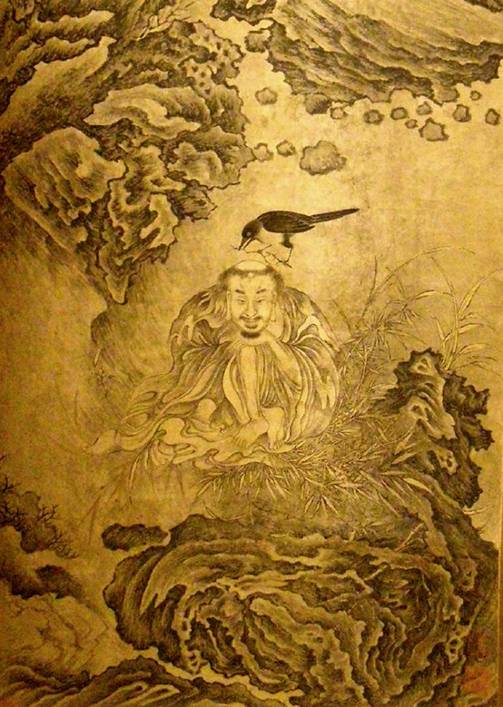
【鸟窠道林禅师圆寂纪念日】南宋佛画珍品:刘国用绘《鹊巢禅师图》赏析 

Niaoge Daolin climbed a gnarled pine tree and made his abode there. The famous poet and respected administrator Bai Juyi came to see him. "Isn't it dangerous up there?" "Much more dangerous where you are!" [This referred to the perils of imperial officialdom, especially for intellectuals.] Bai Juyi understood.

[Bai Juyi] asked another question: “What is the great insight of Buddhism?” The master replied: “Don't do anything bad, and do everything that's good.” Baijuyi replied: “A three-year-old child understands that kind of talk.” The master said: “A three year old child may be able to say it, but an eighty year old can't put it into practice.” 

Here we have the least verbose set of instructions I've seen. "Do good, not bad." We can argue over what constitutes good or bad, and Bodhidharma among others cautions against regarding Dharma as being about "good" and "bad." These teachers don't mean one should behave badly; they do mean that when you behave well you should not expect to be seen as "good" or even see yourself as "good." Just do the "good" thing and then down tools until the next "good thing."

Dharma is both seeing reality clearly and acting accordingly. That's all, folks. 

-- shonin

Tuesday, October 29, 2024

Many are

Mixed signs abound; after the storm, leaves shredded
by hail loll about on the street and
are investigated by crows. Where have the

birds been, all these baked-earth and baked-sky
days? And now they vanish again, as heat
resumes, as gardens wilt, as humans scurry

into delicious air inside sly merchants' shade.
I choose, as viruses have not, despite assurances,
abated, to limit myself, in straw Asian hat,

to observing this stuttering start to autumn
at first hand in the yard, at second hand
while putting away bought things the family's

acquired for me, before retiring once again
to the hermitary, converted tool shed
behind the house at the end of the drive

to zoom into the ether and sit
zazen with a few, who know
where to find me, some quiet, and themselves.

Many are hermits in just this way, though they
might not see it in these terms. A daily
routine within walls, or gardens, or

property lines: boundaries we create
of imagined air clean enough to inhale
without becoming a burden to our loves.


It's not much of a poem but shows what I've been thinking about. Autumn is trying hard to come in, with a strong system off the Pacific having filled our dried-up rain barrels, and awakened all the animals that seemed to be hiding somewhere after the heat waves, one of them topping 100°(f) for five days. We have another heat wave coming in September that looks to go over 90 for five days, with one more day pushing 100. But, yeah, plants have started putting on their fall plumage and the nights are cool.

I notice these things from the yard and while sitting in the "veranda" (basically a deck roof but no deck, just grass growing out of sand), or working in the garden. I have leukemia (slow, the CLL kind) and old age and what not, and a basic shyness with added cognitive decline, so I'm no longer a driver and now no longer a walker of the neighborhood sidewalks, unless someone is with me.

I'm also careful to breathe clean air. Weak lungs and all that, and I don't think much of the current official advice on viruses: Covid has surged hard this summer, and has been proven to have a long tail for many even when not initially presenting with symptoms. Even though my immune system is probably not very compromised, I see no reason to court disaster just because the CDC wants to avoid angering the nation's rentier class.

This adds a burden to the family; they mask up to go get groceries and feel a little self-conscious about it. But they agree that we, as a nuclear family with only one remaining driver, are exposed to too many potential unforeseen circumstances, so a few relatively easily achieved precautions are rational for us.

I spend time on federated social media and am seeing a lot of posts with this kind of thinking; it's like there is an emerging hermit class.

It's, for many, a privileged class, supported by the shipping phenomenon and an underclass (that's, alas, what it is) of front-line warehouse workers, store clerks and delivery people, many drawn from marginalized populations, who are getting sick repeatedly, and many of whom end up horizontal on couches, joining the ranks of those who must be maintained at cost to their tiny social safety nets or overworked social services.

This is like treading water after a ship sank. Many who thought themselves well-to-do are in the water with the people who brought them groceries or rotated their tires. I think there will be more of this and perhaps much more.

Against this slow-motion dystopian background, I think about what my role can or even "should" be. I have some intellect remaining, so I spend most of my days (and nights) doomscrolling for what I think might be the best policies and advice concerning climate, health, extreme weather resilience, and domestic and international relations, including resource wars, to share with whomever wishes to hear all this.

Buddhism came to me in the guise of how one might best behave on a sinking ship (or in the water afterwards); a kind of hospice manual:

"There are four kinds of wisdom that benefit living beings: giving, kind speech, beneficial deeds, and cooperation. These are the practices of the vow of the bodhisattva" -- Dogen.

Clearly the instructions are intended for face-to-face interaction, yet here I am hanging out mostly in my homemade hermitary, a repurposed tool shed. Right; well, my excuses, with the admission of privilege, are as stated above, and my practice (when not raising vegetables) is an online practice. It is twofold: curate links to sensible adaptive choices in a deteriorating system ("secular") and offer opportunities for zazen practice and discussion of anattā and its implications ("religious").

Of course, sometime soon I (we) might not have Internet access. What then? Well, much of the time, when I have my nose out of the computer, I sit in the veranda and watch. There's not much to watch: the clothesline, the power poles that run along our alley instead of our street, some fruit trees, and houses belonging mostly to absentee Airbnb owners. It's a restful spot.


Birds sit the wires in seasonal rotation. Swallows and purple finches have moved off, and currently starlings are passing through. Starlings were permanent residents at the farm in the last decade; before that, they migrated past us as they do here in spring and fall. And we're no longer under the flyway; I miss the honking of vees of geese while I worked the farm garden.

The distance between these two locations is fourteen miles. This variability of population is interesting; I can speculate about it for hours. What's not to entertain?

Or I just ... sit. Right there, every blade of grass continually establishes the temple of the whole universe. What's not to contemplate?

I think the phenomenon of "hermit" life goes vastly unremarked and underappreciated. In this neighborhood alone, many work among their flowers, vegetables and apple trees alone, contemplatively plying trowel and clippers. Kitchen work, too, is often undertaken alone yet not lonely, chopping, folding in, turning from counterspace to sink with a bowl, mind gathered to a single point.

My maternal grandmother had a huge extended family, but as they passed one by one, she accepted a small apartment near us and established a routine of bible study and housekeeping that lasted until she breathed her last. My paternal grandmother outlived all but one son and accepted a small single-wide trailer in his back yard, sitting out front and shelling beans as the geese passed over.

Who's to say they were not practiced eremitic meditators? They both, by the way, faced pancreatic cancer at the end and both dealt with it by no longer eating, with a silent yet not sad patience I admired.

There must be millions of these "hermits," widows, widowers, the divorced, or separated, or abandoned to end-of-life care facilities, or, among those younger, simply content to rise, go forth to stamp books behind a library desk, go home and sit by a window watching people with umbrellas scurry along rain-swept streets, or, or ...

... and not necessarily unhappy about it. Even many who strongly enjoy being social also enjoy solitude.

The worldwide assumption of a religious or even secular requirement that to do well one must do for others does not come with a meter. A quiet life has this to recommend it: those living contented with little typically do not generate much of this world's distress. As such they can serve as models for a life not dependent upon material culture for "happiness."

That in itself benefits living beings.

-- shonin


Sunday, October 20, 2024

Rice and veg


I grew some things and chopped them up. I steamed them enough to call them blanched, and steeped them in rice vinegar and honey.  

It's not like I can't or don't buy groceries, but occasional water-bath canning gives one the cheery sound of lids popping, and a sense of life going ahead.

Pop. Pop. Six or seven times, then go look at the moon.

This is preparation for a winter in the hermitary. 

Pickled veg is famously what Asian hermits have with their rice (when they have rice), especially in winter. Stonehouse recalled having gone through a hundred crocks of pickles, more or less, at his hermitage.

Stonehouse  had a hermitage, whereas I merely have a hermitary, that is, in my case, a she-cave attached to a comfortable home. Sincerity comes in bursts of a few seconds; I feel I would make a terrible Zen leader. 

That's all right. We are bubbles on the stream. When I see three seconds of sincerity, I jump on -- free ride! 

In the morning, rice and veg.

-- shonin 


Forty-some years I've
Lived in the mountains,
Ignorant of the world's
Rise and fall.
Warmed at night by a stove
Full of pine needles;
Satisfied at noon by a bowl
Of wild plants;
Sitting on rocks
Watching clouds and empty thoughts;
Patching my robe in sunlight;
Practicing silence
Till someone asks
Why Bodhidharma came east,
And I hang out my wash

-- Shiwu (Stonehouse) tr. Red Pine


Tuesday, December 21, 2021

Time Flies Free: Guest Post

On December 8, 2021, Shonin's beloved daughter left this world behind. Her age at the time was 35. Rev. Jundo Cohen of Treeleaf Zendo was moved in this occasion to offer this essay in her memory. Reposted by permission. It is about the interpenetration of mortality and eternity, and references Dogen's fascicle on Being/Time.


What time is it?

Looking in the mirror, my grandfather's face stares back at me. My hair is whiter with each day, my cheeks are rough and sunken. I cannot run as fast as I did just awhile ago. The children, come to us late in life, are now grown, or nearly so. Calculating in my head (no longer as sharp), my remaining years are few at best. "Time waits for no one, flies like an arrow, sands through the hour-glass, passes with a candle flicker," and all that. Even the Buddha grew old, grew feeble, became cold ashes. He found no way to halt his own body's aging.

The Buddha could not halt aging. However, fortunately, the Buddha found the trick to halt time.

Not only halt it, but also (as later Zen masters like Master Dogen further elucidated) slow it, reverse it, make it speed up and twirl around, cause it to flow backwards, ultimately to vanish. The Buddha and Masters found something beyond aging and illness too, even death itself.

Hard to believe? And how did Buddha and Dogen grow old and die, yet were free of time, of dying too ... all at the same time?

What I claim might sound like some mystical power, a violation of the laws of physics, of common sense, impossible to achieve.

I assure you that it is all quite real.

Oh, I am not speaking of sorcery, nor a magic incantation to make the world spin backwards, wishes to a genie, secret military tech to travel faster than light. I do not mean a time machine from an H.G. Wells tale, nor have I gone mad.

Rather, it is just a matter of fresh attitudes, of changed perspectives, of new ways to count the minutes and seconds, to divide life (or, better, to stop dividing life), creative ways to see. These abilities derive from changes of heart, mind-altering insights, very literally from quieting the temporal regions of the brain so that we experience time differently, leading to our mentally substituting new inner models of time's flowing (and lack thereof) for the old. Zen practice, the stillness and silence of Zazen, opens these doors.

I think that most people have had moments when they have experienced such states to greater or lesser degree: How time grows slow when we are children waiting for the recess bell, then fast as the end of summer vacation draws near. Looking at a sunrise, or a new baby's smile, we might sense something truly infinite, timeless. Remembering our roots, our ancestors, we may feel intimately connected to the past, as if the past is still present in some way. Holding our children and grandchildren, we know our part in the future.

But I am speaking of something stronger than any of that, longer lasting abilities we can train to summon at will, to taste whenever we wish. It is a skill like any skill, learned talents that are among the fruits of this "goalless, nothing to attain" Zen practice. We can be emancipated from time, also from time's goals and push to attain. No, not from the wrinkles, the nights and days, the grave which calls ... but from concern for time, from seeing it as only slipping away.

It is hard to describe, but I will do my best. Words fail miserably in such things. Nor is this about just a single way of knowing. Rather, I would indicate a collection of ways of knowing time, some quite contradictory when described, any or all of which can be reached for as needed, like tools in a clockmaker's toolbox.

Master Dogen, our Soto Zen non-clockmaker, wrote of such time(s) ... and timeless suchness too ... in his old-time masterpiece, entitled "Being-Time." He spoke there of everybody, every thing, being in its own time, of all our times blending together yet being there own precious individual thing-moment too, of there being something timeless which encompasses it all. Hundreds of years before Einstein made “relative time” a household world, Dogen spoke of each of us, and all things, existing in our own vibrant being-time, connected to the being-time of all other beings and things in this vast, fluid universe. Why is this important? Because it allows us to see the amazing, syncopated, backward-forward, moving-still, timeless-time of this whole life-world where we temporarily find ourselves alive. It also frees us from simply witnessing time as an unstoppable flood in which our youth turns to old age, time passes quickly, life becomes death, and all is nothing but change. The Buddha taught that all composite things are impermanent and ever changing, but he also taught a way beyond all things and change. If I may quote from my own book, "The Zen Master's Dance" (please read it when you have time ), Dogen declared:

For the time being this staff or whisk here held, being-time.
For the time being a pillar or lantern, being-time.
For the time being the children of common families ... being-time.
For the time being the earth and sky, being-time.
In this word “being-time,” time is already just being, and all being is time.

We have our "common sense" measures of time, taking time for granted. However, it need not be only so:

We should come to know in this way that there are myriads
of forms of things, hundreds of blades of grasses
through the earth, and that each blade of grass and each
single appearance is not apart from the entire earth. ... And when
we arrive in the field of the ineffable, there is not but one
blade of grass and one appearance here and now. Whether
there is understanding of this phenomenon or no understanding
of this phenomenon, whether there is understanding
of things or no understanding of things, all is
only this exact moment. Since there is nothing but just
this moment, the time-being is all the time there is. All
moments of being-time are just the whole of time, as all
existent things are time too. The whole universe exists in
individual moments of time, and each moment contains
all existences and all worlds. Reflect now whether any
being or any world or the whole universe is left out of the
present moment of time.

He continues, speaking to us from so long ago:

So, we should not understand only that time flies by.
We should not feel that “flying” is time’s only ability. For if we
just let time fly away, separations from and in it might appear.
Those who fail to experience and grasp the truth of
being-time do so because they only understand time as something that passes.
Ultimately all existences are linked and become time.
Everything that exists throughout the whole universe is
lined up in a series of all individual moments, and at the
same time is each and all time. Because all moments are
being-time [and you are being-time], they are your being-time.
And because time has the nature of flowing, today flows
into tomorrow while today flows into yesterday, all as yesterday
flows into today, today flows into today, and tomorrow
flows into tomorrow.

Finally:

We should not just feel that the passage of time from one
moment to the next is like the movement from east to west
of the wind or a rainstorm. The whole universe is not
unmoving, for all is moving and changing, and the universe
is flowing from one moment to the next. An example
of such a moment-by-moment passing of time is the spring.
The spring has countless aspects arrayed as what we call
“the passage of time.” ... [Yet] because spring
embodies the momentary passing of time, passing time is
being realized and actualized in each present moment of
springtime here and now. The flowing of time occurs by
spring, thus the flowing is completed and brought to fruition
in just this moment of spring.

Dogen's poetic images may be hard to fathom. Let me summarize and bring them down to earth, hopefully not to waste your time:

One can feel, for example, that each moment is whole and complete, as if it holds all time, as if it is timeless with no before or after. It is a wonderful experience, good to know when we worry that this moment will slip away. Nothing slips away, even as time keeps passing, for this moment with no before or after, becomes this next moment with no before or after, then the next and next, each with no before or after ... and not a drop lacking from any one. There is no other moment, nor better moment, than this.

That is so even as, in our ordinary experiencing, time passes, and sometimes brings along so many moments we do wish were otherwise. Though we wish sometimes that they were otherwise, moments of sickness are just moments of sickness, times of loss just times of loss, days of sadness are simply days of sadness ... and all of life is fully life. Our heart flows with acceptance even as, in another chamber of our heart, beating as one, we wish it were not so, and that the times of suffering would never come or quickly pass. Each instant is, in its own way, a shining jewel on the bracelet of life. And, no less, so are the times of health, winning and happiness that we naturally welcome more. Our Zen practice teaches us to welcome all of it, letting each day be that day, welcoming even the hard and terribly ugly parts we do not welcome at all.

And though we might regret the past, feeling still the scars of long ago pain, or we may long for the past and something or somebody now lost, we learn to bow to the past, letting the past just be the past. We honor the past, then let it go, living on from now and here.

Likewise, though we may fear for the future, plan for the future, hold some dream for the future, we learn to grip things lightly and let the future be too. Oh, we take our medicine, work our plan, pursue practical steps to stay healthy and safe. Even so, deep down, we let what will happen happen too. If our health does not return, our project collapses, the whole world comes to an end ... the wisdom within us will flow with it all somehow.

We also sense that the whole world is connected, all things are connected, all times are really one, and all times are each other too. Much as the bird above is merely the fish flying in the sky, while the fish is but the bird in other guise swimming in the sea, tomorrow is yesterday become tomorrow, and right now is tomorrow right here. In fact, it is all now now now ... for yesterday is now as it was then, and Friday is yesterday-now as it will be on Friday. But all is also yesterday yesterday yesterday ... for now is just yesterday posing as now, and Friday is Friday on Friday too. And all is tomorrow tomorrow tomorrow no less, for they are all the same. Realizing so is powerful medicine for our usual sense that all things are separate, conflicting, broken in the world. Nothing is broken when known as the flowing whole. In the flowing, there is this which is wholly stillness yet flowing.

For time flows from today to tomorrow, but also (felt Dogen and those who share his visions) tomorrow flows into today and today into yesterday. In fact, each moment fully holds within all the future and all the past, plus embodies every other moment ... and is just flowing flowing flowing. There is also a face beyond measures of time, beyond all coming and going (thus free even of birth and death), and such is also fully present in each and every twist and change. Thus, to the wise, even moments of passing and death are also free of passing and death. Dogen said that when death comes, let it come, dive right in. He's now gone, but has he truly gone at all?

The famous Zen challenge, inscribed on the wooden Han clock in the temple, alerts us:

Life and Death are the Great Matter;
Time swiftly passes by like an arrow;
Thus, we should strive to awaken;
Do not squander this life.

It is timely advice.

How many of us waste this life, chasing unhealthy desires, caught by anger and revenge, pursuing false treasures and temporary pleasures, all to realize too quickly that the years have gone. Instead, learn to appreciate this moment and the next, all that life brings. Live gently, be kind. Learn to appreciate what is in your life, without running heedless in search of another. Oh, sometimes we must run from fire, from tigers, from wars ... but even in running, see if you can sense the stillness within.

For you see: What we awaken to, the resolution of this Great Matter, is the rediscovery that time is both flowing and still all at once, free of passing even as the clock ticks and the calendar pages are turned. The arrow is always flying and hitting the target at once. There is nothing in need of striving for, no swift or slow. Not a moment, not one drop, is ever squandered ... nor are we confined even within borders of life and death. That being so, live well, live wisely ... keep moving.

It is hard to express.

Better, please sit Zazen, and taste all these time(s) and timeless in each sitting moment.

Gassho, J

dedicated to S

Tuesday, December 18, 2018

In Place 52


Han Shan was not young

his ability to scale slick rock faces

in rainy winter stuns her; what

does falling down on her pasture path mean


She sits by her space heater in the hut reading of Han Shan's adventures in a thin robe high in the mountains year round and shivers at the thought. Just getting back to the house after an evening's introspection will be enough adventure for her old bones. Is there anything left in her flashlight's batteries, she wonders. The bridge! That rushing high water! Thus the exurbs become wilderness. 


Down to the stream to watch the jade flow
or back to the cliff to sit on a boulder
my mind like a cloud remains unattached
what do I need in the faraway world

--Cold Mountain (Han Shan) tr. Red Pine


Wednesday, October 24, 2018

In Place 49

Once a month a silent retreat

with sangha, otherwise

every day no other sound

than wind, or rain, or creek.


The old woman's current community meets monthly at a rural home an hour's drive from her farm, to spend the day in group zazen and a few other practices. She's torn between her habitual hut practice and the notion that Buddhism requires company -- what even are precepts for in the middle of nowhere, alone? But every beloved poem by Han Shan, or Stonehouse, or Ryokan convinces her she's doing real work. As does the rain, as does the moon behind clouds.


    Movement isn’t right and stillness is wrong
    and the realm of no-thought is confusion 
    instead the Patriarch didn’t have no-mind in mind
    any thought at all means trouble
    a hut facing south isn’t so cold
    chrysanthemums along a fence perfume the dusk 
    as soon as drifting clouds start to linger
    the wind blows them past the vines

    -- Stonehouse (Shiwu) tr. Red Pine

Wednesday, August 1, 2018

In Place 43

Inspired by her stairs,

the old woman undertakes

to clear more stream bed;

instant rock garden


Between the stones she has tucked comfrey, mint, and mosses. In drought, she waters the stones, hopefully keeping the “garden” alive till winter.


Plans and events seldom agree
Who can step back doesn't worry
We blossom and fade like flowers
We gather and part like clouds

—Shiwu (Stonehouse, tr. Red Pine)

Wednesday, July 25, 2018

In Place 42

In summer she, grunting, hauls 
 
large stones from the dry wash

up to the hut to make steps

for those who keep to a path


She had no idea she could move anything so heavy. Samu with appropriate sweat.

Back by the stone bridge, mind returns.
Where now the things that troubled me?

— Han Shan (tr. Red Pine)


Monday, December 18, 2017

In Place 38

She stays some nights, by

lamplight studying, or in

bed, watching the moon

stray among still branches 


The solitude of the hut's location is brought to her full attention when she realizes how long the walk-in would be in darkness and rainy or icy conditions. "Should I get up and check my flashlight batteries again?" she wonders, pulling the blanket up to her chin.


    I don't let white clouds leave the valley lightly
    I escort the moon as far as my closed gate

    --Han-shan Te-ch'ing in The Clouds Should Know Me By Now 120 (tr. Red Pine)


Wednesday, March 1, 2017

In Place 33

 Snow seals heat within;

she steams white rice,

tea and veg to have with

scenes of falling white


The snow helps dampen road noise from nearby civilization. She sits, then gets up to muck about. Before long, thoughts creep in that leave her feeling defeated. "If in sitting one finds no distinctions, where do all these distinctions come from to crowd in as soon as I rise to pour tea?"


Snow besieges my plank door I crowd the stove at night
although this form exists it seems as if it doesn't
I have no idea where the months have gone
every time I turn around another year on earth is over

-- Han-Shan Te-Ching (tr. Red Pine)

Sunday, April 5, 2015

In Place 18

For study of old books,

soft light of rainy days

is good; the volcanic young man

helps with her homework


The hut is not off-grid; this is thanks to a long heavy-duty drop cord. The old woman has her steamer, tea maker, small heater, and a lamp. Much of her study consists in seeking out connections between talk of "enlightenment" and talk of the "precepts." For years her question has been: what does understanding reality necessarily have to do with compassion?

Bud­dhas don't keep precepts. And buddhas don't break precepts. 

-- attr. Bodhidharma (tr. Red Pine)

Friday, September 12, 2014

In Place 10

Books, lamp, her mother's desk,

a small cot from which, lying down,

she may observe trilling leaves

of spring and fall cottonwoods


Most of her books are studies of women in Buddhism and some books by Eihei Dogen, Hongzhi, Shunryu Suzuki, Kosho Uchiyama, Ryokan, Red Pine, Shiwu (Stonehouse) and Han Shan (Cold Mountain), along with several collections of Chinese poetry translated by Kenneth Rexroth. The collection changes as the old woman's studies change. From the cot there is an especially intriguing view of young cottonwood and ash trees just across the small creek.


In my hut, I listen to the evening rain
and stretch my legs without a care in the world.

-- Ryokan (tr. Abé and Haskel)
 

Tuesday, July 22, 2014

In Place 5

She cleans up this site;

weeping, she finds toys 

her children had mislaid among thorns

and stones, moss-covered now


Here in 2013 the impending demise of the fir tree has become quite evident. It had shaded the hut as a playhouse and a writer's cabin, as well as numerous picnics. In the 1990s, children played round this structure and inevitably lost some things; plastic toys last a long time but moss may hide them for awhile, waiting to be rediscovered like archeological treasures.


...retiring to my hut I accept white hair
but sigh that today and the years gone by
are mindless like the rivers flowing east

-- Han Shan (Cold Mountain, tr. Red Pine)


Sunday, June 1, 2014

In Place 2

Retired from public life, she moves in, old

eight books she's written here 

not bad books, yet she must admit

she has failed to save the world


"Failing to save the world" in this instance means having attempted, without much impact, to promote to society at large an agrarian subsistence lifestyle as a response to resource depletion and climate change. Those who speak for corporations proved to have the louder voice, and like many others the old woman has been worn down considerably. She is trying a new approach.


To glorify the Way what should people turn to?
To words and deeds that agree
But oceans of greed never fill up
and sprouts of delusion keep growing


—Shiwu (Stonehouse) (after Red Pine, tr.)


Friday, April 18, 2014

In Place 1

Decades ago, a playhouse for her children

but too much window glass for their play

by the fence it stands now, forlorn, lost;

neighbors' horses seem amused


This image was probably taken about 2010, when the playhouse had been mostly unused for almost two decades. The shade tree, a Douglas fir, is already looking a little stressed, perhaps partly because the playhouse was built so near it when it was a small sapling.

     I move my table to read sutras by moonlight
     I pick wildflowers to fill my altar vase

     -- Shiwu (Stonehouse, tr. Red Pine)


Wednesday, November 13, 2013

Use edges and value the marginal


About leaves that generally get stripped and tossed away.

1. Go out to where either your greens have made a whole lot of big side foliage you don't use at table, or have gone to seed producing volunteers (volunteer chard shown), and gather about forty leaves.

2. Stuff your Excelsior or Excalibur or solar dehydrator with them, or just lay them out in the sun. 

3. When they're brittle, fish them out and strip dry matter from midribs. Clean up and crumble to desired consistency. 

4. Dry can (bake) in jars and open to use as needed. Good for up to five years in our experience.

Kale, collards, chard, beets, spinach, cabbage, broccoli, cauliflower, dandelions, false dandelions, lamb's quarters, turnip, arugula, garlic, onions, young bean leaves or knotweed leaves, chicory, plantain, nettles, maple and lilac flowers, nasturtiums, kohlrabi, lettuce, and tatsoi, along with herbs to taste can all be included in this. The more variety, the better nutrition, and they all taste about the same in this form.


You could live a long time, comparatively speaking, if shut in by a pandemic, for example, on just five pounds of dried veggie crumbly and a hundred pounds of rice. (Be sure you have also secured a supply of water.)

You could, with a little acquired knowledge and some persistence, do this entirely with foraged weeds even if you have no garden.

Use in breads, soups, frittatas, quiches, on meats, on potatoes, in eggs, power drinks, hot cereals, salads, wilted salads, stir fries, etc. Also can be added to feeds such as poultry feeds.

Caveat: spinach, chard and amaranths contain a lot of oxalic acid and so there are those who should not consume them in quantity.


After twenty years of nights beneath the moon 
and the clouds to find myself old is hard
crows come looking for food at the altar
monks return with empty begging bowls
others work the waves for shrimp and clams
I swing a hoe in the mountains
when Solomon’s seal is gone there is still pine pollen 
and one square inch free of care

  -- Stonehouse (tr. Red Pine)


Monday, August 12, 2013

Work well


From right doing, right work naturally flows. It is understandable if one has had to keep working at a fast-food place to help support one's children, but one must also keep an eye out for a better livelihood, as fast-food places poison the population.

In general few jobs meet this principle, as the world system has grown toward wage slavery to enrich those already rich, to most of whom the prospect of such enrichment doing harm to the population is of little or no concern.

It can be helpful to learn a craft or trade that may provide safe and nutritious food, clean water, goods or services that are as free as possible of harm through exploitation -- or debt, which is exploitation at one remove (including the system whereby corporate entities prioritize shareholders rather than the good of society and the biosphere).

It can be objected that looking into the probable effects of work is attachment to outcomes. Not necessarily. The spirit of one's commitment to the eightfold way is to acquire a certain level of skill in not doing harm, not to acquire praise or reward for so doing. Remain in the now and just do well.


I may be white-haired and nothing but bones 
but I’m versed in the work of daily survival 
in fall I pound thistles in a wooden mortar
in spring I dry vine buds in a wicker tray
I buy Solomon’s seal from a peddler down below
for seaweed I rely on a monk from across the sea
but who would have guessed at seventy-seven
I would dig a pond for lotus roots and water chestnuts


-- Stonehouse, tr. Red Pine


(To be continued)