Showing posts with label occam. Show all posts

Sunday, December 7, 2025

Just walk

In a lovely manga I've been reading, the Solo Mountain Climbing Girl, near a three thousand meter summit making and having coffee, asks: "I wonder ... 'why is the mountain beautiful/no matter who lays their eyes upon it?'" (A haiku.)

In the next panel she replies to herself, "You are allowed to ask, but you are not allowed to answer ... to limit nature's splendors with words would be foolish." [sip, sigh]

The first three of Siddartha's Four Sights* are: an old person, a sick person, and a corpse. From these he drew the conclusion that drastic measures might have to be taken to avoid these unavoidables, so he took his hint from the fourth sight, that of a meditating sadhu, and left home. 

These sights and their significance stick with him over time:

I am of the nature to grow old. There is no way to escape growing old.

I am of the nature to have ill health. There is no way to escape having ill health.

I am of the nature to die. There is no way to escape death.

All that is dear to me and everyone I love are of the nature to change. There is no way to escape being separated from them.

My actions are my only true belongings. I cannot escape the consequences of my actions. My actions are the ground upon which I stand.

-- Upajjhatthana Sutta (“Subjects for Contemplation”) 

So far, so good. He's seen entropy and its inevitability. He also experienced the unsatisfactory path of the self-abnegating sramana.

He and I, raised in different cultures, may not have quite the same take on why one does whatever one does next. Buddha, or certainly nearly all his followers then and since, clearly thought there was some kind of afterlife with rewards and punishments, though he denied the unchanging soul depicted in his natal Brahmanic faith.

The legends do seem to show Buddha expecting his new monks to be able to keep to the path of non-harm as soon as they have accepted his positive instructions on how to live. On finding that they would need guide rails, he reluctantly provided them.

Bodhidharma mentions, almost in passing, that precepts are already implicit in awakened behavior:  "Bud­dhas don't keep precepts. And buddhas don't break precepts." But I think we will all agree the bar is high on that one. Perhaps something more alarming was required by a society already steeped in its own juices -- and still is.

The idea of hell is even enshrined in the Sotoshu's basic statement of faith, stated as applicable to all laypersons and priests (and made up of quotes cut and pasted from Dogen), the Shushogi:

When there is a spiritual communication of supplication and response, devas, humans, hell dwellers, hungry ghosts, and animals all take refuge.

I personally have no reliable data confirming an afterlife or multiple lives, and little if any basis for speculation on these matters. As such, I have no notion of extinction as a goal for escaping the wheel of karma. Per Occam's Razor, I try to ascertain if what I see and do in this life will fill the bill for what I might call the "yearning to do well."

Concerning teleology and eschatology, then, I
 am allowed to ask, but not allowed to answer ... to limit reality's splendors with words risks entangling myself further in the vines of delusion.

Even without the carrot and stick of heavens and hells, we notice how it feels to treat others well or badly, within our circumstances and cultural touchstones. For me, Buddha's admonition to ground my actions in wisdom resonates with my understanding that to assist in slowing inevitable entropy, while ultimately futile perhaps, is nevertheless exactly that which is ethical.

This entails attempting a drastic reduction in environmental and social harm (as perceived), as way opens. I have elsewhere compared Buddhism with Permaculture, to try to elucidate ways and means. 

Everything is "emptiness." But it may be that wise actions help empty out the emptiness of greed, anger and ignorance through a disciplined process of subtraction.

Simplify, simplify, simplify. Simply fail, again and again, to reach into the world with greedy hands.

Hence the various stories in which teachers and abbots say "when eating, just eat. When walking, just walk."

 -- shonin 


*Actually this story is originally told of an earlier Buddha, Vipassi, who is said to have lived long ago. It's not told of the young Siddhartha Gautama until centuries later, but, as Siddhartha himself is said to have said, Buddhas tend to follow similar timelines.

Monday, November 17, 2025

Little sips

A repost.

I take a lot of interest in "Occam's Razor," which to me is a base from which we can very fruitfully conduct our explorations. It comes from philosophy and is often used in science, but often also critiqued in science discourse.

Duns Scotus formulated it thus: Pluralitas non est ponenda sine necessitate. "Entities must not be multiplied beyond necessity." I guess "necessity" cuts both ways -- don't complexify but also don't simplify past the point where evidence can be replicated.

Aristotle sought to find the lowest common denominator in his search for first principles from which to build arguments: "We may assume the superiority ceteris paribus of the demonstration which derives from fewer postulates or hypotheses." Galileo found it so, as did Newton. 

"Necessity" does arise in physics from time to time, as when Einstein outperforms Newton on gravity calculations, something useful to know about when doing orbital mechanics. But the differences between their results are so small that as a rule of thumb we may continue to use Newton in daily life, even the daily life of construction engineers and airline pilots.

I think it's a strong principle when applied judiciously in life decisions.

In popular culture, our Occam par excellence is Sherlock Holmes. In pursuit of his quarry, Holmes gleefully abandons complex explanations in favor of simple ones, not because the simple is always true, but because the complex is apt to be loaded up with irrelevancies, thereby likely wasting effort: "When you have eliminated all which is impossible, then whatever remains, however improbable, must be the truth." Stripping away specious explanatory principles improves his chances of arriving at an explanation that correctly describes what actually happened.

Society is struggling right now with a cornucopia of misinformation and disinformation, aimed at preventing rather than encouraging sound decision-making on the part of target populations. This is in fact a war, one we're all losing, and we are most likely entering a period of unprecedented suffering brought on by desire for and addiction to political and economic hegemony. 

Buddhism says we are subject to three poisons in our social setting (for our purpose they pretty much require the presence of others to be venemous): greed, anger and ignorance. I think of two of them as subsumed under the third: anger and ignorance serve greed.

Complex, or rather falsified, explanations are mustered to increase ignorance and foment anger in service of greed. Where someone has been duped by the greedy with such explanations, we have misinformation. The misinformed more easily harbor racism, sexism, anti-semitism, trans- "phobia," science denial, and the like, and can be recruited, wholeheartedly and with the belief that they are doing good, into campaigns against the commons, in the form of democratic elections, public health, public education, libraries and more, all of which may tend to equip us to resist the greedy.

Disinformation is the misinformation which is knowingly propagated by the greedy to boost ignorance and anger, so as to create and direct mobs -- armies that can serve as the shock troops -- in informal warfare to serve a will to power, the will of the greedy whose aim is rule in service of their greed.

Even those who recognize the caveat of "beyond necessity" may attack the razor for its imprecision. Such may have thoughts along these lines: "Occam has an out and therefore cannot be entirely trusted as it stands, hence it is misinformation and therefore its choice of theory is ultimately no better than the alternatives." This can be a reason why disinformers remain entirely within their comfort zones while laying waste to whole realms of the commons.

But it's not the micro-scale accuracy of our tools of inquiry that concerns humanity here. It's the motivation behind the uses to which they are put. We don't simply seek to know; we seek to know for benefit, and the majority (rightly, I submit) seek to benefit the many rather than the few.

When Buddha intuited that there is no permanent soul of the individual, he was applying something like Occam's razor. Dependent origination is for him the simple ontological explanation of existence, as opposed to a more complex and less demonstrable dualism, and gives rise to his four truths.

Buddhism does have an ethical position, but it's maybe hard to describe because we are used to prescriptives. The default Buddhist ethic is to show by example. As in, in case y'wanna try this stuff.

Buddha said "come, monk" to anyone who showed up. And then there was a knowledge commons. But whenever anyone took an action that was outside the bubble of right action arising from right view, he found it necessary to proscribe such actions in future, and from this arose the precepts.

Well and good; the precepts are a magnificent set of "skillful means." But Buddha and Occam both appreciate simple adherence to first principles, and at the center of first principles, I think, there is something like a still point. Bodhidharma says (in effect) Buddhas don't obey precepts because they are the precepts.

Here is the ground of minimalism; non-harm through simplicity. If you sit a lot of zazen, by that much you're avoiding being trapped in consumerism and the burning down of the surface of the planet.

When I sit zazen, I'm not ... shopping. 

If I'm not shopping, I'm not under the influence of advertising. Therefore the ontological parsimony of sitting zazen resists the illusions promoted by the greedy, and by extension may be said to be resistance to fascism.

That sounds strenuous, but we're learning to adapt (ableism can be its own form of seeking power). Here is my current not-shopping zazen, in progress.


This is zero-gravity-chair-zazen, practically-reclining-in-bed zazen, very-intermittent zazen. 😁

Some might object that this cannot be zazen on the grounds that I'm not sitting up straight. Some might also object to it on the grounds that I'm probably only really doing it for a few moments at a time, rather than the full half hour of most of the Zoom zazen periods I attend. I'm just not up to much, as I've been deteriorating for some time. 

The doctors tell me they've finally located the problem(s), which are leukemia and cardiac amloidosis. I'm not in much pain, but I'm definitely sort of weak and woozy as a regular thing, so I've adapted my zazen accordingly. In like case, such as Long Covid, others may do the same. The important thing, as any Zen teacher will tell you, is not to be doing much. 

Not traveling to the lake to zip around on jet skis, say.

The goalless goal, I think, for anyone interested in ontology at least, is to not be fooled. I admire those who aren't fooled for a whole half-hour at a time. I like to think I've been there and done that. If socially acceptable practice is in the rear view mirror, though, I can at least, for the time being, be not fooled in little sips. 

Do you know the story of the tigers and the strawberry? Little sips can be very tasty.

-- shonin  


Sunday, May 19, 2013

Buddhism and Permaculture: A pair of ethics toolboxes

This may contain: an image of a garden with plants growing out of the planter and on top of it


The following can be regarded as a compatible pair of ethics toolboxes for designing a life. 

The first is derived from Buddhism. I find its core survives Occam's razor. Its basics are: four truths, which descended from Siddhartha Gautama's contemplation of the Four Sights. And: eight ways for those truths to be manifested in your life. I tend to take this to mean the young man saw a sick person, an old person and a dying person (entropy) and prescribed, within the ontological bounds available to him, negentropic activity as its antidote.

https://1.bp.blogspot.com/-vvAfQawoj44/Sk_fhmVbdxI/AAAAAAAABJ8/N9jENzsQOag/s1600/014.JPG
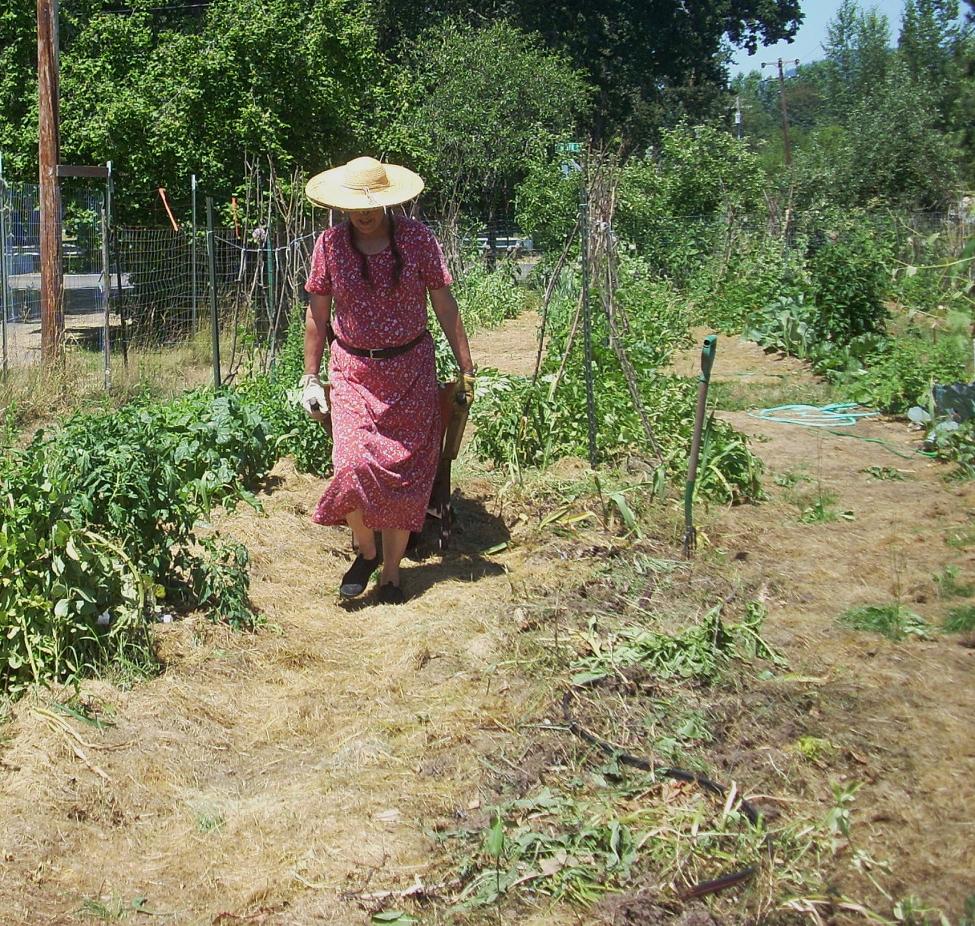
Your author in skinnier days.


Truth one: it's rough out there (second law of thermodynamics). 

Truth two: it's even rougher because we (whether ourselves or others) want things to be different than they are (as if there were no such law).

Truth three: We can change our own behavior, so that things are less rough for us, at least internally (and perhaps slow some of the entropy for ourselves and others through wisdom).

Truth four is a simple method for cultivating these behavioral changes. Here is the method with its eight parts -- they are interrelated; are really aspects of one thing, but broken down for utility.

  1. Right view. See what's happening.

  2. Right aspiration. Care about the things that matter, not the things that don't. Notice the things that matter are not things (esp. as in "owning" "possessions").

  3. Right speech. When communicating with others, delete whatever would hinder them from discovering the truths and using this method. For example, hurtful snark.

  4. Right action. Do not do unto others what you would not want done to you. Heard that before?

  5. Right livelihood. Do not do for a living that which would hinder others from discovering the truths and using this method. Example: fracking engineer. Example: bankster. The best occupations are probably smallholder and the crafts that support smallholders, along with infrastructure workers and the health professions, preferably preventive care. I would include teaching, but prefer it in the form of apprenticeships over large school and university systems.

  6. Right effort. Conducting the parts of the method with due diligence.

  7. Right mindfulness. Clarity of thought concerning the truths, the method and their goal of non-harm.

  8. Right concentration. To achieve clarity of thought, discipline the mind. Simply refusing to load it up with extraneous chatter (from television or Facebook, for example) is a start. I attend virtual Soto Zen Buddhist events. Your mileage may vary.

The second toolbox is the Permaculture Design principles, as formulated by David Holmgren in Permaculture: Principles and Pathways Beyond Sustainability (2002). I find them to be, ultimately, the same box differently adumbrated.

The core ethics are generally expressed as "earth care, people care, and fair share." This could be regarded as "help others slow their entropy." So I find both Buddhism and Permaculture, as ethical systems promoting simple living and reciprocity, to be attempts to build a nonfictional applied philosophy of negentropism.

The ethics are applied in, usually, twelve kinds of activities usually called principles.

  1. Observe and Interact. By taking the time to engage with nature we can design relevant solutions.

  2. Catch and Store Energy. Developing systems to collect resources when abundant, we can use them in need.

  3. Obtain a yield – Ensure that you are getting useful rewards from your work.

  4. Apply Self Regulation and Accept Feedback – Efficient or resilient systems require noting and correcting inefficient or nonresilient practices.

  5. Use and Value Renewable Resources and Services – as opposed to non-renewable resources.

  6. Produce No Waste – “Waste not, want not.”

  7. Design From Patterns to Details – Observe patterns in nature and society. Test their appropriateness broadly, rather than losing yourself in detail.

  8. Integrate Rather Than Segregate – By putting the right things in the right place, relationships develop, creating efficiencies and resiliences.

  9. Use Small and Slow Solutions – Small is beautiful.

  10. Use and Value Diversity – “Don’t put all your eggs in one basket” -- be resilient.

  11. Use Edges and Value the Marginal – These are often the most valuable, diverse and productive elements in the system.

  12. Creatively Use and Respond to Change – We can have a positive impact on inevitable change by carefully observing and then intervening at the right time.

The principles are applied in seven "domains" that have been elucidated. These: The Natural Realm, Building(s), Tools (Technology), Education/Culture, Health (Well-Being), Economics ("as if people mattered"), Governance (participatory democracy preferred).

I'm aware that some leaders in Buddhism and Permaculture have historically and have continued to fall short of the ethics enumerated here, particularly in the treatment of women, and of the colonized by colonizers, by men in positions of authority. So what's new?  I'm going to practice as long as I see the utility of practice; that will at least be one less potential predator in the world, to the extent of my ability. Both Buddhists and Permaculturists practice as exemplars.

You are here for only a moment, less than a moment in the universe's time. Why not simply clear the mind, open the "heart," open the hands, be for and with and not against?

Natural farming, the true and original form of agriculture, is the methodless method of nature, the unmoving way of Bodhidharma. Although appearing fragile and vulnerable, it is potent for it brings victory unfought; it is a Buddhist way of farming that is boundless and yielding, and leaves the soil, the plants, and the insects to themselves. -- Masanobu Fukuoka


(To be continued)