Showing posts with label Dharma. Show all posts

Tuesday, September 29, 2026

Put it down first

Dainin Katagiri: 

"Under all circumstances, we must be rooted in the source of existence. Right in the middle of the dynamic unfolding of our daily life, we must remain calm, quiet, and unperturbed. Whatever praise or criticism you receive—either from yourself or from others—there is no need to get bogged down in it. Just be straightforward.

"To accept life in a straightforward manner is to have a flexible mind, not clinging to ideas of good or bad, right or wrong. We need to learn how solemn, dignified, and sublime human life really is. No matter who we are, we should respect others and not judge them. Nor should we judge ourselves. For example, usually we try to do something about our reputation. We hang on to it when we should instead be learning how to free ourselves from it. If you hang on to thoughts of your reputation, your mind will not be calm, because you are stirring up the water of reputation.

"If someone slanders you, what should you do? Just make the waters calm. In other words, just forget it. This is not an easy practice. But if you hang on to the slander, you will become angry. You will fight. This just perpetuates the problem. This problem is not confined to slander or blame; it applies to praise and admiration as well. If you are admired, don’t hang on to admiration. Just get on with what needs to be done.

"If we are carried away by pros and cons, successes and failures, gains and losses, flattery and disgrace, we will not take care of our daily life. In order not to be carried away by these kinds of things, we must first touch the source of existence.

"Stability, imperturbability, and tranquillity are not stagnant water. They are dynamic and active, and they are constantly working. They are life itself. We can’t know them through ideas. Only through our actual experience can they be known. And only then do we touch the source of existence."

In context (You Have to Say Something: Manifesting Zen Insight) he ties this to human relations. Manifesting here means something like showing. We model Buddha as Buddha modeled Buddha for us. This, Katagiri implies, is how we fulfill the four vows.

While the Precepts seem to be mostly about manifesting Dharma socially, the Diamond Sutra approach seems much more left-hand-must-not-see-what-right-hand-doing. "Manifesting" also when only the wilderness witnesses is consistency in practice.

I used to do a good deal of backpacking, and sometimes came upon heaps of litter at campsites. I learned to carry a trash bag along with me to gather up the stuff, but grumbled in righteous indignation as I did so.

It occurred to me to ask a Zen teacher (this would be about 1971) about my unwitnessed behavior on these occasions. "I find litter in the wilderness and it throws me off my game -- I get really upset with whomever was ahead of me to that site. Am I better off picking up the litter in that state, or just leaving it alone, thus remaining more tranquil?"

"It's good to pick up litter, yes? But maybe not so good to speculate on how it got there. I'd say put it down first before picking it up."

-- shonin


Saturday, January 10, 2026

An appropriate response

From the Blue Cliff Record

Case 14: Yunmen’s “Appropriate Response”

A monk asked Yunmen, “What are the teachings of a whole lifetime?”

Yunmen said, “An appropriate response.”

Shunryu Suzuki says: "Buddha's teaching (as attained by Buddhas) in its pure and formless form, is not expressible by word or idea. Hence, the contribution of each sect to Buddhism is to give system to the scriptures, to set up the true words of the Tathagata ... in a consistent way so that people may understand and follow Buddha's way of life." (Wind Bell corrected text)

That is, that which is real is beyond words, but words can point to the real --provisionally.

Words have no meanings of their own, but are assigned meanings in our minds. The slipperyness of word meaning can be demonstrated by examining the almost universal misunderstanding in English that the prostate is to be referred to as the "prostrate," a verb or adjective supposed to indicate "lying down."

The reason we understand someone who refers to the prostate as the "prostrate" is they use it in either an implied or complete sentence, usually within a context. In language the context is a paragraph, in the world the context may consist of prior conversations or locations. Someone saying, at the front desk of the doctor's office, "I'm here about my prostrate," is likely to be understood and not even corrected by the receptionist.

Language is actually algebra, in which something is conveyed by means of an operator and operands.

Just as a=b is an equation, so is "that stick is a hoe handle." In the real world, "hoe handle" is an abstract concept, but the stick really is a thing, and it's useful to know that the speaker sees it as material shaped by human agency toward a desired end, thus having added value by means of the applied concept. A concept is, for purposes of the material universe, an illusion, but in the case of a hoe it is a useful one. 


In order to convey information, which is made up of a mixture of ideas about things and ideas about ideas about things, we must constantly embed the ideas in formulae, in which the operator ties together two operands, a symbolic representation of a subject and an object, in either a metaphorical equivalency -- assertion -- or denial of equivalency -- refutation. 

In other words, we rely on metaphor to get anything said, trusting in the transitivity of equivalency, a tool used both by those hoping to formulate and communicate a truth and those hoping to deceive.

Information is news of difference (Bateson). To form an argument for purposes of convincing someone that we bring them information requires three implied or actual sentences: 

a = b, b=c, ∴ a=c (assertion), 

or 

a = b, b≠c, ∴ a≠c (refutation). 

The three sentences of the argument form the structure of a complete paragraph. This is solving a system with equations (in disguise).

It's very, very difficult for two humans in conversation to solve systems with equations on the fly, especially if one of them is using chicanery in the construction and conveying of some of the information in order to achieve an end at variance with the end that would benefit them both. Often each is trying to do this to the other.

Where there is plenty of greed, anger and ignorance, there is much politicking and commerce, hence advertising, scamming and so on. These are all about broken promises and failure to honor contracts, and are made possible by appeals to greedy illusiveness by means of malevolently employed enthymemes: incomplete or incorrect paragraphs and incomplete or incorrect sentences, many of which are carefully nurtured fallacies. 

Dukkha is Buddha's word for the not-quite-rightness of the world as he has found it; much if not nearly everything about human behavior seems off to him, like a cart wheel set off center on the axle, causing the cart to go down the road jolting itself apart even in the absence of potholes ... "dukkha, dukkha." We all are of the nature to become ill, to become old, and to die. Accepting that this is so, and helping one another home, so to speak, is wisdom -- a centered wheel and a smoother ride for all. But the world's common sense is non-acceptance: ignorance, greed, and anger that our illusory, greedy expectations have not been met.

Buddha offers a remedy for our vulnerability to fallacy and its consequences, from disappointment all the way up to life-threatening danger. He noticed, immediately upon seeing the morning star, that the remedy would be difficult to explain, because even honest use of language involves imprecision: no one has the exact same set of meanings of signifiers. 

And those who do not mean well are apt to capitalize on the apparent similarity between inadvertently imprecise honest speech or actions and purposefully imprecise (dishonest) speech or actions.

Yet he persisted. The risk, to him, was worth the gamble.


This is why Buddha speaks of "expedient means" (upaya). Even his most direct verbal teachings made use of language; even at their most formal they were all expedient means toward the ending of suffering, yet inevitably open to interpretation, leading to perceived contradictions over time; the more so as agreed-upon meanings of words drifted.

When we talk about Dharma, just as we talk about anything, our talk does not approach the reality of dharmas (phenomena), or, in the case of Dharma, what we might call our secondary reality -- of ideas. 

And yet we trust in Dharma (the set of available truths about dharmas -- Thusness) to hone our behaviors toward the lessening of suffering -- ours and that of others.

There is some truth in truth, enough so that we if we intend be on its side against injuring, lying, stealing, misuse of pleasures, and misuse of resources, a way forward can be found.

Buddhists speak of the paramitas. Theravada traditionally lists ten; Mahayana  six. But it seems clear, as commentators have noted, that the two lists are just two ways of covering the same ground. The main thing is to provide, as best we can -- 
toward whatever is before us -- an appropriate response.

 -- shonin 


Saturday, December 27, 2025

It's a thing

Dogen makes much of shikan-taza as being the whole of practice. "Although it is said that there are as many minds as there are persons, still they all negotiate the way solely in zazen." 

He's not wrong. Stillness is where you find true-ness. At the same time, his monks had to get up and go clean the zendo sometime, and there was also construction, maintenance, cooking, water carrying and farming going on. His explanation was that at the root of all this activity there is still that same stillness. Whether or not you fan yourself, air is air.

When we lived for eight years in the outskirts of one small city and I worked in the larger city across the river, I often biked to work along established bicycle routes and across the wide river on a bike bridge, a scenic round trip of some sixteen miles. In heavier weather, I took the bus.

Bodhidharma splits up practice in much the same way. If wall-gazing does it for you, he says, gaze away! It is, when you do it, the entirety of practice. On the other hand, everything else is waiting for you as practice: the whole of life's activity. One of my hardest-working spiritual teachers, a Hutterite, Barbara Maendel, put it drolly when handing out our farm chores from a seemingly endless list: "a change is as good as a rest."

Zazen is the bicycle. Just get on it and go. In heavier weather, a change is good too. Just get on the bus and go.

Life practice is the bus. If you're sitting in the doctor's waiting room, sure, you can work on your stillness, but also there's the check-in and the visit, which may provide vexations. The arriving and the departing may stress as well -- that near-miss in the parking lot, say. Everything seems to push and pull. To deal with these as Dharma practice, form Dharma life habits.

Bodhidharma breaks life practice into four parts: absence of resentment, acceptance of circumstances, absence of craving, and accord with Dharma. 

To form the habit of not resenting can be a big change in lifestyle for many of us. It means accepting circumstances just as they are, with no craving for them to be any different. That doesn't mean don't swim when you fall into the water, it just means don't spend your swimming energy on uselessly grieving the fall or being angry that you were bumped. Swim. 

Accord with Dharma means embodying Buddha's truth by living the six wisdoms (paramitas). Six tools are available to bring us to the place of non-resentment: giving, ethical discipline, patience, effort, meditation, wisdom.

"Giving" is practice in being kind, a way of cultivating a cooperative, productive and peaceful community.

"Ethical discipline" is self-regulation: holding anger, greed and delusion in check, we foster a cooperative, productive and peaceful community.

"Patience" is practice in accepting circumstances as they are; it's rooted in letting go of the past and especially the future, allowing the community's cooperation, productivity and peace to unfold unforced.

"Effort" here is not the willful struggle that might be envisioned by the ascetic, but the steady self-application to practice that leaves behind the constructed self composed of greed, anger and delusion. This too benefits the community.

"Meditation" in the midst of life practice is that stillness in the doctor's waiting room, increasingly expanding into the visit and the coming and going. You may call it equanimity. It is beneficial to the community.

"Wisdom" here is "prajna," an ongoing appreciation of the ontological truth of the Dharma: "thusness." An insight into thusness is provided by the idea of dependent origination: all things are what they are together, in the same nowness, and nothing exists separately. As our illusion of separateness fades, our actions spring from this realization, and we benefit the community.

shonin painted six rocks, each with a paramita, as mnemonic devices. What, she's 76.


To see Dogen's practical application of the principle of life practice, samu practice, read his "Instructions to the cook," Tenzo Kyokun.

If you only have wild grasses with which to make a broth, do not disdain them. If you have ingredients for a creamy soup do not be delighted. Where there is no attachment, there can be no aversion. Do not be careless with poor ingredients and do not depend on fine ingredients to do your work for you but work with everything with the same sincerity. If you do not do so then it is like changing your behaviour according to the status of the person you meet; this is not how a student of the Way is. (tr. Anzan Hoshin and Yasuda Joshu Dainen)

Hongzhi sums up. "You must purify, cure, grind down, or brush away all the ten­dencies you have fabricated into apparent habits. Then you can reside in the clear circle of brightness."

The bicycle in good weather carried me to the entrance of the building where I worked. I arrived exercised and healthy, ready to benefit the community.

The bus, in heavy weather, stopped right in front of the same building. I arrived rested, composed, ready to benefit the community.

Not saying I always rose to the occasion. But that clear circle of brightness -- it's a thing. We should all look into it.

 -- shonin 


Monday, November 17, 2025

Little sips

A repost.

I take a lot of interest in "Occam's Razor," which to me is a base from which we can very fruitfully conduct our explorations. It comes from philosophy and is often used in science, but often also critiqued in science discourse.

Duns Scotus formulated it thus: Pluralitas non est ponenda sine necessitate. "Entities must not be multiplied beyond necessity." I guess "necessity" cuts both ways -- don't complexify but also don't simplify past the point where evidence can be replicated.

Aristotle sought to find the lowest common denominator in his search for first principles from which to build arguments: "We may assume the superiority ceteris paribus of the demonstration which derives from fewer postulates or hypotheses." Galileo found it so, as did Newton. 

"Necessity" does arise in physics from time to time, as when Einstein outperforms Newton on gravity calculations, something useful to know about when doing orbital mechanics. But the differences between their results are so small that as a rule of thumb we may continue to use Newton in daily life, even the daily life of construction engineers and airline pilots.

I think it's a strong principle when applied judiciously in life decisions.

In popular culture, our Occam par excellence is Sherlock Holmes. In pursuit of his quarry, Holmes gleefully abandons complex explanations in favor of simple ones, not because the simple is always true, but because the complex is apt to be loaded up with irrelevancies, thereby likely wasting effort: "When you have eliminated all which is impossible, then whatever remains, however improbable, must be the truth." Stripping away specious explanatory principles improves his chances of arriving at an explanation that correctly describes what actually happened.

Society is struggling right now with a cornucopia of misinformation and disinformation, aimed at preventing rather than encouraging sound decision-making on the part of target populations. This is in fact a war, one we're all losing, and we are most likely entering a period of unprecedented suffering brought on by desire for and addiction to political and economic hegemony. 

Buddhism says we are subject to three poisons in our social setting (for our purpose they pretty much require the presence of others to be venemous): greed, anger and ignorance. I think of two of them as subsumed under the third: anger and ignorance serve greed.

Complex, or rather falsified, explanations are mustered to increase ignorance and foment anger in service of greed. Where someone has been duped by the greedy with such explanations, we have misinformation. The misinformed more easily harbor racism, sexism, anti-semitism, trans- "phobia," science denial, and the like, and can be recruited, wholeheartedly and with the belief that they are doing good, into campaigns against the commons, in the form of democratic elections, public health, public education, libraries and more, all of which may tend to equip us to resist the greedy.

Disinformation is the misinformation which is knowingly propagated by the greedy to boost ignorance and anger, so as to create and direct mobs -- armies that can serve as the shock troops -- in informal warfare to serve a will to power, the will of the greedy whose aim is rule in service of their greed.

Even those who recognize the caveat of "beyond necessity" may attack the razor for its imprecision. Such may have thoughts along these lines: "Occam has an out and therefore cannot be entirely trusted as it stands, hence it is misinformation and therefore its choice of theory is ultimately no better than the alternatives." This can be a reason why disinformers remain entirely within their comfort zones while laying waste to whole realms of the commons.

But it's not the micro-scale accuracy of our tools of inquiry that concerns humanity here. It's the motivation behind the uses to which they are put. We don't simply seek to know; we seek to know for benefit, and the majority (rightly, I submit) seek to benefit the many rather than the few.

When Buddha intuited that there is no permanent soul of the individual, he was applying something like Occam's razor. Dependent origination is for him the simple ontological explanation of existence, as opposed to a more complex and less demonstrable dualism, and gives rise to his four truths.

Buddhism does have an ethical position, but it's maybe hard to describe because we are used to prescriptives. The default Buddhist ethic is to show by example. As in, in case y'wanna try this stuff.

Buddha said "come, monk" to anyone who showed up. And then there was a knowledge commons. But whenever anyone took an action that was outside the bubble of right action arising from right view, he found it necessary to proscribe such actions in future, and from this arose the precepts.

Well and good; the precepts are a magnificent set of "skillful means." But Buddha and Occam both appreciate simple adherence to first principles, and at the center of first principles, I think, there is something like a still point. Bodhidharma says (in effect) Buddhas don't obey precepts because they are the precepts.

Here is the ground of minimalism; non-harm through simplicity. If you sit a lot of zazen, by that much you're avoiding being trapped in consumerism and the burning down of the surface of the planet.

When I sit zazen, I'm not ... shopping. 

If I'm not shopping, I'm not under the influence of advertising. Therefore the ontological parsimony of sitting zazen resists the illusions promoted by the greedy, and by extension may be said to be resistance to fascism.

That sounds strenuous, but we're learning to adapt (ableism can be its own form of seeking power). Here is my current not-shopping zazen, in progress.


This is zero-gravity-chair-zazen, practically-reclining-in-bed zazen, very-intermittent zazen. 😁

Some might object that this cannot be zazen on the grounds that I'm not sitting up straight. Some might also object to it on the grounds that I'm probably only really doing it for a few moments at a time, rather than the full half hour of most of the Zoom zazen periods I attend. I'm just not up to much, as I've been deteriorating for some time. 

The doctors tell me they've finally located the problem(s), which are leukemia and cardiac amloidosis. I'm not in much pain, but I'm definitely sort of weak and woozy as a regular thing, so I've adapted my zazen accordingly. In like case, such as Long Covid, others may do the same. The important thing, as any Zen teacher will tell you, is not to be doing much. 

Not traveling to the lake to zip around on jet skis, say.

The goalless goal, I think, for anyone interested in ontology at least, is to not be fooled. I admire those who aren't fooled for a whole half-hour at a time. I like to think I've been there and done that. If socially acceptable practice is in the rear view mirror, though, I can at least, for the time being, be not fooled in little sips. 

Do you know the story of the tigers and the strawberry? Little sips can be very tasty.

-- shonin  


Wednesday, November 5, 2025

The exemplar empty place

 Lately I've been fascinated by reciprocal roofs, which are popular with those who want to try a round house with a smoke hole or perhaps a round central skylight. Here's an example from Wikipedia:  

https://upload.wikimedia.org/wikipedia/commons/6/60/Wholewoods_reciprocal_roof_0010.jpg
By Adrian Leaman

The roof beams each lean upon one another in an endless progression, each contributing to the strength and utility of the whole, while leaving a hole that also has utility.

I tend to think of certain lists -- the eightfold way, immeasurables, precepts, paramitas, Shishobo, eight great realizations -- as reciprocal structures, each arranged around the same hole. 

The roundhouse smoke hole has function; it lets smoke out through the roof, admits light, and helps to regulate ventilation, temperature and humidity. But by itself it's not a thing. It is brought into "being" by the beams around it.

I came up with these ruminations while reading these lines, for the umpteenth time, from the Song of the Jewel Mirror Samadhi:

    Like facing a precious mirror; form and reflection behold each other.
    You are not it, but in truth it is you.

The mirror is an upaya teaching-metaphor for thusness. "You are not it." This sounds nihilistic, but "it is you." Here there is a teachable (actually, taught) moment: it is when you let go of your personality.

Shakyamuni is said to have been on his begging rounds when he was interrupted by a Brahmin who had heard his teachings were reliable. "Teach me!" "Not now; we are among the houses doing our begging rounds." "Yeah, but something may happen to either of us and then I will not have received the Dharma!" "Okay, I'll give you the short version:"

    In what is seen there must be only what is seen,
    in what is heard there must be only what is heard,
    in what is sensed there must be only what is sensed,
    in what is cognized there must be only what is cognized.
    This is the way you should train yourself.
    And since for you, in what is seen there will be only what is seen,
    in what is heard there will be only what is heard,
    in what is sensed there will be only what is sensed,
    in what is cognized there will be only what is cognized,
    therefore, you will not be with that;
    and since you will not be in that, therefore, you
    will not be here or hereafter or in between the two
    - just this is the end of suffering.  

I was puzzling over this passage, which I had encountered in 
Charlie Korin Pokorny's commentary on the Jewel Mirror, while on my "kinh hanh" round of the neighborhood, when for whatever reason I saw a very detailed mental picture of Gautama sitting beneath the fig tree looking at the morning star, smiling, and saying "aha! The morning star is me! But I am not the morning star!" -- upon which the rafters of his forthcoming teachings click into place and he becomes the exemplar empty place for us all.


-- shonin 


Friday, March 14, 2025

Dharma

(Continued from The "thusness" zone)
 
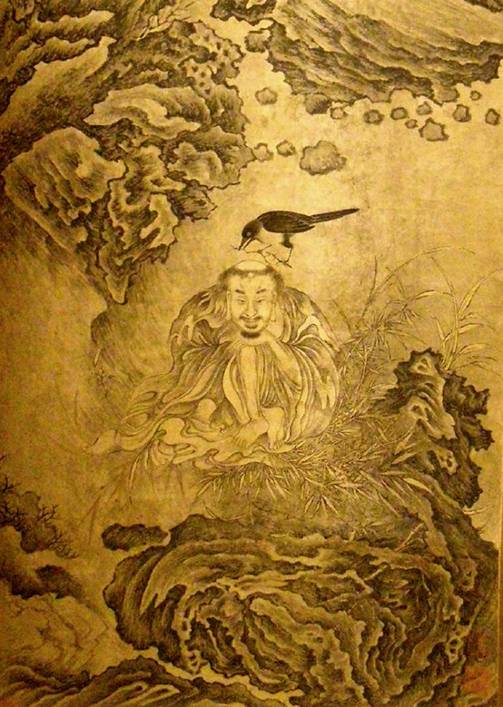
【鸟窠道林禅师圆寂纪念日】南宋佛画珍品:刘国用绘《鹊巢禅师图》赏析 

Niaoge Daolin climbed a gnarled pine tree and made his abode there. The famous poet and respected administrator Bai Juyi came to see him. "Isn't it dangerous up there?" "Much more dangerous where you are!" [This referred to the perils of imperial officialdom, especially for intellectuals.] Bai Juyi understood.

[Bai Juyi] asked another question: “What is the great insight of Buddhism?” The master replied: “Don't do anything bad, and do everything that's good.” Baijuyi replied: “A three-year-old child understands that kind of talk.” The master said: “A three year old child may be able to say it, but an eighty year old can't put it into practice.” 

Here we have the least verbose set of instructions I've seen. "Do good, not bad." We can argue over what constitutes good or bad, and Bodhidharma among others cautions against regarding Dharma as being about "good" and "bad." These teachers don't mean one should behave badly; they do mean that when you behave well you should not expect to be seen as "good" or even see yourself as "good." Just do the "good" thing and then down tools until the next "good thing."

Dharma is both seeing reality clearly and acting accordingly. That's all, folks. 

-- shonin

Thursday, March 13, 2025

The "thusness" zone

(Continued from Just Fail)

In response to the four sights, Buddha formulates four truths, the first three being about the first three sights, and the fourth being a critical response to the fourth sight. Rather than be a self-punishing sadhu, just join the sangha -- the community of those embodying the dharma, that is responding to reality realistically. He details the ways of doing this: see rightly, resolve thoroughly, speak sense, behave, work honorably, see it all through to an honorable conclusion, bear in mind those things that matter, and sit, stand, walk, and lie down with a centered stillness.

These are mutually supporting and overlapping activities, the positives that are later joined by prohibitions that arose as needed because human nature, embedded within the ongoing system of greed, anger and ignorance, finds these positives difficult to apply to all of one's life.

Chinese monks and nuns found that it helped to go and spend some time alone, and so adapted some of Taoism's hermetic culture -- "leaving behind the rest dust (of the cities)" -- for years or even decades in many cases. But the eight practices were intended to be carried out in the midst of society, as the point of behaving well is to behave well toward others.

Bodhidharma is said to have similar instructions in a document know as the "Two Entrances and Four Practices."

In it, he notes that an intellectual appreciation of Dharma, combined with zazen, can serve as a way into the life of thusness, but he seems to prefer the other Entrance: four recommended practices of what could be called applied Dharma. These are: acceptance of suffering, such as from injustices, acceptance of circumstances as we find them, ignoring cravings, and according with Dharma, that is to say, practicing the six perfections. Those are: giving, ethics, patience, effort, meditation, wisdom.

I sometimes think all these instruction, especially if one throws in the Vinaya or at least the precepts, amount to busywork to stave off the three poisons.

Buddha's early instructions, and Bodhidharma's instructions, if followed, certainly seem to be capable of bringing one's life away from the worst effects of these poisons and into the "thusness" zone.

If we need to put it in less verbose form, though, I think that can be done.

 -- shonin 

(To be continued)


Tuesday, August 29, 2023

Water over stones


 Image result
 

Neither/nor stuff is all over Buddhism, and of course it's all true, but only in the cumbersome sense of talking in the realm of talking. 😊 Dharma is in a place where what is not said takes up the whole universe, so we're probably best off, at least in the first moment of full awareness, just standing there stunned by the riffle of a bit of water over stones. 

-- shonin

Now, in the unhindered and unobstructed dharma-opening of the dharma-realm there is no dharma, and yet no non-dharma; no opening, and yet no non-opening. Thus it is neither large nor small, neither in a hurry nor taking its time; neither moving nor still, neither one nor many. Since it is not large, it can become an atom, leaving nothing behind. Since it is not small, it can contain all of space with room left over. Unhurried, it can include all the kalpas in the three time periods; not taking its time, it can enter fully into an instant. Since it is neither moving nor still, samsāra is nirvāna and nirvāna is samsāra. Being neither one nor many, one dharma is all dharmas and all dharmas are one dharma.

-- Wonhyo, tr. Muller   


Image: Dongshan Liangjie attains insight while crossing a stream.

Saturday, July 29, 2023

The practice of a true person

https://blogger.googleusercontent.com/img/b/R29vZ2xl/AVvXsEjYAjQOp54Hsl139su8zrPH43M2aodZPhSfiKWWgtVEw5f7XhstIVOMtuwoxy50FE4b37Jr4ajmW59Vf0zWkqv2MekhwolK2DrU1Iy_QkK92WpuAW6dGKgWJuR30aOZxk9yIV90viJzMgOZOOQki9d4BD2-br_hdXu4X-8esO0rBdesu9ujfBWxRc9bFCY/s640/DSC01216.JPG

My favorite Zen text is Tenzo Kyokun, Dogen's Instructions for the (Monastery) Cook.

Here is a passage to which I have returned multiple times: 

When you take care of things, do not see with your common eyes, do not think with your common sentiments. Pick a single blade of grass and erect a sanctuary for the jewel king; enter a single atom and turn the great wheel of the teaching. So even when you are making a broth of coarse greens, do not arouse an attitude of distaste or dismissal. Even when you are making a high-quality cream soup, do not arouse an attitude of rapture or dancing for joy. If you already have no attachments, how could you have any disgust? Therefore, although you may encounter inferior ingredients, do not be at all negligent; although you may come across delicacies, be all the more diligent. Never alter your state of mind based on materials. People who change their mind according to ingredients, or adjust their speech to [the status of] whoever they are talking to, are not people of the Way. -- Dogen's Pure Standards for the Zen Community : A Translation of the Eihei Shingi ed./tr. Leighton and Okumura

When we make a judgment or show a preference, we impose a delusion on what's right in front of us, ignoring the co-dependent arising of all things. Buddhist ethics is training in thusness; that which is before us, rather than that which we wish is there or wish not there.

We can cover much, if not all, of the precepts by means of a single term: "honesty." Honest living simply precludes stealing, lying, misusing, murdering, willfully injuring, gossiping, disparaging, and disrespecting. Buddha spelled out these things because training in honesty is hard.

Dogen points out that the stakes are quite high. Though he continually refers to "just sitting" as the entire Buddhist project, he explicitly sets a high bar for the behavior that gives "just sitting" a chance to even happen: "People who... adjust their speech to whoever they are talking to, are not people of the Way."

As for the attitude while preparing food, the essential point is deeply to arouse genuine mind and respectful mind without making judgments about the ingredients' fineness or coarseness....  Although they create relationship to buddha, [donations that are] abundant but lacking [in heart] are not as good as those that are small but sincere. This is the practice of a [true] person.

We might try being honest to our vegetables and see if it doesn't feel a bit like training in "right doing." 😄 

-- shonin


Monday, August 5, 2013

Ethics are not your beliefs, they are what you do


Key to understanding why there are eight parts to the long- established Buddhist way and twelve principles to the more recent Permaculture way is this concept of "right doing."

If we are alive, we do some things. But perhaps some of them are thoughtless things. Then it behooves us to think this through. To do well, it may help to have (and keep to) a plan. (If we are uncomfortable calling what we do by the names given here, we may use other names. The important thing is the action.)

The Buddhist way may in general practice be reduced to the Golden Rule: do not do to others what you would not have done to yourself.

The Permaculture principles are thought to be an expression of three ethics, caring for the earth, caring for people, and fairness -- which is really but one ethic, and may also in general practice be reduced to the Golden Rule.

Everything unfolds from the observation that there is one observable reality, regardless of how it may be described, and that therefore in some sense there is no one or nothing from which we can be divided. Care for the earth is people care and is sharing.

So we can try this experimentally. See, feel, say (or refrain from saying), do, earn, strive, think, and manifest caring and sharing. We may find that it works, and that our cynicism has been a hindrance. Why should we ever be bored a single moment in an awakened life dedicated to right doing? It's not really harder than wrong doing.


Being mindful of generosity is a gate to what the Dharma illumines, for due to that we do not expect rewards. 

-- Dogen, 108 dharma gates, tr. Nearman


(To be continued)

Sunday, May 19, 2013

Buddhism and Permaculture: A pair of ethics toolboxes

This may contain: an image of a garden with plants growing out of the planter and on top of it


The following can be regarded as a compatible pair of ethics toolboxes for designing a life. 

The first is derived from Buddhism. I find its core survives Occam's razor. Its basics are: four truths, which descended from Siddhartha Gautama's contemplation of the Four Sights. And: eight ways for those truths to be manifested in your life. I tend to take this to mean the young man saw a sick person, an old person and a dying person (entropy) and prescribed, within the ontological bounds available to him, negentropic activity as its antidote.

https://1.bp.blogspot.com/-vvAfQawoj44/Sk_fhmVbdxI/AAAAAAAABJ8/N9jENzsQOag/s1600/014.JPG
Your author in skinnier days.


Truth one: it's rough out there (second law of thermodynamics). 

Truth two: it's even rougher because we (whether ourselves or others) want things to be different than they are (as if there were no such law).

Truth three: We can change our own behavior, so that things are less rough for us, at least internally (and perhaps slow some of the entropy for ourselves and others through wisdom).

Truth four is a simple method for cultivating these behavioral changes. Here is the method with its eight parts -- they are interrelated; are really aspects of one thing, but broken down for utility.

  1. Right view. See what's happening.

  2. Right aspiration. Care about the things that matter, not the things that don't. Notice the things that matter are not things (esp. as in "owning" "possessions").

  3. Right speech. When communicating with others, delete whatever would hinder them from discovering the truths and using this method. For example, hurtful snark.

  4. Right action. Do not do unto others what you would not want done to you. Heard that before?

  5. Right livelihood. Do not do for a living that which would hinder others from discovering the truths and using this method. Example: fracking engineer. Example: bankster. The best occupations are probably smallholder and the crafts that support smallholders, along with infrastructure workers and the health professions, preferably preventive care. I would include teaching, but prefer it in the form of apprenticeships over large school and university systems.

  6. Right effort. Conducting the parts of the method with due diligence.

  7. Right mindfulness. Clarity of thought concerning the truths, the method and their goal of non-harm.

  8. Right concentration. To achieve clarity of thought, discipline the mind. Simply refusing to load it up with extraneous chatter (from television or Facebook, for example) is a start. I attend virtual Soto Zen Buddhist events. Your mileage may vary.

The second toolbox is the Permaculture Design principles, as formulated by David Holmgren in Permaculture: Principles and Pathways Beyond Sustainability (2002). I find them to be, ultimately, the same box differently adumbrated.

The core ethics are generally expressed as "earth care, people care, and fair share." This could be regarded as "help others slow their entropy." So I find both Buddhism and Permaculture, as ethical systems promoting simple living and reciprocity, to be attempts to build a nonfictional applied philosophy of negentropism.

The ethics are applied in, usually, twelve kinds of activities usually called principles.

  1. Observe and Interact. By taking the time to engage with nature we can design relevant solutions.

  2. Catch and Store Energy. Developing systems to collect resources when abundant, we can use them in need.

  3. Obtain a yield – Ensure that you are getting useful rewards from your work.

  4. Apply Self Regulation and Accept Feedback – Efficient or resilient systems require noting and correcting inefficient or nonresilient practices.

  5. Use and Value Renewable Resources and Services – as opposed to non-renewable resources.

  6. Produce No Waste – “Waste not, want not.”

  7. Design From Patterns to Details – Observe patterns in nature and society. Test their appropriateness broadly, rather than losing yourself in detail.

  8. Integrate Rather Than Segregate – By putting the right things in the right place, relationships develop, creating efficiencies and resiliences.

  9. Use Small and Slow Solutions – Small is beautiful.

  10. Use and Value Diversity – “Don’t put all your eggs in one basket” -- be resilient.

  11. Use Edges and Value the Marginal – These are often the most valuable, diverse and productive elements in the system.

  12. Creatively Use and Respond to Change – We can have a positive impact on inevitable change by carefully observing and then intervening at the right time.

The principles are applied in seven "domains" that have been elucidated. These: The Natural Realm, Building(s), Tools (Technology), Education/Culture, Health (Well-Being), Economics ("as if people mattered"), Governance (participatory democracy preferred).

I'm aware that some leaders in Buddhism and Permaculture have historically and have continued to fall short of the ethics enumerated here, particularly in the treatment of women, and of the colonized by colonizers, by men in positions of authority. So what's new?  I'm going to practice as long as I see the utility of practice; that will at least be one less potential predator in the world, to the extent of my ability. Both Buddhists and Permaculturists practice as exemplars.

You are here for only a moment, less than a moment in the universe's time. Why not simply clear the mind, open the "heart," open the hands, be for and with and not against?

Natural farming, the true and original form of agriculture, is the methodless method of nature, the unmoving way of Bodhidharma. Although appearing fragile and vulnerable, it is potent for it brings victory unfought; it is a Buddhist way of farming that is boundless and yielding, and leaves the soil, the plants, and the insects to themselves. -- Masanobu Fukuoka


(To be continued)