Showing posts with label Bodhidharma. Show all posts

Saturday, December 27, 2025

It's a thing

Dogen makes much of shikan-taza as being the whole of practice. "Although it is said that there are as many minds as there are persons, still they all negotiate the way solely in zazen." 

He's not wrong. Stillness is where you find true-ness. At the same time, his monks had to get up and go clean the zendo sometime, and there was also construction, maintenance, cooking, water carrying and farming going on. His explanation was that at the root of all this activity there is still that same stillness. Whether or not you fan yourself, air is air.

When we lived for eight years in the outskirts of one small city and I worked in the larger city across the river, I often biked to work along established bicycle routes and across the wide river on a bike bridge, a scenic round trip of some sixteen miles. In heavier weather, I took the bus.

Bodhidharma splits up practice in much the same way. If wall-gazing does it for you, he says, gaze away! It is, when you do it, the entirety of practice. On the other hand, everything else is waiting for you as practice: the whole of life's activity. One of my hardest-working spiritual teachers, a Hutterite, Barbara Maendel, put it drolly when handing out our farm chores from a seemingly endless list: "a change is as good as a rest."

Zazen is the bicycle. Just get on it and go. In heavier weather, a change is good too. Just get on the bus and go.

Life practice is the bus. If you're sitting in the doctor's waiting room, sure, you can work on your stillness, but also there's the check-in and the visit, which may provide vexations. The arriving and the departing may stress as well -- that near-miss in the parking lot, say. Everything seems to push and pull. To deal with these as Dharma practice, form Dharma life habits.

Bodhidharma breaks life practice into four parts: absence of resentment, acceptance of circumstances, absence of craving, and accord with Dharma. 

To form the habit of not resenting can be a big change in lifestyle for many of us. It means accepting circumstances just as they are, with no craving for them to be any different. That doesn't mean don't swim when you fall into the water, it just means don't spend your swimming energy on uselessly grieving the fall or being angry that you were bumped. Swim. 

Accord with Dharma means embodying Buddha's truth by living the six wisdoms (paramitas). Six tools are available to bring us to the place of non-resentment: giving, ethical discipline, patience, effort, meditation, wisdom.

"Giving" is practice in being kind, a way of cultivating a cooperative, productive and peaceful community.

"Ethical discipline" is self-regulation: holding anger, greed and delusion in check, we foster a cooperative, productive and peaceful community.

"Patience" is practice in accepting circumstances as they are; it's rooted in letting go of the past and especially the future, allowing the community's cooperation, productivity and peace to unfold unforced.

"Effort" here is not the willful struggle that might be envisioned by the ascetic, but the steady self-application to practice that leaves behind the constructed self composed of greed, anger and delusion. This too benefits the community.

"Meditation" in the midst of life practice is that stillness in the doctor's waiting room, increasingly expanding into the visit and the coming and going. You may call it equanimity. It is beneficial to the community.

"Wisdom" here is "prajna," an ongoing appreciation of the ontological truth of the Dharma: "thusness." An insight into thusness is provided by the idea of dependent origination: all things are what they are together, in the same nowness, and nothing exists separately. As our illusion of separateness fades, our actions spring from this realization, and we benefit the community.

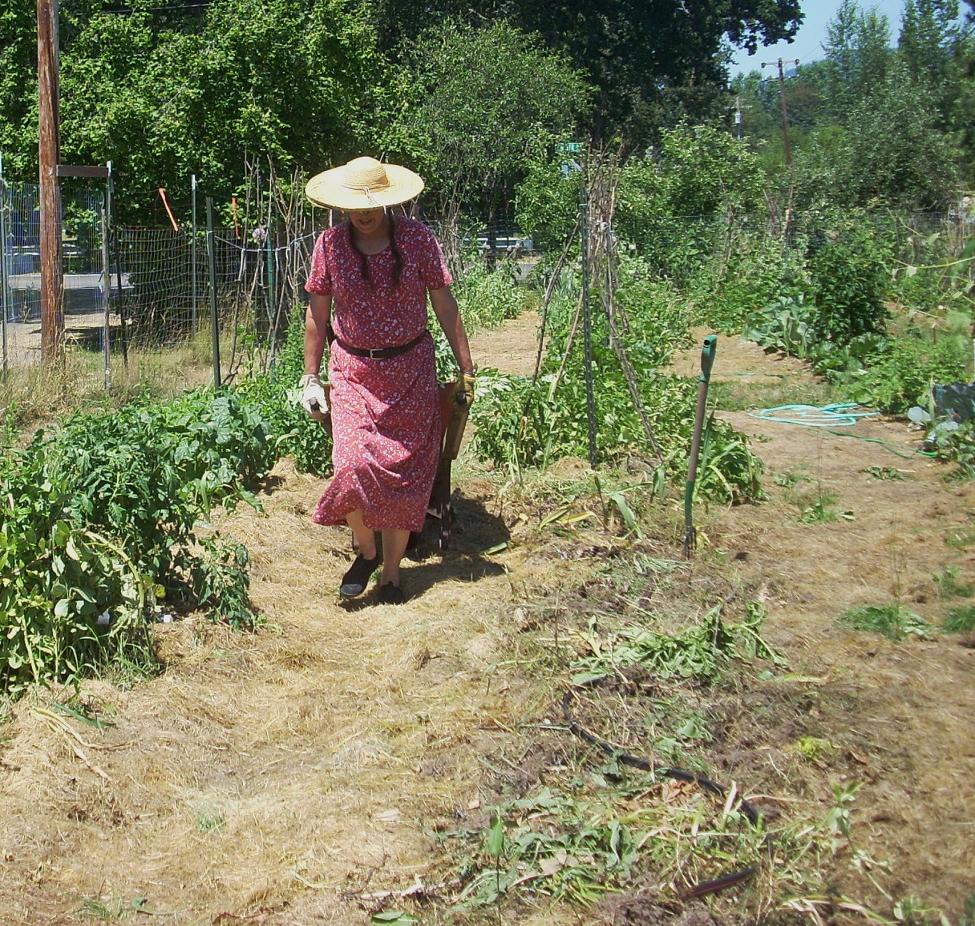
shonin painted six rocks, each with a paramita, as mnemonic devices. What, she's 76.


To see Dogen's practical application of the principle of life practice, samu practice, read his "Instructions to the cook," Tenzo Kyokun.

If you only have wild grasses with which to make a broth, do not disdain them. If you have ingredients for a creamy soup do not be delighted. Where there is no attachment, there can be no aversion. Do not be careless with poor ingredients and do not depend on fine ingredients to do your work for you but work with everything with the same sincerity. If you do not do so then it is like changing your behaviour according to the status of the person you meet; this is not how a student of the Way is. (tr. Anzan Hoshin and Yasuda Joshu Dainen)

Hongzhi sums up. "You must purify, cure, grind down, or brush away all the ten­dencies you have fabricated into apparent habits. Then you can reside in the clear circle of brightness."

The bicycle in good weather carried me to the entrance of the building where I worked. I arrived exercised and healthy, ready to benefit the community.

The bus, in heavy weather, stopped right in front of the same building. I arrived rested, composed, ready to benefit the community.

Not saying I always rose to the occasion. But that clear circle of brightness -- it's a thing. We should all look into it.

 -- shonin 


Sunday, December 7, 2025

Just walk

In a lovely manga I've been reading, the Solo Mountain Climbing Girl, near a three thousand meter summit making and having coffee, asks: "I wonder ... 'why is the mountain beautiful/no matter who lays their eyes upon it?'" (A haiku.)

In the next panel she replies to herself, "You are allowed to ask, but you are not allowed to answer ... to limit nature's splendors with words would be foolish." [sip, sigh]

The first three of Siddartha's Four Sights* are: an old person, a sick person, and a corpse. From these he drew the conclusion that drastic measures might have to be taken to avoid these unavoidables, so he took his hint from the fourth sight, that of a meditating sadhu, and left home. 

These sights and their significance stick with him over time:

I am of the nature to grow old. There is no way to escape growing old.

I am of the nature to have ill health. There is no way to escape having ill health.

I am of the nature to die. There is no way to escape death.

All that is dear to me and everyone I love are of the nature to change. There is no way to escape being separated from them.

My actions are my only true belongings. I cannot escape the consequences of my actions. My actions are the ground upon which I stand.

-- Upajjhatthana Sutta (“Subjects for Contemplation”) 

So far, so good. He's seen entropy and its inevitability. He also experienced the unsatisfactory path of the self-abnegating sramana.

He and I, raised in different cultures, may not have quite the same take on why one does whatever one does next. Buddha, or certainly nearly all his followers then and since, clearly thought there was some kind of afterlife with rewards and punishments, though he denied the unchanging soul depicted in his natal Brahmanic faith.

The legends do seem to show Buddha expecting his new monks to be able to keep to the path of non-harm as soon as they have accepted his positive instructions on how to live. On finding that they would need guide rails, he reluctantly provided them.

Bodhidharma mentions, almost in passing, that precepts are already implicit in awakened behavior:  "Bud­dhas don't keep precepts. And buddhas don't break precepts." But I think we will all agree the bar is high on that one. Perhaps something more alarming was required by a society already steeped in its own juices -- and still is.

The idea of hell is even enshrined in the Sotoshu's basic statement of faith, stated as applicable to all laypersons and priests (and made up of quotes cut and pasted from Dogen), the Shushogi:

When there is a spiritual communication of supplication and response, devas, humans, hell dwellers, hungry ghosts, and animals all take refuge.

I personally have no reliable data confirming an afterlife or multiple lives, and little if any basis for speculation on these matters. As such, I have no notion of extinction as a goal for escaping the wheel of karma. Per Occam's Razor, I try to ascertain if what I see and do in this life will fill the bill for what I might call the "yearning to do well."

Concerning teleology and eschatology, then, I
 am allowed to ask, but not allowed to answer ... to limit reality's splendors with words risks entangling myself further in the vines of delusion.

Even without the carrot and stick of heavens and hells, we notice how it feels to treat others well or badly, within our circumstances and cultural touchstones. For me, Buddha's admonition to ground my actions in wisdom resonates with my understanding that to assist in slowing inevitable entropy, while ultimately futile perhaps, is nevertheless exactly that which is ethical.

This entails attempting a drastic reduction in environmental and social harm (as perceived), as way opens. I have elsewhere compared Buddhism with Permaculture, to try to elucidate ways and means. 

Everything is "emptiness." But it may be that wise actions help empty out the emptiness of greed, anger and ignorance through a disciplined process of subtraction.

Simplify, simplify, simplify. Simply fail, again and again, to reach into the world with greedy hands.

Hence the various stories in which teachers and abbots say "when eating, just eat. When walking, just walk."

 -- shonin 


*Actually this story is originally told of an earlier Buddha, Vipassi, who is said to have lived long ago. It's not told of the young Siddhartha Gautama until centuries later, but, as Siddhartha himself is said to have said, Buddhas tend to follow similar timelines.

Friday, March 14, 2025

Dharma

(Continued from The "thusness" zone)
 
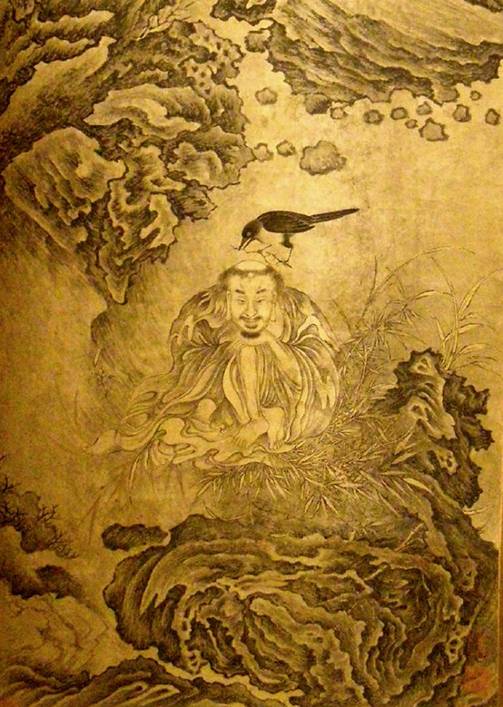
【鸟窠道林禅师圆寂纪念日】南宋佛画珍品:刘国用绘《鹊巢禅师图》赏析 

Niaoge Daolin climbed a gnarled pine tree and made his abode there. The famous poet and respected administrator Bai Juyi came to see him. "Isn't it dangerous up there?" "Much more dangerous where you are!" [This referred to the perils of imperial officialdom, especially for intellectuals.] Bai Juyi understood.

[Bai Juyi] asked another question: “What is the great insight of Buddhism?” The master replied: “Don't do anything bad, and do everything that's good.” Baijuyi replied: “A three-year-old child understands that kind of talk.” The master said: “A three year old child may be able to say it, but an eighty year old can't put it into practice.” 

Here we have the least verbose set of instructions I've seen. "Do good, not bad." We can argue over what constitutes good or bad, and Bodhidharma among others cautions against regarding Dharma as being about "good" and "bad." These teachers don't mean one should behave badly; they do mean that when you behave well you should not expect to be seen as "good" or even see yourself as "good." Just do the "good" thing and then down tools until the next "good thing."

Dharma is both seeing reality clearly and acting accordingly. That's all, folks. 

-- shonin

Thursday, March 13, 2025

The "thusness" zone

(Continued from Just Fail)

In response to the four sights, Buddha formulates four truths, the first three being about the first three sights, and the fourth being a critical response to the fourth sight. Rather than be a self-punishing sadhu, just join the sangha -- the community of those embodying the dharma, that is responding to reality realistically. He details the ways of doing this: see rightly, resolve thoroughly, speak sense, behave, work honorably, see it all through to an honorable conclusion, bear in mind those things that matter, and sit, stand, walk, and lie down with a centered stillness.

These are mutually supporting and overlapping activities, the positives that are later joined by prohibitions that arose as needed because human nature, embedded within the ongoing system of greed, anger and ignorance, finds these positives difficult to apply to all of one's life.

Chinese monks and nuns found that it helped to go and spend some time alone, and so adapted some of Taoism's hermetic culture -- "leaving behind the rest dust (of the cities)" -- for years or even decades in many cases. But the eight practices were intended to be carried out in the midst of society, as the point of behaving well is to behave well toward others.

Bodhidharma is said to have similar instructions in a document know as the "Two Entrances and Four Practices."

In it, he notes that an intellectual appreciation of Dharma, combined with zazen, can serve as a way into the life of thusness, but he seems to prefer the other Entrance: four recommended practices of what could be called applied Dharma. These are: acceptance of suffering, such as from injustices, acceptance of circumstances as we find them, ignoring cravings, and according with Dharma, that is to say, practicing the six perfections. Those are: giving, ethics, patience, effort, meditation, wisdom.

I sometimes think all these instruction, especially if one throws in the Vinaya or at least the precepts, amount to busywork to stave off the three poisons.

Buddha's early instructions, and Bodhidharma's instructions, if followed, certainly seem to be capable of bringing one's life away from the worst effects of these poisons and into the "thusness" zone.

If we need to put it in less verbose form, though, I think that can be done.

 -- shonin 

(To be continued)


Sunday, November 3, 2024

A droplet amid the rain

"The commons is the cultural and natural resources accessible to all members of a society, including natural materials such as air, water, and a habitable Earth. These resources are held in common even when owned privately or publicly." -- Wikipedia

 You know the commons when you see it. 

Rain is falling on "your" garden, where it becomes "your" water, and from the corner of your eye, you see a hummingbird zip in and snatch a droplet from the air. Secure in the knowledge that there is enough, this rain that you share, you admire the hummingbird and feel no grudge arising in your gullet. Rather, you feel at one with the hummingbird.

It's a little tougher to acknowledge this when you discover that a pocket gopher has shared in the commons of the beets at your feet. Perhaps you think of ways, some violent, some less so, of preventing more such sharing. 😅 To hoard is human; we're not the only species that does that, but we're certainly special in a way that's nothing to be proud of, I think.

Use of force, whether warfare or simple privatization, is enclosure. Usually it can be described as class warfare over the commons, wherein those who have styled themselves as an "upper" class forcibly exclude others from resources. Disinformation is the barbed wire with which the few fence off knowledge from the many, in order to commodify resources once held in common or in equitable distribution.

Much of what we think of as religion is enclosure; some of us have a god or gods to whom we offer prayers in the form of special pleading for the fruits of a prosperity gospel. "Give to me grapes, milk and honey, to show these Canaanites they worship false gods," we say, and feel justified in displacing the Canaanites from the lands they have cultivated. Prosperity epistemology, prosperity ontology, above all prosperity teleology, with big box stores to provide us with ever more fencing and locked gates. 

Centralization/industrialization is enclosure; where once villages of weavers stood, utilizing local wool, a wagon came to carry away baled wool to a mill on a river, and the very gravity (a commons) that made the river sing is enclosed in the wheel to drive enclosed looms attended by enclosed workers to create enclosed clothing for sale in enclosed shops.

And there is, seemingly, never an end to the complexification that ensues. The crofter's looms were but a livelihood, whereas the mill on the river is a profit to an encloser, but not enough (never enough), so that then the wool must go overseas to a windowless enclosed room with enclosed humming machines attended by other machines with enclosed (prorietary) software, to make products to be shipped back overseas and sold (enclosed).

And so it goes. 

For now.

Meanwhile some of us rediscover some irreducible commons in various places. 

It's cheap to sit staring at a wall.

Bodhidharma is said to have said:

Those who turn from delusion back to reality, who meditate on walls, the absence of self and other, the oneness of mortal and sage, and who remain unmoved even by scriptures are in complete and unspoken agreement with reason. -- Two Entrances and Four Practices

I've mentioned my difficulty in sitting facing a wall. Well, I can sit "reclined." My current practice wall is the ceiling.


Sometimes this sitting provides an opportunity for attentive chanting, or for visualizing taking and sending of suffering. This is because practice is not enclosed; it's for the benefit of all. Otherwise why bother? I can calm myself down or lower my blood pressure by artificial means which are probably more efficient than "practice."

But the air I breathe is a commons, as is the light entering the room. Everywhere there are ceilings; those of us who are lying down at home may study them. Those who are lying in ambulances may regard them. Those who lie in hospital beds or return home to hospice may take note of them. At last, there may be a ceiling within a grave; the body resting there does not, perhaps, take note of such a ceiling, but there is a sense in which it is indeed a commons.

The enclosers will charge for the beds, the doctors, and the grave, and certainly for all the ceilings, but for them the view of the ceiling is an intangible; its value has eluded them. It will always elude them, I think.

So, it's there for you to harvest. 
 
Take it as your fair share, as you might take a droplet amid the rain.
 
-- shonin 


Sunday, May 19, 2013

Buddhism and Permaculture: A pair of ethics toolboxes

This may contain: an image of a garden with plants growing out of the planter and on top of it


The following can be regarded as a compatible pair of ethics toolboxes for designing a life. 

The first is derived from Buddhism. I find its core survives Occam's razor. Its basics are: four truths, which descended from Siddhartha Gautama's contemplation of the Four Sights. And: eight ways for those truths to be manifested in your life. I tend to take this to mean the young man saw a sick person, an old person and a dying person (entropy) and prescribed, within the ontological bounds available to him, negentropic activity as its antidote.

https://1.bp.blogspot.com/-vvAfQawoj44/Sk_fhmVbdxI/AAAAAAAABJ8/N9jENzsQOag/s1600/014.JPG
Your author in skinnier days.


Truth one: it's rough out there (second law of thermodynamics). 

Truth two: it's even rougher because we (whether ourselves or others) want things to be different than they are (as if there were no such law).

Truth three: We can change our own behavior, so that things are less rough for us, at least internally (and perhaps slow some of the entropy for ourselves and others through wisdom).

Truth four is a simple method for cultivating these behavioral changes. Here is the method with its eight parts -- they are interrelated; are really aspects of one thing, but broken down for utility.

  1. Right view. See what's happening.

  2. Right aspiration. Care about the things that matter, not the things that don't. Notice the things that matter are not things (esp. as in "owning" "possessions").

  3. Right speech. When communicating with others, delete whatever would hinder them from discovering the truths and using this method. For example, hurtful snark.

  4. Right action. Do not do unto others what you would not want done to you. Heard that before?

  5. Right livelihood. Do not do for a living that which would hinder others from discovering the truths and using this method. Example: fracking engineer. Example: bankster. The best occupations are probably smallholder and the crafts that support smallholders, along with infrastructure workers and the health professions, preferably preventive care. I would include teaching, but prefer it in the form of apprenticeships over large school and university systems.

  6. Right effort. Conducting the parts of the method with due diligence.

  7. Right mindfulness. Clarity of thought concerning the truths, the method and their goal of non-harm.

  8. Right concentration. To achieve clarity of thought, discipline the mind. Simply refusing to load it up with extraneous chatter (from television or Facebook, for example) is a start. I attend virtual Soto Zen Buddhist events. Your mileage may vary.

The second toolbox is the Permaculture Design principles, as formulated by David Holmgren in Permaculture: Principles and Pathways Beyond Sustainability (2002). I find them to be, ultimately, the same box differently adumbrated.

The core ethics are generally expressed as "earth care, people care, and fair share." This could be regarded as "help others slow their entropy." So I find both Buddhism and Permaculture, as ethical systems promoting simple living and reciprocity, to be attempts to build a nonfictional applied philosophy of negentropism.

The ethics are applied in, usually, twelve kinds of activities usually called principles.

  1. Observe and Interact. By taking the time to engage with nature we can design relevant solutions.

  2. Catch and Store Energy. Developing systems to collect resources when abundant, we can use them in need.

  3. Obtain a yield – Ensure that you are getting useful rewards from your work.

  4. Apply Self Regulation and Accept Feedback – Efficient or resilient systems require noting and correcting inefficient or nonresilient practices.

  5. Use and Value Renewable Resources and Services – as opposed to non-renewable resources.

  6. Produce No Waste – “Waste not, want not.”

  7. Design From Patterns to Details – Observe patterns in nature and society. Test their appropriateness broadly, rather than losing yourself in detail.

  8. Integrate Rather Than Segregate – By putting the right things in the right place, relationships develop, creating efficiencies and resiliences.

  9. Use Small and Slow Solutions – Small is beautiful.

  10. Use and Value Diversity – “Don’t put all your eggs in one basket” -- be resilient.

  11. Use Edges and Value the Marginal – These are often the most valuable, diverse and productive elements in the system.

  12. Creatively Use and Respond to Change – We can have a positive impact on inevitable change by carefully observing and then intervening at the right time.

The principles are applied in seven "domains" that have been elucidated. These: The Natural Realm, Building(s), Tools (Technology), Education/Culture, Health (Well-Being), Economics ("as if people mattered"), Governance (participatory democracy preferred).

I'm aware that some leaders in Buddhism and Permaculture have historically and have continued to fall short of the ethics enumerated here, particularly in the treatment of women, and of the colonized by colonizers, by men in positions of authority. So what's new?  I'm going to practice as long as I see the utility of practice; that will at least be one less potential predator in the world, to the extent of my ability. Both Buddhists and Permaculturists practice as exemplars.

You are here for only a moment, less than a moment in the universe's time. Why not simply clear the mind, open the "heart," open the hands, be for and with and not against?

Natural farming, the true and original form of agriculture, is the methodless method of nature, the unmoving way of Bodhidharma. Although appearing fragile and vulnerable, it is potent for it brings victory unfought; it is a Buddhist way of farming that is boundless and yielding, and leaves the soil, the plants, and the insects to themselves. -- Masanobu Fukuoka


(To be continued)