Friday, March 14, 2025

Dharma

(Continued from The "thusness" zone)
 
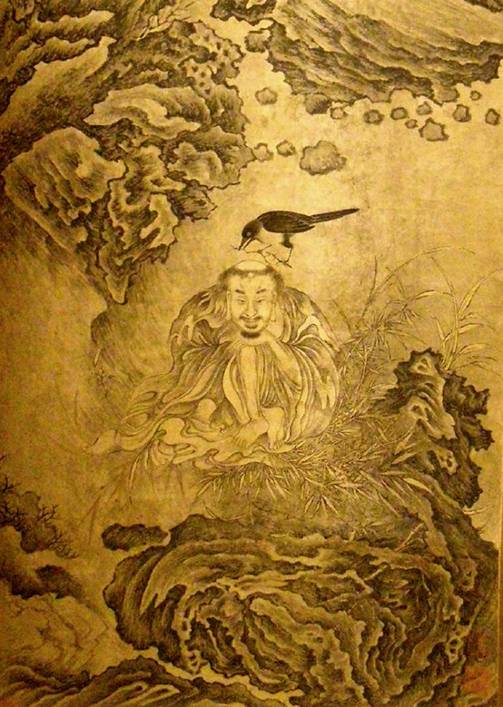
【鸟窠道林禅师圆寂纪念日】南宋佛画珍品:刘国用绘《鹊巢禅师图》赏析 

Niaoge Daolin climbed a gnarled pine tree and made his abode there. The famous poet and respected administrator Bai Juyi came to see him. "Isn't it dangerous up there?" "Much more dangerous where you are!" [This referred to the perils of imperial officialdom, especially for intellectuals.] Bai Juyi understood.

[Bai Juyi] asked another question: “What is the great insight of Buddhism?” The master replied: “Don't do anything bad, and do everything that's good.” Baijuyi replied: “A three-year-old child understands that kind of talk.” The master said: “A three year old child may be able to say it, but an eighty year old can't put it into practice.” 

Here we have the least verbose set of instructions I've seen. "Do good, not bad." We can argue over what constitutes good or bad, and Bodhidharma among others cautions against regarding Dharma as being about "good" and "bad." These teachers don't mean one should behave badly; they do mean that when you behave well you should not expect to be seen as "good" or even see yourself as "good." Just do the "good" thing and then down tools until the next "good thing."

Dharma is both seeing reality clearly and acting accordingly. That's all, folks. 

-- shonin

Thursday, March 13, 2025

The "thusness" zone

(Continued from Just Fail)

In response to the four sights, Buddha formulates four truths, the first three being about the first three sights, and the fourth being a critical response to the fourth sight. Rather than be a self-punishing sadhu, just join the sangha -- the community of those embodying the dharma, that is responding to reality realistically. He details the ways of doing this: see rightly, resolve thoroughly, speak sense, behave, work honorably, see it all through to an honorable conclusion, bear in mind those things that matter, and sit, stand, walk, and lie down with a centered stillness.

These are mutually supporting and overlapping activities, the positives that are later joined by prohibitions that arose as needed because human nature, embedded within the ongoing system of greed, anger and ignorance, finds these positives difficult to apply to all of one's life.

Chinese monks and nuns found that it helped to go and spend some time alone, and so adapted some of Taoism's hermetic culture -- "leaving behind the rest dust (of the cities)" -- for years or even decades in many cases. But the eight practices were intended to be carried out in the midst of society, as the point of behaving well is to behave well toward others.

Bodhidharma is said to have similar instructions in a document know as the "Two Entrances and Four Practices."

In it, he notes that an intellectual appreciation of Dharma, combined with zazen, can serve as a way into the life of thusness, but he seems to prefer the other Entrance: four recommended practices of what could be called applied Dharma. These are: acceptance of suffering, such as from injustices, acceptance of circumstances as we find them, ignoring cravings, and according with Dharma, that is to say, practicing the six perfections. Those are: giving, ethics, patience, effort, meditation, wisdom.

I sometimes think all these instruction, especially if one throws in the Vinaya or at least the precepts, amount to busywork to stave off the three poisons.

Buddha's early instructions, and Bodhidharma's instructions, if followed, certainly seem to be capable of bringing one's life away from the worst effects of these poisons and into the "thusness" zone.

If we need to put it in less verbose form, though, I think that can be done.

 -- shonin 

(To be continued)


Wednesday, March 12, 2025

Just fail

We face a world which is threatened not only with disorganization of many kinds, but also with the destruction of its environment, and we, today, are still unable to think clearly about the relations between an organism and its environment. What sort of a thing is this, which we call ‘organism plus environment?'   -- Gregory Bateson

Since the question was asked in the 1960s, evidence has continued to accrue that organisms are dissipative structures ("me") made up of dissipative structures (organs, tissues, cells, biosyntheses, gut bacteria)  and also constitutive of dissipative structures (families, tribes, cities, nation-states, ecosystems, biospheres). 

All these accumulate matter and energy for reproduction at their constrained scales (negentropy), and all continually drop crumbs down their shirt fronts (entropy).

You can "rewind" a video or movie but you can't rewind life; there are no prior frames except in the form of constructs in your brain, running on the electrical potential between synapses. 

Likewise, you can't fast-forward. There's no "there" to jump to.

Everyone you meet is already, in a sense, dying; you encounter them in the now on an arc of motion: the energy they accumulate, perhaps while having lunch with you, also dissipates; and it's eventually going to dissipate at a greater rate than their capacity to maintain stasis. 

And then there's a corpse, and it too begins immediately to disincorporate.

We have, to a greater or lesser degree, an impulse to live forever; but DNA's brief does not support that. 

It jumps to new substrate, beginning from a single conjoined cell in each instance, and leaves prior generations like so many bugs on a windshield. 

Looking at it this way, we might conclude that DNA, not us as organisms, is what's alive. 

Carl Sagan
was inclined to suspect so, though in summarizing the available evidence he left the question open in a way that suggests it can be tested:

 It is not known whether open-system thermodynamic processes in the absence of replication are capable of leading to the sorts of complexity that characterize biological systems.

That said, here we are, replicating, accumulating, dissipating, and, while doing these things, possibly mostly hallucinating. 

The hallucinating appears to be built in, one of DNA's strategies for protecting itself by giving us consciousness, an interplay of hormones and synaptical storage that statistically safeguards our reproduction rate.

If we find all this disheartening, well, it's where we are in the game, so to speak. Religions in general tend to deny all of the above, by doubling down on the hallucinating: play the game this way (insert doctrines and commandments) and thermodynamics will no longer apply to you (insert version of Heaven). 

Or don't, and we'll ply your ghost with clubs and matches (Hell).

Sagan's job was to prepare us to defend scientific method, the ground of the Renaissance and the Enlightenment, against profiteers who, while themselves beneficiaries of the "modern miracles" of flight and laser surgery, nevertheless would, in search of bigger profit margins, upend the ballot boxes in favor of a return to medieval hierarchy -- God, angels, masculine rich men, and the rest of us, who can look forward to bullying maybe the family dog at best -- a hierarchy threatened by the discovery, which science could hardly eventually shirk, that everything is exactly equal in "intrinsic" value and utility to everything else in an interpenetrating and cyclical universe.

And Sagan was among those who had noted that neo-Darwinism, propped up as the justification of sociopathic rich men in their hyper-accumulative and hyper-dissipative activities, was flawed. 

Lynn Margulis
, who was married to him at one time, had found evidence of symbiosis as the origin of eukaryotic cells, work that was resisted for decades within the scientific community, much of which had fallen under the spell of the rugged individualism of neo-Darwinists and their boosters among the profit-minded. 

If every living thing is made up of tiny cooperatives, what implications might that have for the model we are now living under, of maximized exploitation within a finite ecosystem?

Even the not-very-rich, embedded in economic structures created by and for the very rich, defend the structures vociferously when nature's networks are shown to be at least as cooperative as competitive. When Suzanne Simard merely found that birch and Douglas firs were sending carbon back and forth, it was enough to end her career with the governmental agency that employed her at the time. 

It is easy at this point for us, contemplating the effects of the activities of the very rich, to become angry at the state of the world and angry with those we have identified as the principal actors. Motivated by such anger, many become active in seeking out and applying strategems for opposing the rich, from boycotts to revolutions.

We can see from the history of applied Marxism in the twentieth century that the cure can be equivalent to or worse than the disease, taking into consideration the usual measures of human misery and environmental degradation. One might cogently observe that these revolutions and their subsequent political evolutions show evidence of a reversion to authoritarianism linked to the protected well-being of the authoritarians and their families and friends, much the same as the conditions that had engendered the revolutions. 

Greed, anger and delusion are not the peculiar province of the rich. They are endemic to all, and come to a boil when we too, impelled by impulses instinctive to us, subsequently become the rich, or at least those ensnared by the leavings of the rich.. 

I have some sympathy for us all. We're born dupes -- The process of replication that we call life has, in all living beings, its own project, and requires of us that we cooperate by being deluded as to our individual aims in life, reaching greedily for resources to further those aims, and angrily defending those resources from others who appear to be reaching for them. We're mightily stressed by all this. Is there a way out of what we may reasonably describe as our plight?

This is where Buddha comes in. Having seen the old, the sick and the dying, he gives up his possessions, his relationships and his United Health Insurance policy and heads for the hills, making his clothing from rags pilfered from a dump in a cemetery. Correctly surmising that the fourth sight -- a self-denying sadhu -- harbors a clue to a cogent reaction to his distress, he nearly starves himself to death, and then realizes one cogent reaction need not be the only cogent reaction. There's no need to stop eating. There's only a need to stop eating greedily. There's no need to snub society. There's only a need not to react to the foibles of others angrily. There's no need to tilt at the windmills of delusion. There's only a need to refrain from behaving in a deluded manner.

"The Way is actually very easy," declares the author of the Xinxin Ming. "Just fail to have any preferences." 

Ha-ha-ha, we reply and skip down to the, mostly, to us, incomprehensible verses that follow, looking for an out.

-- shonin

(To be continued)


Sunday, November 10, 2024

Some cold tea

The renovations that took place here seven years ago led to there being a massive pile of rubble and old cinderblocks and another of lumber studded with rusty bent nails, which quickly acquired a covering of very robust Himalaya blackberries. 

I'd had a notion of building some kind of greenhouse/shadehouse out of these bits and bobs, but renters occupied much of the premises during most of that time, and I felt shy of hammering and sawing in their sunbathing space, so ... but this year, I resolved to evict the blackberries and put up a structure in their stead, using the materials now solidly locked in their embrace.

Once the cutting, uprooting re-piling and tilling was done (this took a couple of months), I sorted materials, pulled nails, and meditated on the shape of the space. It would be about ten feet by sixteen, and would need to be tall enough to allow for a door, yet low enough not to exceed the height of my neighbor's wooden fence, which stood only six feet tall on a curb of about fourteen inches height along the property line.

I had imported the screen door from the farm, ideal for the purpose as it was made of wood and had been cut down to accommodate a low porch ceiling. I attached the door to the back corner of Manzoku-an with hinges and framed it. The height of the door frame determined the height of the east-facing wall of the structure, facing in toward the back yard. I then bolted a two-by four, eleven feet long, across the back of the hut, with enough slope to shed water past the door. This would determine the height of the walls and height and slope of the roof.

From there, I proceeded to wrap walls around to the east and north, always using wood from the rapidly diminishing pile, framing in scrap windows as I went.

It was now possible to roof the space, which was done with corrugated fiberglass also found in the pile.

On the floor, with some digging, I managed to create a path of sorts using the rubble and cinderblocks.

It would be nice to have raised beds, but I've used up the materials. So, for now, I'll spread straw. The uphill bed is straight, about fifteen feet long, and the downhill bed is a kind of keyhole pattern.

I've brought in the seedling shelves, potting table and tools, freeing up a bit of breathing room for Manzoku-an, where they spent the last year.


Yes, it's close to the fence line, but Manzoku-an predates the fence, this is a tiny agricultural project, and it's free-standing. None of it is attached to the fence.

Will this thing work? I expect there will be problems at first. At the moment the ambient temperature is 76F, the hut has 83 and the greenhouse is a toasty 92 (!!) -- but of course I'm not bothering to shade and ventilate much until next summer. It's not a proper shadehouse with such big windows, nor is it a proper greenhouse as it does not face south, but -- assuming I have allowed enough light -- I feel it has some potential toward season extending. We'll see.

Left to right: "deer fence," Manzoku-an, "greenhouse," tool shed. 
Some leftover used lumber is stored on the hut's roof.

The last construction project for the year is deer proofing the old and new beds with a bit of chicken wire fence. Whether it will work is for the deer to decide.

I think will go now and sit in the shade with some cold tea.

-- shonin


There are four inherent attributes to tea: peacefulness, respectfulness, purity and quietness.
-- Martine Batchelor


Sunday, November 3, 2024

A droplet amid the rain

"The commons is the cultural and natural resources accessible to all members of a society, including natural materials such as air, water, and a habitable Earth. These resources are held in common even when owned privately or publicly." -- Wikipedia

 You know the commons when you see it. 

Rain is falling on "your" garden, where it becomes "your" water, and from the corner of your eye, you see a hummingbird zip in and snatch a droplet from the air. Secure in the knowledge that there is enough, this rain that you share, you admire the hummingbird and feel no grudge arising in your gullet. Rather, you feel at one with the hummingbird.

It's a little tougher to acknowledge this when you discover that a pocket gopher has shared in the commons of the beets at your feet. Perhaps you think of ways, some violent, some less so, of preventing more such sharing. 😅 To hoard is human; we're not the only species that does that, but we're certainly special in a way that's nothing to be proud of, I think.

Use of force, whether warfare or simple privatization, is enclosure. Usually it can be described as class warfare over the commons, wherein those who have styled themselves as an "upper" class forcibly exclude others from resources. Disinformation is the barbed wire with which the few fence off knowledge from the many, in order to commodify resources once held in common or in equitable distribution.

Much of what we think of as religion is enclosure; some of us have a god or gods to whom we offer prayers in the form of special pleading for the fruits of a prosperity gospel. "Give to me grapes, milk and honey, to show these Canaanites they worship false gods," we say, and feel justified in displacing the Canaanites from the lands they have cultivated. Prosperity epistemology, prosperity ontology, above all prosperity teleology, with big box stores to provide us with ever more fencing and locked gates. 

Centralization/industrialization is enclosure; where once villages of weavers stood, utilizing local wool, a wagon came to carry away baled wool to a mill on a river, and the very gravity (a commons) that made the river sing is enclosed in the wheel to drive enclosed looms attended by enclosed workers to create enclosed clothing for sale in enclosed shops.

And there is, seemingly, never an end to the complexification that ensues. The crofter's looms were but a livelihood, whereas the mill on the river is a profit to an encloser, but not enough (never enough), so that then the wool must go overseas to a windowless enclosed room with enclosed humming machines attended by other machines with enclosed (prorietary) software, to make products to be shipped back overseas and sold (enclosed).

And so it goes. 

For now.

Meanwhile some of us rediscover some irreducible commons in various places. 

It's cheap to sit staring at a wall.

Bodhidharma is said to have said:

Those who turn from delusion back to reality, who meditate on walls, the absence of self and other, the oneness of mortal and sage, and who remain unmoved even by scriptures are in complete and unspoken agreement with reason. -- Two Entrances and Four Practices

I've mentioned my difficulty in sitting facing a wall. Well, I can sit "reclined." My current practice wall is the ceiling.


Sometimes this sitting provides an opportunity for attentive chanting, or for visualizing taking and sending of suffering. This is because practice is not enclosed; it's for the benefit of all. Otherwise why bother? I can calm myself down or lower my blood pressure by artificial means which are probably more efficient than "practice."

But the air I breathe is a commons, as is the light entering the room. Everywhere there are ceilings; those of us who are lying down at home may study them. Those who are lying in ambulances may regard them. Those who lie in hospital beds or return home to hospice may take note of them. At last, there may be a ceiling within a grave; the body resting there does not, perhaps, take note of such a ceiling, but there is a sense in which it is indeed a commons.

The enclosers will charge for the beds, the doctors, and the grave, and certainly for all the ceilings, but for them the view of the ceiling is an intangible; its value has eluded them. It will always elude them, I think.

So, it's there for you to harvest. 
 
Take it as your fair share, as you might take a droplet amid the rain.
 
-- shonin 


Tuesday, October 29, 2024

Many are

Mixed signs abound; after the storm, leaves shredded
by hail loll about on the street and
are investigated by crows. Where have the

birds been, all these baked-earth and baked-sky
days? And now they vanish again, as heat
resumes, as gardens wilt, as humans scurry

into delicious air inside sly merchants' shade.
I choose, as viruses have not, despite assurances,
abated, to limit myself, in straw Asian hat,

to observing this stuttering start to autumn
at first hand in the yard, at second hand
while putting away bought things the family's

acquired for me, before retiring once again
to the hermitary, converted tool shed
behind the house at the end of the drive

to zoom into the ether and sit
zazen with a few, who know
where to find me, some quiet, and themselves.

Many are hermits in just this way, though they
might not see it in these terms. A daily
routine within walls, or gardens, or

property lines: boundaries we create
of imagined air clean enough to inhale
without becoming a burden to our loves.


It's not much of a poem but shows what I've been thinking about. Autumn is trying hard to come in, with a strong system off the Pacific having filled our dried-up rain barrels, and awakened all the animals that seemed to be hiding somewhere after the heat waves, one of them topping 100°(f) for five days. We have another heat wave coming in September that looks to go over 90 for five days, with one more day pushing 100. But, yeah, plants have started putting on their fall plumage and the nights are cool.

I notice these things from the yard and while sitting in the "veranda" (basically a deck roof but no deck, just grass growing out of sand), or working in the garden. I have leukemia (slow, the CLL kind) and old age and what not, and a basic shyness with added cognitive decline, so I'm no longer a driver and now no longer a walker of the neighborhood sidewalks, unless someone is with me.

I'm also careful to breathe clean air. Weak lungs and all that, and I don't think much of the current official advice on viruses: Covid has surged hard this summer, and has been proven to have a long tail for many even when not initially presenting with symptoms. Even though my immune system is probably not very compromised, I see no reason to court disaster just because the CDC wants to avoid angering the nation's rentier class.

This adds a burden to the family; they mask up to go get groceries and feel a little self-conscious about it. But they agree that we, as a nuclear family with only one remaining driver, are exposed to too many potential unforeseen circumstances, so a few relatively easily achieved precautions are rational for us.

I spend time on federated social media and am seeing a lot of posts with this kind of thinking; it's like there is an emerging hermit class.

It's, for many, a privileged class, supported by the shipping phenomenon and an underclass (that's, alas, what it is) of front-line warehouse workers, store clerks and delivery people, many drawn from marginalized populations, who are getting sick repeatedly, and many of whom end up horizontal on couches, joining the ranks of those who must be maintained at cost to their tiny social safety nets or overworked social services.

This is like treading water after a ship sank. Many who thought themselves well-to-do are in the water with the people who brought them groceries or rotated their tires. I think there will be more of this and perhaps much more.

Against this slow-motion dystopian background, I think about what my role can or even "should" be. I have some intellect remaining, so I spend most of my days (and nights) doomscrolling for what I think might be the best policies and advice concerning climate, health, extreme weather resilience, and domestic and international relations, including resource wars, to share with whomever wishes to hear all this.

Buddhism came to me in the guise of how one might best behave on a sinking ship (or in the water afterwards); a kind of hospice manual:

"There are four kinds of wisdom that benefit living beings: giving, kind speech, beneficial deeds, and cooperation. These are the practices of the vow of the bodhisattva" -- Dogen.

Clearly the instructions are intended for face-to-face interaction, yet here I am hanging out mostly in my homemade hermitary, a repurposed tool shed. Right; well, my excuses, with the admission of privilege, are as stated above, and my practice (when not raising vegetables) is an online practice. It is twofold: curate links to sensible adaptive choices in a deteriorating system ("secular") and offer opportunities for zazen practice and discussion of anattā and its implications ("religious").

Of course, sometime soon I (we) might not have Internet access. What then? Well, much of the time, when I have my nose out of the computer, I sit in the veranda and watch. There's not much to watch: the clothesline, the power poles that run along our alley instead of our street, some fruit trees, and houses belonging mostly to absentee Airbnb owners. It's a restful spot.


Birds sit the wires in seasonal rotation. Swallows and purple finches have moved off, and currently starlings are passing through. Starlings were permanent residents at the farm in the last decade; before that, they migrated past us as they do here in spring and fall. And we're no longer under the flyway; I miss the honking of vees of geese while I worked the farm garden.

The distance between these two locations is fourteen miles. This variability of population is interesting; I can speculate about it for hours. What's not to entertain?

Or I just ... sit. Right there, every blade of grass continually establishes the temple of the whole universe. What's not to contemplate?

I think the phenomenon of "hermit" life goes vastly unremarked and underappreciated. In this neighborhood alone, many work among their flowers, vegetables and apple trees alone, contemplatively plying trowel and clippers. Kitchen work, too, is often undertaken alone yet not lonely, chopping, folding in, turning from counterspace to sink with a bowl, mind gathered to a single point.

My maternal grandmother had a huge extended family, but as they passed one by one, she accepted a small apartment near us and established a routine of bible study and housekeeping that lasted until she breathed her last. My paternal grandmother outlived all but one son and accepted a small single-wide trailer in his back yard, sitting out front and shelling beans as the geese passed over.

Who's to say they were not practiced eremitic meditators? They both, by the way, faced pancreatic cancer at the end and both dealt with it by no longer eating, with a silent yet not sad patience I admired.

There must be millions of these "hermits," widows, widowers, the divorced, or separated, or abandoned to end-of-life care facilities, or, among those younger, simply content to rise, go forth to stamp books behind a library desk, go home and sit by a window watching people with umbrellas scurry along rain-swept streets, or, or ...

... and not necessarily unhappy about it. Even many who strongly enjoy being social also enjoy solitude.

The worldwide assumption of a religious or even secular requirement that to do well one must do for others does not come with a meter. A quiet life has this to recommend it: those living contented with little typically do not generate much of this world's distress. As such they can serve as models for a life not dependent upon material culture for "happiness."

That in itself benefits living beings.

-- shonin


Sunday, October 20, 2024

Rice and veg


I grew some things and chopped them up. I steamed them enough to call them blanched, and steeped them in rice vinegar and honey.  

It's not like I can't or don't buy groceries, but occasional water-bath canning gives one the cheery sound of lids popping, and a sense of life going ahead.

Pop. Pop. Six or seven times, then go look at the moon.

This is preparation for a winter in the hermitary. 

Pickled veg is famously what Asian hermits have with their rice (when they have rice), especially in winter. Stonehouse recalled having gone through a hundred crocks of pickles, more or less, at his hermitage.

Stonehouse  had a hermitage, whereas I merely have a hermitary, that is, in my case, a she-cave attached to a comfortable home. Sincerity comes in bursts of a few seconds; I feel I would make a terrible Zen leader. 

That's all right. We are bubbles on the stream. When I see three seconds of sincerity, I jump on -- free ride! 

In the morning, rice and veg.

-- shonin 


Forty-some years I've
Lived in the mountains,
Ignorant of the world's
Rise and fall.
Warmed at night by a stove
Full of pine needles;
Satisfied at noon by a bowl
Of wild plants;
Sitting on rocks
Watching clouds and empty thoughts;
Patching my robe in sunlight;
Practicing silence
Till someone asks
Why Bodhidharma came east,
And I hang out my wash

-- Shiwu (Stonehouse) tr. Red Pine


Thursday, October 10, 2024

One's own deep peace

What's new? fourfold: 

1) reading, writing, watching events unfold, speaking, remembering are full of gaps, like data is dropping out in increments of about 1/10 second. I'm re-typing words in every sentence. 

2) sleeping all the time -- naps throughout the day, often right in the middle of reading or watching whatever 

3) alimentary system seems poorly, with many trips to the potty, not always making it, lots of clothing changes and doing of laundry accordingly. I'm not embarrassed; a body is a body and does not come with guarantees; however I wish I was still good at pants legs and sleeves and not getting into things inside out and backwards repeatedly under duress. 😅

4) I used to feel a flash of anger when interrupted while coding. The sharp intake of breath and pained facial expression I produced were quite alarming to the interruptor, so I generally made an effort to apologize and explain. This has spread into interrupted reading, writing, speaking, or even zoning out. I'm stressing every time I see a hand raised to let me know I need to switch on my hearing device and pay attention. It's exhausting both for me and those who have to communicate with me. I'm realizing that to shift my attention causes actual distress, which I experience as pressure behind the eyes and a short-duration dull ache in the prefrontal lobes.

Not much in the way of sharp pains, though, so there's that. No idea whether all this is CLL related or just normal demented aging.

I sit in the veranda with the Bear folk and watch for bats swooping in the gathering twilight, a good life. 

People do not realize how much they do not need; I have tried to impart this insight with varying success for 50+ years and often felt frustrated over this, but now just sitting out back seems to be its own right thing, a completion. 

Sometimes it's enough just to be responsible for one's own deep peace. 

-- shonin


You see the true realm of human life in the peaceful breeze and in quiet waves. You realize the original nature of the mind in plain tastes and quiet talk. 

-- Caigentan by Hong Zicheng tr. Robert Aitken with Daniel W. Y. Kwok


Sunday, September 29, 2024

No problem


People who are unwell may find that their options appear to be limited. Waking with a dry mouth and eyes and a hammering heart, they wonder if they are going to be able to get up this morning; then they find (this time) that they can do it. They get up and go do a few chores, then find themselves short of breath and the hammer heart has not gone away, which is a little new. They go back to bed and sleep at midday, then awaken to find there is a cup of tea left for them on the side table by a concerned family member. It's not quite hot; that was an unexpectedly long nap.

Perhaps they struggle up again, re-heat the tea, and, spilling a little (Oh, hot!), wander out back to sit in the sun, going over what chores remain that could be done somehow. "I might move that little ash tree that came up in the lawn, find it a better home. I wonder where the shovel for that is."

Planning a task is not failure to be in the moment. Those who go out shopping must sequence their activities: "bag, check. List, check. Keys, check. Phone, check. Okay, leave a cup of tea for the old-timer and say I'm going out. Oh, she's out cold. Well, she'll figure it out. I'll just tiptoe away."

All these activities are miracles of right now. Planning and listing are the sort of thing those new to zen may feel they must struggle against, but not so. The past vanishes into memory and the future is merely ideation, but these memories and ideas are indubitably part of the present moment.

The trick is to be all of you all the time, because you are all of the universe, with its air and warmth and tea passing through "you," along with the sound of jays out back for the old-timer and the changing colors of the stop light for the shopper. If what you are doing is what you are doing, inhabit all of it, like a star shining into all parts of its stellar system and on into the great beyond.

-- shonin

Katagiri says: 

Taking care of right now is coping with an emergency case. So when a moment comes, whatever happens, just face your life as it really is, giving away any ideas of good or bad, and try your best to carry out what you have to do. You can do this; you can face your life with a calm mind and burn the flame of your life in whatever you do. This is Buddha’s practice. That’s why teachers always tell you to practice, devote yourself to doing something, and forget yourself. When you forget yourself and put your wholehearted effort into facing every moment, you can do something, and simultaneously you can rest in the continuous flow of life energy. Then you really enjoy your life. 

Suzuki adds:

Knowing that your life is short, to enjoy it day after day, moment after moment, is the life of "form is form, and emptiness emptiness." When Buddha comes, you will welcome him; when the devil comes, you will welcome him. The famous Chinese Zen master Ummon, said, "Sun-faced Buddha and moon-faced Buddha." When he was ill, someone asked him, "How are you?" And he answered, "Sun-faced Buddha and moon-faced Buddha." That is the life of "form is form and emptiness is emptiness." There is no problem. One year of life is good.

Thursday, August 29, 2024

Nap time


I have been reading Zen poets.
Cold Mountain resents his limp,
his former married life,

his former neighbors,
and envies, I suspect,
the beauty of youth.

He's at his best
lying on moss, letting
icy creek water

clean his ears, or so
he says. I'll trust him
on that; it's not like I have

no resentments of my own!
Stonehouse is enamored
of his little clay stove

which he feeds leaves
while he sits close, listening
to gibbons down the mountain,

howling. Does he ever invite
them to tea? I'll trust that
he does, and lets them

sit warm with him in the long
winter. Great Fool is
my favorite; when not tacking

calligraphy to his walls
by his lone oil lamp, he
sets out briskly in rain

to ask housewives for
a little rice, and visit
children who bounce balls

and count. I lean back
in my squeaky chair
and sip a bit of yard

tea, this one mostly cats'
ear and stinky bob herbs.
Gee, if I could write poems

like these three, what would
that be like? Dogen said
don't write poems at all,

as narrative is a trap.
Please note: Dogen wrote
hundreds. One more

sip, and it's nap time for me.

-- shonin