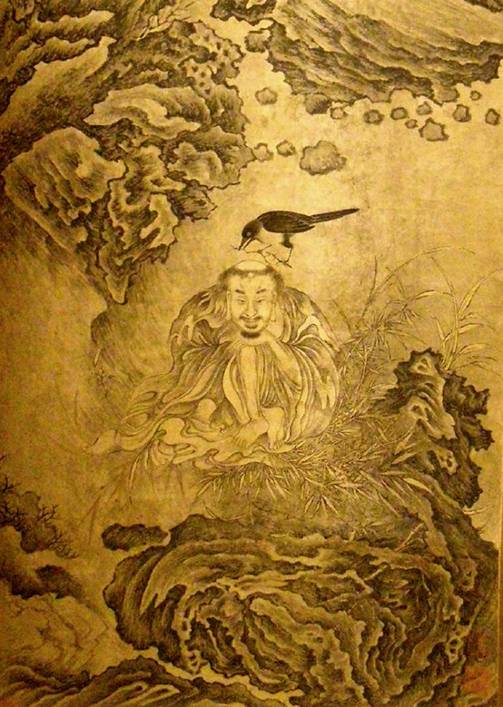
Monday, September 8, 2025

No aversion

 I get questions about hermitary cookery.

There might not be much to tell; I'll try.

There are as many ways to cook and eat as there are people. Some ways are just "I'll eat whatever they parachute into this refugee camp" or "well, I sure hope I get to eat in the rapidly approaching afterlife." In other words, eating, let alone cooking, is a privilege in the world, more so, perhaps, than when foraged food was all there was to be had.

So, I'm conflicted about what may appear to be showing off. On the other hand, mindful eating can be an exercise in responsible behavior. I do think that my solitary routine, now established, is less wasteful, more nutritious, and healthier than before. While that may not do much for the world, it does something. Dogen tells us a little is a lot in Buddhist practice. You never know where a given small yet sincere practice will take you, but usually not to anyplace those around you will regard as a hindrance. Taking proper care of yourself takes care of others in many ways, often unforeseen.

Dogen wrote a small treatise, the title of which can be loosely translated "Instructions for the Monastery Head Cook (Tenzo)," which was/is intended as a guide to ethically feeding, in effect, a commune. 

Also the position tends to be a rotating one. Everyone has already been told to tough it out if you prove to be untalented, and by gosh they had better be thankful for it. So it's great that I, an untalented cook with only one patron, don't at all mind most of my mistakes. If it's truly inedible, just apologize to it with a gassho and add it to the compost.

In my movements and attitude, to the extent possible for me, I follow the "Instructions to the Tenzo. "

Here's the kitchen. The hut is nine feet wide. Most daily use items fit along a six foot section of one wall. Some supplies and less frequently used items are stored under or above the sewing table, alongside the opposite wall. Indoor plants and a basin and ewer share the space, along with baskets of fabric and sundries.

You can see I'm a pack rat, dating back to days of actual rather than currently simulated poverty. Everything here is hand-me-downs. I think that matters in the case of an attached hermitary, because I'm duplicating equipment already available in the kitchen of the household. But that kitchen, in a 1950s starter bungalow, is also tiny and the other family members have their own dietary requirements. We stay out of one another's hair, so to speak.

The hut has one wall outlet with its own circuit breaker, good for up to twenty amps, which enforces attentive power usage. The tiny fridge is on all the time, so the kettle and microwave and rice cooker and space heater can be used in twos but not in threes or fours. This enforces some discipline and thinking ahead, especially in winter.

As homesteaders/nomads, we used to cook on a smallish wood stove, the top of which enforced a similar discipline: a pot of water for washing dishes might take up half the surface and a Dutch oven with beans or bread in it taking up the other half. We inverted their lids and set bowls of whatever on them to simmer. My current efforts reflect the frugality of those years.

Back in the day

I forage very locally, mostly on this one city lot.

We don't use herbicides or pesticides, so I safely wander around the yard, then the garden. What draws my interest? In season, chicory, dandelions, nipplewort, narrow leaf plantain, crimson clover, deadnettle, cat’s ears, blackberry leaves, fir or spruce needles, money plant, parlsey, sage, rosemary, thyme, Bigleaf maple flowers, willow leaves, herb Robert, and crop foliage such as kale, chard, beet greens, squash blossoms and leaves, pea and bean foliage, corn silk, and the like.

Out of season, many of these are not as bitter as some foraging websites will tell you, and if worst comes to worst, for the pot I steam first and reserve the bitter stock to give to my house plants or garden.

Often the yard is so productive I don't even make it into the garden. That's the maritime Pacific Northwest for you.

I bring my treasures into the hut and decide how they will be used. My cookery revolves around making tea (tisane) first. If what I gathered appeals to me as tea only, I put that in the tea strainer, set the strainer in a cup, run the kettle and pour boiling water over the foliage. It won't make much color in the cup unless there is something like beet greens, or I've dried the foliage, or I'm adding green tea or perhaps Darjeeling. That's fine. Minimalists need not be nutrition maximalists, let alone flavor maximalists, except perhaps if they can afford some loose-packed Darjeeling.

This tea is to have when Zooming with the sangha, or a friend, or while reading, or just watching the moon cross the window.

Next, I notice it's meal time. Some things that we all like to eat raw, I have to eat only a little of or not at all, so I do tend to focus on the steamer.

The little Aroma rice steamer, which is the heart of the hermitary kitchen, was handed down because it forgot its time limit for making rice. So I have to keep an eye on it for that cycle. I may use that for rice, or lentils, or root vegs, but I don't need a lot, and I'm not a fan of the coating on the metal liner you're supposed to cook in. My porcelain eating bowl fits inside the liner. So I put an inch of water from the pitcher (rain water, if it's fresh) inside the liner and set the bowl in that. 

I'm also not fond of the plastic steamer basket that came with the appliance, so that added to my interest in learning to cook in various ways in the bowl.

I then cut up any root vegs I'm using, including skins if possible, or pour in the rice or lentils, and add water, salt, spices as needed. Set on Rice or sometimes twice on Steam. Udon I find I can make on Steam (5 minutes), though the consistency might not be to everyone's taste. Summer vegs such as zucchini should wait out the first five minutes and then be thrown in, chopped. Density is my guide here.

Meanwhile, if I'm adding greens, I have options. I might use what's in the strainer, if it's not anything I really shouldn't try to eat (for example, willow bark). Or I may choose to roll up some dandelion and chicory leaves with onion greens in a leaf of collard or kale and chop small, then check to see if the carbs are done, then turn off the rice steamer, pop in the greens (and maybe small tomatoes and such), and close the lid for some residual-heat cooking.

The bowl will be a little hot to fish out of the liner with my fingers, as there's little room along the sides, so I grab the bowl with a handy pair of side-cutting pliers and set it on a coaster. Here I may add more seasoning or soy sauce as desired. I pour some water in a cup and keep it handy, or if the broth is palatable, I'll use that, and sit down and eat.

This can be a wet way to eat, so I often pour off the liquids to drink. This is a matter of taste; in Japan folks eat the solids, then drink liquids from the bowl as a chaser. Great! I have to spend a lot of time in my zero gravity chair and pretty much only eat there, so draining the bowl first saves me trouble with wet chin and fabric.

I mostly rotate four "recipes" based on rice, then potatoes, then lentils, then noodles, through the two daily meals and there is my week. For snacks there might be a deadfall apple or whatever comes my way.

I used to do a lot more drying of fruits and foliage than needed for the winters and now mostly just set aside some of my foraging to dry on a hardware-cloth shelf in the "greenhouse," or chop it all up to stuff into an ice cube tray, maybe with a bit of olive oil, for itinerant use.

Aside from this routine, I grind mixed grains in the Corona once a year and jar it up for the occasional breakfast with apple butter, and if I have extra fruit or root vegs on hand I may get out the small graniteware water bath canner and make preserves or pickled vegs to use over the winter, in very small jars.

 
The herb Robert and willow are part of my efforts to treat leukemia. 

I wouldn't ask anyone to try to duplicate my diet, but I do encourage experimentation for those interested in simplifying. This kind of food prep and eating is adaptable to many situations, especially for anyone living alone in a small space. Also it is a very portable way to eat, though maybe not as Spartan as this: Cooking Without a Kitchen: The Coffeemaker Cookbook

By not unnecessarily frequenting restaurants and supermarkets, it is possible to simplify quite a lot. Some foods are becoming scarce and I like to think I am leaving it on the shelves for someone else. 

I think the complexity of our civilization has a lot of inflicted suffering to live down. Courtesy shows there is a commons of the heart.  🙏

-- shonin 


If you only have wild grasses with which to make a broth, do not disdain them ... Where there is no attachment, there can be no aversion. -- Dogen

Monday, September 1, 2025

Another meditation on Hongzhi's Acupuncture Needle of Zazen

Hongzhi likes untouched function.
Action said to be action of Buddhas
past and present is to see all

in the ten directions without
reaching for the pry bar.
Without reaching for the pry bar,

just appreciate. See, appreciate,
settle in, sip tea. Fearlessly sipping tea
is a tiger's roar. The squirrel

out there watches a jay bury acorns.
He relentlessly digs and eats them.
The jay returns with more acorns.

The squirrel returns and digs.
I set down my cup, chuckling.

-- shonin 

Monday, August 25, 2025

Reality gives me cold toes


Chiyono’s No Water, No Moon. Hidden Lamp, p. 37. Chiyono was a servant in a Zen convent who wanted to practice zazen. One day she approached an elderly nun and asked, “I’m of humble birth. I can’t read or write and must work all the time. Is there any possibility that I could attain the way of Buddha even though I have no skills?”

The nun answered her, “This is wonderful, my dear. In Buddhism there are no distinctions between people. There is only this – each person must hold fast to the desire to awaken and cultivate a heart of great compassion. People are complete as they are. If you don’t fall into delusive thoughts, there is no Buddha and no sentient being; there is only one complete nature. If you want to know your true nature you need to turn toward the source of your delusive thoughts. This is called zazen.”

Chiyono said, with happiness, “With this practice as my companion I have only to go about my daily life, practicing day and night.”

There are varied stories of Chiyono's life. Richard Bryan McDaniel, in Zen Masters of Japan, says: "One of Bukko’s students was the first Japanese woman to receive a certificate of inka. Her Buddhist name was Mugai Nyodai, but she is remembered by her personal name, Chiyono. She was a member of the Hojo family by marriage and a well-educated woman who long had an interest in the Dharma. After her husband died and her family responsibilities had been fulfilled, she went to study with the Chinese master."

He goes on to recount a longer version of the story told in Hidden Lamp, after warning us it is apocryphal, as Chiyono was of the lower samurai class, rather than of the Hisabetsu-buraku (discriminated hamlet class) as implied in both the story and in Hakuin's illustration above. 

Was she perhaps in a servant-like role as many new students are, in a training-monastery setting? Whether as a servant or a somewhat respectable widow, there is the implication that Chiyono must seek enlightenment with the handicap of actual or temporary (for training purposes) low status to be overcome.

There is also a story that when Chiyono was ready to begin her koan study with the master, her presence in the zendo was at first objected to by the monks, on the grounds that her beauty would distract them. And that to overcome this she burned her face with a hot iron rod. Some have noted an apparent sag in her face as depicted in her lifelike portrait sculpture as evidence of the truth of this story.

These two stories are related. But to continue.

Zen is grounded in work, both on and off the cushion. Work off the cushion is called samu. Monks and nuns are famous for their samu: sweeping, chopping wood and carrying water. Chiyono is known to have carried water.

After months of wholehearted practice, she went out on a full moon night to draw some water from the well. The bottom of her old bucket, held together by bamboo strips, suddenly gave way, and the reflection of the moon vanished with the water. When she saw this she attained great realization.

She wrote a realization poem.

With this and that I tried to keep the bucket together,
And then the bottom fell out.
Where water does not collect,
The moon does not dwell.

I have been asked three questions in the presence of this koan.

1. What are you trying to keep together at this time of your life?
2. Where does the moon go when its reflection disappears?
3. Where do we go when we let go completely?

1. What I am trying to keep together at this time of my life is my body, with its diminishing capacity for activity/work, awareness, compassion, and kindness, largely because I feel I still have some responsibilities to family and community, including the sangha. My life has been greatly simplified due to bodily conditions: I don't drive or shop or handle finances, and am praised for shuffling around the block with my two sticks. "Got your phone? Okay, have fun."

I still have grief and regret. There's not much to do about that but carry a few tiny blossoms to a cairn nearby. Some self-indulgence in this, I think, may be excused.

It's easy to vanish into an easy chair. Letting go, now, would be as simple as the decision not to try to stand up. But also I'm still capable of spouting verbal abuse, which originates right here in the body, a part of nature. Channeling my speech (and facial cues) away from such may be my final exercise in letting go.

2. I reflect on the moon's beauty in its path across the sky, and then I don't. The moment a thought is over, it's nowhere, especially as near-term memory paths erode in one's cortex.  In resting from even reflection we come to ground truth -- not by seeking to rest, but by the simple expedient of absent-mindedness. This could be called the practice of not practicing, for which, for our purposes, we may use the model of a pet rock.

3. We don't go anywhere at all.

The bucket's bamboo strap unwinds and its moldy bottom falls out. Icy well water sluices down mossy stone steps. My feet are wet. Reality gives me cold toes.

-- shonin 

Monday, August 18, 2025

Hermiting is universal

I'm spending a lot more time in the hut. It's a tool shed dating back to the 50s, rebuilt for zazen practice and teleconferencing with the sangha (we mostly only meet online). I grow vegetables close at hand, pick "weeds" for tea, and use the tiny kitchen quite a lot. The leukemia seems to be in stasis for now. I greet crows outside my window.


Makeshift interior walls, makeshift altar, makeshift nun. At 76 and newly fragile health-wise, I sit here at the computer and commingle with my peers in the form of streams of electrons.

The kitchen is just a rice cooker, micro sized microwave, electric kettle, and a few jars and cans and utensils, most of them in a little hand-me-down butcher block table. I do most of my cooking in my eating bowl set inside the rice cooker liner in an inch or so of water. Works great. Kitchen table was my grandmother's from the 1930s. I ran my forehead into it on my scooter when I was three and just about knocked myself out. 

I'm told I got up and tried again and again. Whirr, wham! Whirr, wham! There's a lesson in that somewhere.


Stepping outside. The han is a plaque a friend made for me. I don't use it very often as there is no one to call with it and it's too near the neighbors. But I like having it. The mallet is a leatherworker's mallet that I retrieved from a dumpster somewhere.

Manzoku-an (Hermitage of Enough) is a former tool shed at the end of what was once a long carport. It's nine by thirteen feet. I've built a little courtyard for it using framed reed mats. I have used this hut for part-time hermiting off and on for nine years, overlapping with the previous hut, Gogo-an (10X10'), which I used for about the same span, or for a combined total of eleven years.


 What have I learned from this activity? Not so very much; the skills for living simply -- even somewhat starkly -- were acquired in childhood, as my parents encouraged me in running wild in the woods. At thirteen I camped for a week on an island in a swamp in subzero weather, building a kind of beaver lodge for myself of sticks and leaves. I kept a fire going at the entrance, and chopped ice for water from the frozen creek with a hatchet.

As a young adult, I lived in a succession of yurts, vehicles and small travel trailers, moving from place to place for forestry contracting, and did not fully return to "civilization" until I was thirty-six. I then worked at a university for twenty-two years and retired, at fifty-nine, to farm an acre. Hand tools were the order of the day -- an intention to return to simplicity.

When I began to study Zen with a teacher, I looked around the farm for a place to sit quietly out of the way, and the children's abandoned playhouse filled the bill. It did not take me long to move in a few items and begin cooking and even sometimes sleeping there as well as sitting zazen. This sort of thing just felt natural to me, and the family supported my efforts.

When I discovered an online sangha to sit with, I brought a laptop out to the hut, Gogo-an, and practiced with them, even participating in an online ango and rohatsu. This was a change from hermiting -- or was it? Our routine was much like that of the Discalced Carmelite sisters, each in her own hut but gathering with the others for ritual. 

Along came the pandemic and my local sangha moved online as well, where it has stayed ever since. Such groups have a bit of a Carmelite flavor. Many of the people with whom I sit zazen or sesshin live alone. Many others practice with the assent of family members, but most do sit alone in their choice of room (or sometimes outdoors), as teleconferencing tends to place each person in a box, containing mostly a face, with perhaps an altar and bookcase in frame.

This mode of being isolated in company is not unfamiliar to monks and nuns in a monastery or local sangha. Benedictines gather, but each is alone with God in the company of others, perhaps to the extent of wearing a hooded cowl, or in the case of nuns, a coif, wimple and veil. Muslims have the sajada, or prayer rug, again alone with God amid the multitude. Zen practitioners tend to sit in a row, all facing the same direction, each alone with Dharma. Every religious person is already a hermit.

Religion, as we tend to define it, may not be the whole Venn diagram here.

People who live alone generally, or find themselves alone with or among others (there are many single beds in apartments, houses and ship cabins), or even who find themselves walking to the waterfront to commune with gulls and the stench of the wharf, are also hermits. Never make the mistake of supposing that someone who stops only briefly to admire a daffodil has had no important business there.

Some may think they do not have hermiting skills, but I think we all do. What we may lack is the expectation that we'll have to live simply for an extended period of time, which can take some planning and prioritization. And in fact, though I have done that, it's not really what I'm doing right now; the hut is fifty feet from shared modern conveniences -- my bedroom is in the house. 

But I like to practice living simply in the hut, to keep the skills up (y'know "just in case," or in case someone else needs to know the little that I know) and to support my Buddhist practice. I'm doing a lot of sits. I find they're "good" for me; I need centering. It's cheaper than psychotherapy.

As we find ourselves more and more constrained by our unwieldy modernity, with the likelihood of catastrophic weather events, pandemics and crop failures, we may make some effort, as is always commendable, to ease the burdens of those around us but cannot hope, as individuals, to remedy all. 

What we can hope to do on our small scale (along with whatever else we're up to) is recognize that much of the time, what we might call down time or at least our in-between times, is what Buddhists call practice, which I will provisionally term as hermiting. Prayer, recollection, meditation, sittin' at the dock o' th' bay, admiring a daffodil, these are things that most anyone can do as they come to them, but I think we also, many of us, recognize that there are skilled ways of going about solitude. We know skilled loners when we see them, whether in films, videos, or sidewalk encounters.

Your bedroom, your kitchen, your study (if you have one), your creekside path, your hut attached to the family home or in its back yard -- your brief alone time "amid the noise and the haste" is your practice place. Whatever practice you do there, may it flow as a spring of water of life for you, and may you, in your short time here, find whatever you may recognize as blessing.

 -- shonin

Saturday, March 15, 2025

Sounds pretty good

Grasping, in the Buddhist sense, has two forms: grasping for something, as in consumerism, which is the sort of thing we usually think of when we use the term "greed," but also aversion -- seeking another outcome than the one currently presenting itself to us as likely, unless we intervene in some way. I think of Kurt Lewin's approach/avoidance theory here.

That which we feel will benefit us or those whom we value (provide negentropy, mainly), we approach; that which we feel will harm us (speed up our entropy), we avoid. We also tend to evaluate our coping mechanisms and decide if they are up to the approach or avoidance task; and we may also decide whether approach or avoiding is the right choice in such an instance.

When the author of the Xin Xin Ming advises we have no preferences, this may be simply a shorthand way of recommending Buddha's Middle Way.

Where there are no preferences, there is wu-wei. Less is more, here.

Consider a practice of restraint. What might such a practice entail (without, of course, straying into extreme asceticism)?

Perhaps I might realize I do not need air travel, or, indeed much in the way of travel and tourism at all. Also, I might not need to subject myself to television commercials and all the forms of advertising. Perhaps I do not need sports fandom, fashion, or events at crowded venues. Perhaps I decide I do not need pesticides, herbicides, and complex household chemicals and beauty products. Expensive furniture may be unnecessary, along with shelter with a very large footprint. Perhaps I can get along without a large lawn, a riding lawnmower, gasoline-powered tools, "natural" gas. One winter coat might suffice, rather than, say, five. And I hardly need a motorboat or jet ski.

It can be a useful exercise to go to the big box store with a clipboard (perhaps several times, to avoid raising the eyebrows of employees) and make a list of all the things we do not need. It might be a very long list; or we could simply say with Socrates, “How many things I can do without!” He was famous for his simplicity of lifestyle, as was Diogenes who took up abode in an abandoned jar and is said to have tossed away his cup on realizing he could drink well enough from his hands. 

This accords with what is told of Xu You, an ancient Chinese hermit who drank from his hands and, when offered a drinking gourd, used it once, hung it on a tree, and walked away. That story is referenced in hundreds of works by poets and essayists of simplicity, from Tao Yuanming to Chomei.

Xu You lived long enough ago that it's clear Buddha has no corner on simplicity, yet Buddha's (and many in his wake) take on it has a certain ring to it. Look at the rules in the Vinaya to get a sense of what he regarded as necessary to a fulfilling life ... not many possessions, eh? Three robes and three bowls, or maybe just one, and pillow your head on your arm. Mind you, nights are relatively warm in India, but still. There's some kind of principle here.

As a teenager, I had some sense that freedom consisted in freedom from possessions as well as freedom from being possessed, and was known to "run away" from home (with tacit permission, leaving a note of duration and location) and live for days at a time in the woods with some jerky, a hatchet and some matches. 

I was fascinated by this kind of reductionism, and upon discovering Thoreau, read my copy until it disintegrated, and have never been without one since.

Yet Buddhist advice on simplicity goes far beyond Thoreau. Aside from having only a tiny cabin with fireplace cookery and one table and two chairs (one for the visitor) and a bean patch, Buddhist literature extols the simplicity of sitting very still, eyes half closed, "non thinking." Such practice is, at least while one is doing it, the ultimate in poverty -- it does without the radio and television and cell phone, does without even food and drink and "did I pay the taxes" for the duration of the sit, and can serve as a baseline for kindness, compassion, shared joy, and equanimity, none of which require one to own a single thing. 

Practice leads to practical applications of that which has been practiced, as a rule. What you have not needed during shikantaza, zazenkai or sesshin you may not need ever. There are limits to this, of course. To live, eat food ("not too much, mostly plants," as Michael Pollan says), drink clean water (who needs sugary pop, really?) and breathe clean air if you can get it. The rest as applicable.

We had here in Eugene back in the last century a well-to-do man, Charles Gray, who, after donating his way out of the embarrassment of money, lived for a number of years on what he called the World Equity Budget, which was the average income of humans -- which was low enough that to do this in Eugene confined him to a rented room, cooking on a hot plate, and getting about on a bicycle (with a bike trailer as needed). It was, he said, the happiest time of his life. 

If everyone did it, ... "Gracious, that would be wonderful. It would all be green. There would still be fish in the sea; there would be trees on the mountains." [Source]

I'm not him; he devoted much of a lifetime to the standard he set for himself, whereas I was that poor by choice maybe from age twenty-one to about thirty at most. I'm seventy-six now, living on a fixed income, but by World Equity Budget standards it's certainly easy street. Philanthropy helps, but I feel in my diseased bones that simple is better; maybe it's time for me to try more of less again.

Fish and trees; sounds pretty good.

  --shonin


Friday, March 14, 2025

Dharma

(Continued from The "thusness" zone)
 
【鸟窠道林禅师圆寂纪念日】南宋佛画珍品:刘国用绘《鹊巢禅师图》赏析 

Niaoge Daolin climbed a gnarled pine tree and made his abode there. The famous poet and respected administrator Bai Juyi came to see him. "Isn't it dangerous up there?" "Much more dangerous where you are!" [This referred to the perils of imperial officialdom, especially for intellectuals.] Bai Juyi understood.

[Bai Juyi] asked another question: “What is the great insight of Buddhism?” The master replied: “Don't do anything bad, and do everything that's good.” Baijuyi replied: “A three-year-old child understands that kind of talk.” The master said: “A three year old child may be able to say it, but an eighty year old can't put it into practice.” 

Here we have the least verbose set of instructions I've seen. "Do good, not bad." We can argue over what constitutes good or bad, and Bodhidharma among others cautions against regarding Dharma as being about "good" and "bad." These teachers don't mean one should behave badly; they do mean that when you behave well you should not expect to be seen as "good" or even see yourself as "good." Just do the "good" thing and then down tools until the next "good thing."

Dharma is both seeing reality clearly and acting accordingly. That's all, folks. 

-- shonin

Thursday, March 13, 2025

The "thusness" zone

(Continued from Just Fail)

In response to the four sights, Buddha formulates four truths, the first three being about the first three sights, and the fourth being a critical response to the fourth sight. Rather than be a self-punishing sadhu, just join the sangha -- the community of those embodying the dharma, that is responding to reality realistically. He details the ways of doing this: see rightly, resolve thoroughly, speak sense, behave, work honorably, see it all through to an honorable conclusion, bear in mind those things that matter, and sit, stand, walk, and lie down with a centered stillness.

These are mutually supporting and overlapping activities, the positives that are later joined by prohibitions that arose as needed because human nature, embedded within the ongoing system of greed, anger and ignorance, finds these positives difficult to apply to all of one's life.

Chinese monks and nuns found that it helped to go and spend some time alone, and so adapted some of Taoism's hermetic culture -- "leaving behind the rest dust (of the cities)" -- for years or even decades in many cases. But the eight practices were intended to be carried out in the midst of society, as the point of behaving well is to behave well toward others.

Bodhidharma is said to have similar instructions in a document know as the "Two Entrances and Four Practices."

In it, he notes that an intellectual appreciation of Dharma, combined with zazen, can serve as a way into the life of thusness, but he seems to prefer the other Entrance: four recommended practices of what could be called applied Dharma. These are: acceptance of suffering, such as from injustices, acceptance of circumstances as we find them, ignoring cravings, and according with Dharma, that is to say, practicing the six perfections. Those are: giving, ethics, patience, effort, meditation, wisdom.

I sometimes think all these instruction, especially if one throws in the Vinaya or at least the precepts, amount to busywork to stave off the three poisons.

Buddha's early instructions, and Bodhidharma's instructions, if followed, certainly seem to be capable of bringing one's life away from the worst effects of these poisons and into the "thusness" zone.

If we need to put it in less verbose form, though, I think that can be done.

 -- shonin 

(To be continued)


Wednesday, March 12, 2025

Just fail

We face a world which is threatened not only with disorganization of many kinds, but also with the destruction of its environment, and we, today, are still unable to think clearly about the relations between an organism and its environment. What sort of a thing is this, which we call ‘organism plus environment?'   -- Gregory Bateson

Since the question was asked in the 1960s, evidence has continued to accrue that organisms are dissipative structures ("me") made up of dissipative structures (organs, tissues, cells, biosyntheses, gut bacteria)  and also constitutive of dissipative structures (families, tribes, cities, nation-states, ecosystems, biospheres). 

All these accumulate matter and energy for reproduction at their constrained scales (negentropy), and all continually drop crumbs down their shirt fronts (entropy).

You can "rewind" a video or movie but you can't rewind life; there are no prior frames except in the form of constructs in your brain, running on the electrical potential between synapses. 

Likewise, you can't fast-forward. There's no "there" to jump to.

Everyone you meet is already, in a sense, dying; you encounter them in the now on an arc of motion: the energy they accumulate, perhaps while having lunch with you, also dissipates; and it's eventually going to dissipate at a greater rate than their capacity to maintain stasis. 

And then there's a corpse, and it too begins immediately to disincorporate.

We have, to a greater or lesser degree, an impulse to live forever; but DNA's brief does not support that. 

It jumps to new substrate, beginning from a single conjoined cell in each instance, and leaves prior generations like so many bugs on a windshield. 

Looking at it this way, we might conclude that DNA, not us as organisms, is what's alive. 

Carl Sagan
was inclined to suspect so, though in summarizing the available evidence he left the question open in a way that suggests it can be tested:

 It is not known whether open-system thermodynamic processes in the absence of replication are capable of leading to the sorts of complexity that characterize biological systems.

That said, here we are, replicating, accumulating, dissipating, and, while doing these things, possibly mostly hallucinating. 

The hallucinating appears to be built in, one of DNA's strategies for protecting itself by giving us consciousness, an interplay of hormones and synaptical storage that statistically safeguards our reproduction rate.

If we find all this disheartening, well, it's where we are in the game, so to speak. Religions in general tend to deny all of the above, by doubling down on the hallucinating: play the game this way (insert doctrines and commandments) and thermodynamics will no longer apply to you (insert version of Heaven). 

Or don't, and we'll ply your ghost with clubs and matches (Hell).

Sagan's job was to prepare us to defend scientific method, the ground of the Renaissance and the Enlightenment, against profiteers who, while themselves beneficiaries of the "modern miracles" of flight and laser surgery, nevertheless would, in search of bigger profit margins, upend the ballot boxes in favor of a return to medieval hierarchy -- God, angels, masculine rich men, and the rest of us, who can look forward to bullying maybe the family dog at best -- a hierarchy threatened by the discovery, which science could hardly eventually shirk, that everything is exactly equal in "intrinsic" value and utility to everything else in an interpenetrating and cyclical universe.

And Sagan was among those who had noted that neo-Darwinism, propped up as the justification of sociopathic rich men in their hyper-accumulative and hyper-dissipative activities, was flawed. 

Lynn Margulis
, who was married to him at one time, had found evidence of symbiosis as the origin of eukaryotic cells, work that was resisted for decades within the scientific community, much of which had fallen under the spell of the rugged individualism of neo-Darwinists and their boosters among the profit-minded. 

If every living thing is made up of tiny cooperatives, what implications might that have for the model we are now living under, of maximized exploitation within a finite ecosystem?

Even the not-very-rich, embedded in economic structures created by and for the very rich, defend the structures vociferously when nature's networks are shown to be at least as cooperative as competitive. When Suzanne Simard merely found that birch and Douglas firs were sending carbon back and forth, it was enough to end her career with the governmental agency that employed her at the time. 

It is easy at this point for us, contemplating the effects of the activities of the very rich, to become angry at the state of the world and angry with those we have identified as the principal actors. Motivated by such anger, many become active in seeking out and applying strategems for opposing the rich, from boycotts to revolutions.

We can see from the history of applied Marxism in the twentieth century that the cure can be equivalent to or worse than the disease, taking into consideration the usual measures of human misery and environmental degradation. One might cogently observe that these revolutions and their subsequent political evolutions show evidence of a reversion to authoritarianism linked to the protected well-being of the authoritarians and their families and friends, much the same as the conditions that had engendered the revolutions. 

Greed, anger and delusion are not the peculiar province of the rich. They are endemic to all, and come to a boil when we too, impelled by impulses instinctive to us, subsequently become the rich, or at least those ensnared by the leavings of the rich.. 

I have some sympathy for us all. We're born dupes -- The process of replication that we call life has, in all living beings, its own project, and requires of us that we cooperate by being deluded as to our individual aims in life, reaching greedily for resources to further those aims, and angrily defending those resources from others who appear to be reaching for them. We're mightily stressed by all this. Is there a way out of what we may reasonably describe as our plight?

This is where Buddha comes in. Having seen the old, the sick and the dying, he gives up his possessions, his relationships and his United Health Insurance policy and heads for the hills, making his clothing from rags pilfered from a dump in a cemetery. Correctly surmising that the fourth sight -- a self-denying sadhu -- harbors a clue to a cogent reaction to his distress, he nearly starves himself to death, and then realizes one cogent reaction need not be the only cogent reaction. There's no need to stop eating. There's only a need to stop eating greedily. There's no need to snub society. There's only a need not to react to the foibles of others angrily. There's no need to tilt at the windmills of delusion. There's only a need to refrain from behaving in a deluded manner.

"The Way is actually very easy," declares the author of the Xinxin Ming. "Just fail to have any preferences." 

Ha-ha-ha, we reply and skip down to the, mostly, to us, incomprehensible verses that follow, looking for an out.

-- shonin

(To be continued)


Sunday, November 10, 2024

Some cold tea

The renovations that took place here seven years ago led to there being a massive pile of rubble and old cinderblocks and another of lumber studded with rusty bent nails, which quickly acquired a covering of very robust Himalaya blackberries. 

I'd had a notion of building some kind of greenhouse/shadehouse out of these bits and bobs, but renters occupied much of the premises during most of that time, and I felt shy of hammering and sawing in their sunbathing space, so ... but this year, I resolved to evict the blackberries and put up a structure in their stead, using the materials now solidly locked in their embrace.

Once the cutting, uprooting re-piling and tilling was done (this took a couple of months), I sorted materials, pulled nails, and meditated on the shape of the space. It would be about ten feet by sixteen, and would need to be tall enough to allow for a door, yet low enough not to exceed the height of my neighbor's wooden fence, which stood only six feet tall on a curb of about fourteen inches height along the property line.

I had imported the screen door from the farm, ideal for the purpose as it was made of wood and had been cut down to accommodate a low porch ceiling. I attached the door to the back corner of Manzoku-an with hinges and framed it. The height of the door frame determined the height of the east-facing wall of the structure, facing in toward the back yard. I then bolted a two-by four, eleven feet long, across the back of the hut, with enough slope to shed water past the door. This would determine the height of the walls and height and slope of the roof.

From there, I proceeded to wrap walls around to the east and north, always using wood from the rapidly diminishing pile, framing in scrap windows as I went.

It was now possible to roof the space, which was done with corrugated fiberglass also found in the pile.

On the floor, with some digging, I managed to create a path of sorts using the rubble and cinderblocks.

It would be nice to have raised beds, but I've used up the materials. So, for now, I'll spread straw. The uphill bed is straight, about fifteen feet long, and the downhill bed is a kind of keyhole pattern.

I've brought in the seedling shelves, potting table and tools, freeing up a bit of breathing room for Manzoku-an, where they spent the last year.


Yes, it's close to the fence line, but Manzoku-an predates the fence, this is a tiny agricultural project, and it's free-standing. None of it is attached to the fence.

Will this thing work? I expect there will be problems at first. At the moment the ambient temperature is 76F, the hut has 83 and the greenhouse is a toasty 92 (!!) -- but of course I'm not bothering to shade and ventilate much until next summer. It's not a proper shadehouse with such big windows, nor is it a proper greenhouse as it does not face south, but -- assuming I have allowed enough light -- I feel it has some potential toward season extending. We'll see.

Left to right: "deer fence," Manzoku-an, "greenhouse," tool shed. 
Some leftover used lumber is stored on the hut's roof.

The last construction project for the year is deer proofing the old and new beds with a bit of chicken wire fence. Whether it will work is for the deer to decide.

I think will go now and sit in the shade with some cold tea.

-- shonin


There are four inherent attributes to tea: peacefulness, respectfulness, purity and quietness.
-- Martine Batchelor


Sunday, November 3, 2024

A droplet amid the rain

"The commons is the cultural and natural resources accessible to all members of a society, including natural materials such as air, water, and a habitable Earth. These resources are held in common even when owned privately or publicly." -- Wikipedia

 You know the commons when you see it. 

Rain is falling on "your" garden, where it becomes "your" water, and from the corner of your eye, you see a hummingbird zip in and snatch a droplet from the air. Secure in the knowledge that there is enough, this rain that you share, you admire the hummingbird and feel no grudge arising in your gullet. Rather, you feel at one with the hummingbird.

It's a little tougher to acknowledge this when you discover that a pocket gopher has shared in the commons of the beets at your feet. Perhaps you think of ways, some violent, some less so, of preventing more such sharing. 😅 To hoard is human; we're not the only species that does that, but we're certainly special in a way that's nothing to be proud of, I think.

Use of force, whether warfare or simple privatization, is enclosure. Usually it can be described as class warfare over the commons, wherein those who have styled themselves as an "upper" class forcibly exclude others from resources. Disinformation is the barbed wire with which the few fence off knowledge from the many, in order to commodify resources once held in common or in equitable distribution.

Much of what we think of as religion is enclosure; some of us have a god or gods to whom we offer prayers in the form of special pleading for the fruits of a prosperity gospel. "Give to me grapes, milk and honey, to show these Canaanites they worship false gods," we say, and feel justified in displacing the Canaanites from the lands they have cultivated. Prosperity epistemology, prosperity ontology, above all prosperity teleology, with big box stores to provide us with ever more fencing and locked gates. 

Centralization/industrialization is enclosure; where once villages of weavers stood, utilizing local wool, a wagon came to carry away baled wool to a mill on a river, and the very gravity (a commons) that made the river sing is enclosed in the wheel to drive enclosed looms attended by enclosed workers to create enclosed clothing for sale in enclosed shops.

And there is, seemingly, never an end to the complexification that ensues. The crofter's looms were but a livelihood, whereas the mill on the river is a profit to an encloser, but not enough (never enough), so that then the wool must go overseas to a windowless enclosed room with enclosed humming machines attended by other machines with enclosed (prorietary) software, to make products to be shipped back overseas and sold (enclosed).

And so it goes. 

For now.

Meanwhile some of us rediscover some irreducible commons in various places. 

It's cheap to sit staring at a wall.

Bodhidharma is said to have said:

Those who turn from delusion back to reality, who meditate on walls, the absence of self and other, the oneness of mortal and sage, and who remain unmoved even by scriptures are in complete and unspoken agreement with reason. -- Two Entrances and Four Practices

I've mentioned my difficulty in sitting facing a wall. Well, I can sit "reclined." My current practice wall is the ceiling.


Sometimes this sitting provides an opportunity for attentive chanting, or for visualizing taking and sending of suffering. This is because practice is not enclosed; it's for the benefit of all. Otherwise why bother? I can calm myself down or lower my blood pressure by artificial means which are probably more efficient than "practice."

But the air I breathe is a commons, as is the light entering the room. Everywhere there are ceilings; those of us who are lying down at home may study them. Those who are lying in ambulances may regard them. Those who lie in hospital beds or return home to hospice may take note of them. At last, there may be a ceiling within a grave; the body resting there does not, perhaps, take note of such a ceiling, but there is a sense in which it is indeed a commons.

The enclosers will charge for the beds, the doctors, and the grave, and certainly for all the ceilings, but for them the view of the ceiling is an intangible; its value has eluded them. It will always elude them, I think.

So, it's there for you to harvest. 
 
Take it as your fair share, as you might take a droplet amid the rain.
 
-- shonin