Tuesday, December 24, 2013

The 500 robes

To conclude this meditation on the Eightfold Way and the Permaculture Principles, here is a story after the Guṇa Jātaka, based on the translation by Piya Tan:

[The elder Ānanda instructed the rajah's queens. They gave him five hundred robes
.] They all set aside their robes, and the next day gave them to the elder Ānanda, while they themselves wore the old robes, and went to where the rajah was having his breakfast.

The rajah asked: “I’ve given you robes worth a thousand each. Why are you not wearing them?”

“Your majesty, we have given them to the elder Ānanda.”

“All taken by the elder Ānanda...?”

“Yes, your majesty.”

“The fully self-awakened Buddha only allows the three robes. Has the elder Ānanda
become a cloth merchant, to have taken so many robes?”

Angry with the elder Ānanda, the rajah, after breakfast, went to the monastic residence and entered the elder’s cloister. After saluting the elder, he sat down, and asked: “Bhante, do the women in our house learn or listen the Dharma in your presence?”

“Yes, maharajah, they learn whatever they ought to, they hear whatever they ought to.”

“What, do they only listen to you, or do they give you upper robes and undergarments, to you, too?”

“Today, maharajah, they gave five hundred robes worth a thousand each.”

“You took them all, bhante?”

“Yes, maharajah.”

“But, bhante, does not the Teacher allow only the three robes?”

“Yes, maharajah, three robes are allowed for each monk, but there is also an allowance under the category of ‘use’. For, it is not forbidden to receiving what is offered. Therefore, I accepted the robes, from which I gave to those others whose robes are old.”

“But when these monks have received the robes from you, what they do with the old robes?”

“The old upper robes are made into outer robes.”

“What do you do with the old outer robes?”

“They are made into undergarments.”

“What do you do with the old undergarments?”

“They are made into cover-sheets.”

“What do you do with the old cover-sheets?”

“They are made into carpets.” 

“What do you do with the old carpets?”

“We make them into foot-towels.”

“What do you do with the old foot-towels?”

“Maharajah, it is not proper to waste what is given by the faithful. Therefore, we break up the old foot-towels with a sharp knife, mix them with clay, and plaster them over the walls of our lodgings.”

The Rajah was satisfied.

🙇  🙇  🙇  

Sunday, December 1, 2013

Creatively use and respond to change


"Creatively use and respond to change."

Four stages. 1. Broadfork 2. Mulch. 3. Drip irrigate. 4. Harvest.

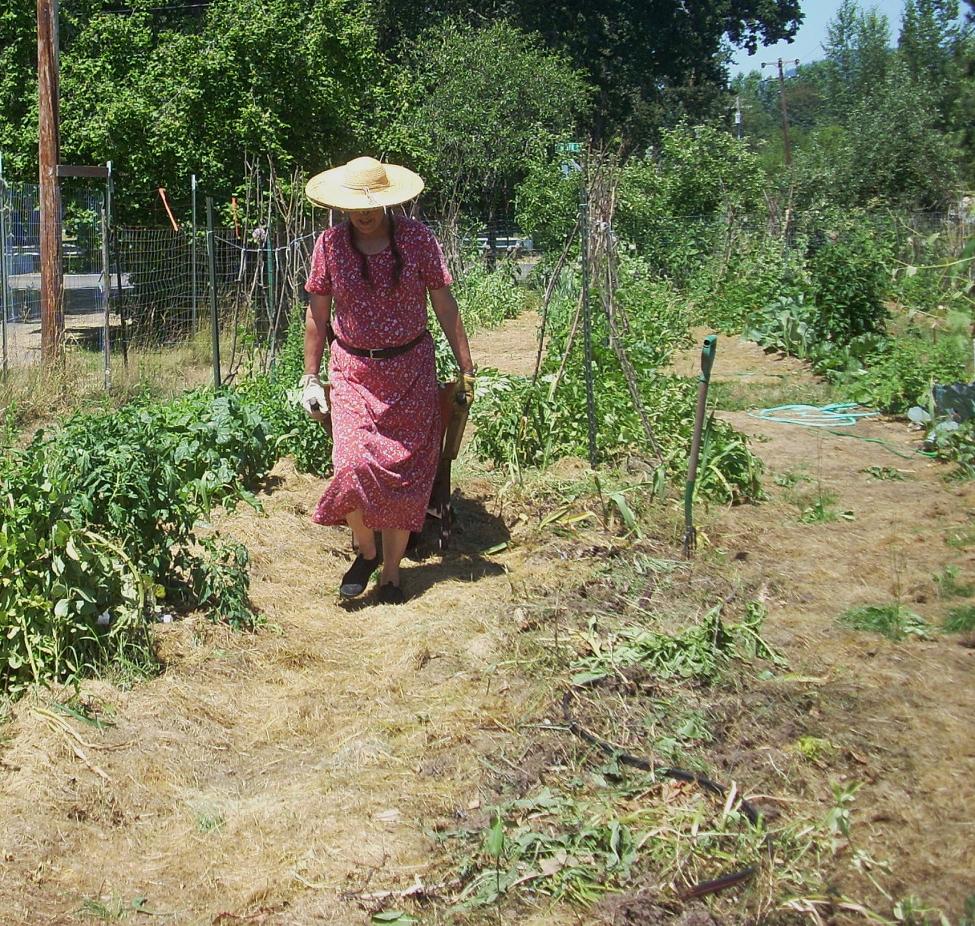
The current situation here is drought. More drought now, in August, than we had last year at any stage, which was more than we've ever seen at this site. So the plants are doing as well as they are, I think, because we broadforked the beds and are spot-watering a lot of the plants at their bases. Those that start to wilt get immediate attention.

It is very difficult to garden right now in Pleasant Hill, Oregon.

Yes, I know guilds are supposed to be helpful. For reasons I won't go into, this particular garden must be kept tree free. But we have done what we can around the edges. Also we are trellising in every other bed in the far back, which really seems to help with partially shading the beds in between. The summer squash bed and the winter squash bed I don't worry about -- they have formed a solid canopy.

Change is the basic fact of the universe. Roll with it. 🙏


That everything changes is the basic truth for each existence. No one can deny this truth, and all the teaching of Buddhism is condensed within it. This is the teaching for all of us. Wherever we go this teaching is true. This teaching is also understood as the teaching of selflessness. Because each existence is in constant change, there is no abiding self. In fact, the self-nature of each existence is nothing but change itself, the self-nature of all existence.

  -- Shunryu Suzuki, Zen Mind Beginners Mind

(To be continued)

Wednesday, November 13, 2013

Use edges and value the marginal


About leaves that generally get stripped and tossed away.

1. Go out to where either your greens have made a whole lot of big side foliage you don't use at table, or have gone to seed producing volunteers (volunteer chard shown), and gather about forty leaves.

2. Stuff your Excelsior or Excalibur or solar dehydrator with them, or just lay them out in the sun. 

3. When they're brittle, fish them out and strip dry matter from midribs. Clean up and crumble to desired consistency. 

4. Dry can (bake) in jars and open to use as needed. Good for up to five years in our experience.

Kale, collards, chard, beets, spinach, cabbage, broccoli, cauliflower, dandelions, false dandelions, lamb's quarters, turnip, arugula, garlic, onions, young bean leaves or knotweed leaves, chicory, plantain, nettles, maple and lilac flowers, nasturtiums, kohlrabi, lettuce, and tatsoi, along with herbs to taste can all be included in this. The more variety, the better nutrition, and they all taste about the same in this form.


You could live a long time, comparatively speaking, if shut in by a pandemic, for example, on just five pounds of dried veggie crumbly and a hundred pounds of rice. (Be sure you have also secured a supply of water.)

You could, with a little acquired knowledge and some persistence, do this entirely with foraged weeds even if you have no garden.

Use in breads, soups, frittatas, quiches, on meats, on potatoes, in eggs, power drinks, hot cereals, salads, wilted salads, stir fries, etc. Also can be added to feeds such as poultry feeds.

Caveat: spinach, chard and amaranths contain a lot of oxalic acid and so there are those who should not consume them in quantity.


After twenty years of nights beneath the moon 
and the clouds to find myself old is hard
crows come looking for food at the altar
monks return with empty begging bowls
others work the waves for shrimp and clams
I swing a hoe in the mountains
when Solomon’s seal is gone there is still pine pollen 
and one square inch free of care

  -- Stonehouse (tr. Red Pine)


Monday, October 28, 2013

Use and value diversity


"Use and value diversity." Everything is an aspect of one thing, the universe, but also everything is itself, so explore your environment and all that is in it, both for utility and wonder.

1. On the land, try everything. Some trees, perennials and annuals will do better, some will not like your climate or soils. For those who work with animals, it's much the same -- one five acre place might do well with a Devon cow and calf, whereas another, with smaller available pasture, might require a Dexter. Do early spring gardens do better here than fall? What greens last through winter freezes? What flint corn or what winter squash seems happier here?

2. Explore the native and non-native field and forest biota and geology for further utility. Are there acorns? Abandoned fruit trees, or wild plums or persimmons? Walnuts? Black walnuts? wild grapes? Edible berries, seeds, annuals, biennials, mushrooms? Which make good medicines, teas, seasonings, dyes, basketry, axe handles, beanpoles, wattles? What animals are there, and which are predators to your plants and animals, which are appropriate to hunt (if you do)? Fish, eels, clams, mussels? What's legal or illegal, abundant or under pressure and needing conservation, and what are the seasons?

3. Experiment and extend your range of skills for your own benefit and pleasure as well as to benefit your family, friends and neighbors. Can you sew, mend, design an interior, clean house, paint, plumb, do carpentry, electric, roofing, assemble hardware, install appliances, cut glass, caulk, set tile, grout, lay bricks, set a stone wall, bed a pathway, maintain tools, cook, preserve foods, bake, dance, sing, play an acoustic instrument, do martial arts, perform a play, chair a meeting, tend to the sick, attend a birth, comfort the dying, meditate, survive, evade, escape, tan leather, shoe a horse, dip candles? Or maybe only a few of these, but are willing to bank them at the community center in exchange for others? Also, when you've learned a skill, how about extending your range, trying new things with new ingredients or materials? Shown is a small loaf of spelt/rye/oatmeal bread with duck eggs, sea salt, veggie crumble, and brewer's yeast, baked in a crock pot. Next, perhaps we'll try in a Dutch oven on a rocket stove.

4. What do you know of your site, its watershed and region, and what they have to offer? Explore (where it is not trespassing) the fields, woods, streams, and bodies of water. Where does the water come from and where does it go; what is its quality? Where are the prevailing winds? Are you prone to hurricanes, tornadoes, earthquakes? Where are the straight saplings for your stamping shed roof, round heat-safe rocks for your sweat lodge, flat rocks for your path to the compost heap, "trash" fish for your fertilizer? Where is the nearest doctor, dentist, veterinarian, grocer, etc., but also who is the go-to blacksmith, wild foods teacher, seed-saver? What birds and animals live (year-round or seasonally) in which areas -- are there rattler dens and poison oak or ivy to respect? What is the history here? How were things done in the past? How do local, state or province and national jurisdictions impact the site, locality and region? What are the current social and commercial impacts? What is changing, and can the changes be met with adequate adaptation? You cannot, maybe, discover all this, but by seeking may find much, and then you will never suffer boredom.


The view that all things exist is one extreme; the view that nothing exists is the other extreme. Being apart from these two extremes, the Tathagata teaches the dharma of the Middle Way: because this exists, that exists; because this arises, that arises. 
 
  -- Agamas qtd. in Uchiyama, Opening the Hand of Thought
 

Saturday, October 19, 2013

Use small and slow solutions


Holmgren and Mollison began developing the Permaculture Principles in the era of publication of E. F. Schumacher's Small is Beautiful: A Study Economics as if People Mattered. Still recommended, especially the chapter on "Buddhist economics." 

The permaculturist is enjoined to consider edges and diversity partly because foraging is more sustainable than farming, and one place you can forage is in the garden! This year we have an abundance of chard that came up on its own as a result of our having let a plant go to seed. It's doing better than any of our transplanted greens.

One leaf meal: volunteer Fordhook chard.

1. Cut and bring in.

2. Wash and cut up.

3. Steam stem pieces 20 min.

4. Add leafy green pieces and steam 10 min. Salt and butter to taste and serve.

Making a meal from something that "just came up" is even more local than your CSA. Think of the ways that fits into "Earth Care, People Care, Fair Share." Invite the neighbors to have some and you will really be on a roll.

Fordhook dates from the 1920s and was a Burpee developed strain. The stems are to my mind even better than the greens. Transplants well. Does like well composted loose soil and lots of water. Tolerates both sun and shade and lasts through most of our summers and most of our winters. Seeds prolifically and volunteers grow true to form. Seed companies say it grows to 18" high but they are being modest. Many specimens here have gone over three feet not counting those that bolted in heat waves.


From an economist’s point of view, the marvel of the Buddhist way of life is the utter rationality of its pattern — amazingly small means leading to extraordinarily satisfactory results. 

  -- E. F. Schumacher, "Buddhist Economics" in Small is Beautiful

Sunday, October 6, 2013

Integrate rather than segregate


Create efficiencies and resiliences (Yin and Yang, if you will).

1. This is the poultry moat/orchard at Stony Run Farm, an example of function stacking. Outside fence, slowly becoming a hedge that yields blackberries, plums and wild cherries, is a woven wire deer fence for excluding deer, coyotes and stray dogs from poultry area and garden. Inside fence, lower left, is a welded wire poultry fence and keeps poultry out of the garden until wanted. Fruit trees are planted on a north-south axis to shade one another's roots. They also provide shade to poultry as well as protection from glide-path predators. Poultry pick up fallen fruit and predate on slugs, snails and insects headed for the garden, drop some fertilizer. Chickens, ducks and geese have overlapping but not identical dietary interests.

2. Polyculture; species mixing. Different perennials and annuals mix it up in some beds with a range of heights and leaf and root patterns, allowing some plants to look for slightly different nutrients and water profiles than others, varying sunlight and shade, hiding some plants better from their predators. We never got the hang of companion planting charts but sometimes we get lucky!

3. Variation in height; trellised crops alternate with low-growing spreading crops, assisting each other with partial shade, moisture conservation and weed suppression.

4. Graze; instead of gathering a bushel of this here and that there, one can work one's way up a single bed, finding what's ripe and what's appealing and bring in a fresh meal. Potentially what you're bringing in has less predation, less nutrient depletion, less drought shock, was what your body was really hungry for, and will be eaten fresher. Do the same for poultry or stock; they like their lettuce in season as well.


He who sees the nature of a phenomenon
Is said to [see] the nature of everything.
For the emptiness of a phenomenon
Is the emptiness of everything.


  -- Aryadeva (in Mahatthanadull Et al., "Research Report: A Theory of Buddhism  Integration for Sustainable Development of Wisdom and Virtue in the 21 st Century" (Compatibility of Buddhism and Science in support of the UN SDGs)
 

Saturday, September 28, 2013

Design from pattern to detail


"Design from pattern to detail."

 
Four views by evening light.

"Permanent" and temporary structures, walkways, paths, beds, guilds, garden architecture, pastures, woodlots, shade, sun, and wildlife corridors should interlock to the advantage of all concerned and also reflect your own needs, movements and temperament. 

Know in what direction are summer and winter sun and shade, where the weather tends to come from, and the state of your soil and watershed. (I would add first and last frost, but who knows, these days?) Remember humanity is a heat engine and way over energy budget: what are things you can do to lower the cost to others of your short time here? 

The buildings shown here, for example, are insulated, shaded, and have white walls and roofs. Many of their materials are recycled and recyclable.

Go lightly on the earth and others and also build soil!


One day Master Guishan asked Huiji, “How do you understand inconceivable, clear, bright mind?” Huiji said, “Mountains, rivers, the great earth, the sun, the moon, and the stars.”

  -- Treasury of the Forest of Ancestors, comp. Satyavayu

(To be continued)

Monday, September 23, 2013

Produce no waste


"Produce no waste."

Here is a cycle:

1. We gather barn bedding, leaves, grass clippings, kitchen wastes, aged humanure, woodlot waste -- anything that is compostable, does not pass along disease, undesirable chemicals or plastic.

2. Heap and turn, or bin and worm. There are good texts on ways to do so. Keep under cover in rainy weather to prevent leaching out.

3. Distribute. Make enough to feed all beds, or it may be, pots. Consider using more where crops are hungry feeders, but give something to all soils if you can.

4. Reap the rewards ("Obtain a yield"). But remember to return all wastes -- leaving roots intact to rot in place, for example -- either by chop and drop, or carrying them to the heap or bin. If there are wastes that must be burned due to disease or pests, consider returning the ashes at least.

During the off season, if you have one, consider allowing stock (in our case poultry) access, to eat up pests and weed seeds. Meanwhile, start all over at 1.

Let your soil's seasons be to you like your days, with an awakening, sustenance, productivity, and rest.


Today humanity is challenged to discover the meaning and role it seeks in the ongoing, long-term task of repairing the rupture between us and mother earth. That healing will transform us as much as the biosphere.

  -- David Loy

If you have acres, maybe do this. If you have a few containers on the porch, do try this.

(To be continued)

Thursday, September 19, 2013

Use and value renewable resources and services


"Use and value renewable resources and services"

My first thought when contemplating this principle was the adage: "reduce, renew, reuse, repurpose, recycle." And you do see some of that here: at 2. the harvest/forage bag has been made from a conference tote bag by snipping the handles at one end and sewing them to each other to make a shoulder strap, while at 3. the compost bins are made from pallets and the mailbox is repurposed as a rain-proof hand tool bin.

But it also means to let the earth gift you with things you may use and then return to the earth.

1. Perennials give and grow back, just as trees offer fruit and nuts and then offer them again.

2. Annuals provide fruit and veg but also seed, so that they may come again.

3. "Wastes" become compost gold. Water goes onto the soil, then out to the sea, becomes clouds, returns as rain and snow.

4. Our straw comes from local wheat farmers, and the following year comes from local wheat farmers again. The trellises are made from shoots from hazel, maple, ash, knotweed, and even Oregon grape, all growing on the premises, and renewing from the land cyclically. "Services," indeed. As these become soil and become food for us and the other creatures here, we make some small return via the composting potty and the kitchen "waste" bucket.

There's really no such thing as waste -- the continental plates will subduct all. What there is is spoilage -- hastened entropy, making the things you have used into things that are (in the nearer term than geologic processes) harmful or unusable for others. 

On a grand scale, the Pacific Garbage Patch would be an example of such spoilage, or the Love Canal, or whatever has been touched by the Tar Sands or nuclear industries. Closer to home, lead paint, indiscriminate herbicide usage, or motoring to the store with a V-8 engine to buy cigarettes, say. 

Watch what happens to the stream of gifts from the Earth you sample. Where do the beanpoles go? The apple cores? The old fence boards? 

Respect the cycle.


Simplicity and non-violence are obviously closely related. The optimal pattern of consumption, producing a high degree of human satisfaction by means of a relatively low rate of consumption, allows people to live without great pressure and strain and to fulfill the primary injunction of Buddhist teaching: “Cease to do evil; try to do good.” As physical resources are everywhere limited, people satisfying their needs by means of a modest use of resources are obviously less likely to be at each other’s throats than people depending upon a high rate of use. Equally, people who live in highly self-sufficient local communities are less likely to get involved in large-scale violence than people whose existence depends on world-wide systems of trade.

  -- E. F. Schumacher, "Buddhist Economics" in Small is Beautiful


(To be continued)


Sunday, September 15, 2013

Apply self-regulation and accept feedback


"Apply self-regulation and accept feedback."

Efficient or resilient systems require noting and correcting inefficient or non-resilient practices.

My old labor cooperative, The Hoedads, ran on Robert's Rules of Order, but also appended to the end of each meeting a session borrowed from 
anarcho-syndicalist committee work, known as "Crit-Self-Crit." We would each rise in place and air a grievance we had with anyone, or clique, or the whole team, followed by a grievance we had with our own performance. Dialoguing was not permitted; one had to wait one's turn and even then responding to a specific criticism, other than to contribute to a solution, was discouraged. In this way we had time to consider the viewpoint that had been expressed, and perhaps acknowledge the truth in it and rise to the moment, making a public and private commitment to do better for the sake of all. Solidarity is People Care.

1. Ask your site what it wants from you, through close observation and interaction. Watch the seasons and learn.

2. Contemplate what you have seen and learned in a place and state of reflection.

3. Observe what is happening off-site as well, remembering that everything affects all. Here we see smoke from tundra and taiga fires over a thousand miles away. What does this mean for the world? Your region? Your locality? Your site? How should you respond?

4. Check your findings with others and be prepared to discover, in everyone's accumulated wisdom, your mistakes. Freely acknowledge these when they have been confirmed -- this too adds to the pool of knowledge.

In this way, your commitment to Earth Care, People Care, Fair Share will be honed and strengthened, and in your short time in the world you will have made a contribution.


To find out, to examine, to unravel, to penetrate, there must be freedom to listen and freedom to perceive.
  -- Krishnamurti

(
To be continued)

Thursday, September 12, 2013

Catch and store energy


Our budget at Stony Run Farm hasn't been up to what often comes to mind with this principle, which is a set of solar panels. But we do in fact catch and store energy.

1. A 3X50' bed of potatoes stores a lot of solar energy in the form of a wheelbarrow full of spuds. We eat about two thirds over the winter and then plant the rest the following spring. Rotating beds seems to help reduce the risks associated with using your own spuds for seed. Ours are Yukon Golds, Reds, and German Butterball.

2. We do buy in some wood for each winter but also manage our own coppice and woodlot. This is another form of solar, similar in principle to the potatoes (photosynthesis). One warms you on the inside, the other on the outside. Splits, rounds and smallwood go in the woodpile, which faces the sun to season the wood. Leftover branches and twigs, such as the pine boughs shown, are treated as chop-and-drop mulch material, scattered around beneath fruit trees or incorporated into the garden beds. One heap of twiggy "waste" is left for a wildlife safe zone. Many of the trees in our rotation we planted ourselves. Saw used here is electric, and we buy 100% wind from our power co-op.

3. We also use passive solar in the form of a used hot water heater with its jacket and insulation peeled back, and painted black, resting on a pallet inside its own cold frame. It's tapped into the main line between the well and house, and serves as a pre-heater for the inside electric hot water heater, reducing costs half the year. In two decades it has never needed maintenance.

4. Homemade solar dryers consisting of no more than a plywood box with a window on it, with holes in the ends, have served us well, perhaps because we have had such low humidity (and getting lower! Gulp) in summer. 


To see the wondrous nature of water, you need to look beyond the sign (appearance) of the water, and see that it is made of non-water elements. If you think that water is only water, that it cannot be the sun, the earth, or the flower, you are not correct. When you can see that the water is the sun, the earth, and the flower, that just by looking at the sun or the earth you can see the water, this is "the signlessness of signs." An organic gardener who looks at a banana peel, dead leaves, or rotting branches can see flowers, fruit, and vegetables in them. She is able to see the nonself nature of flowers, fruit, and garbage. When she can apply this insight to all other spheres, she will realize complete awakening.

  -- Thich Nhat Hanh, The Heart of Buddha's Teaching

(To be continued)

Saturday, September 7, 2013

Obtain a yield


1. Tomatoes, squash, eggplant, apple butter. People may not care for most of your home canning, but they will eat your apple butter.

2. Duck eggs and chicken eggs resting on a foraged bench. 

3. Greens being harvested for fresh consumption, for poultry, and for dehydration for later use by both humans and poultry. 

4. A persistent weed, Japanese knotweed, being collected for food, fodder, mulch, compost, trellising poles, bee hotels, and kindling.

These are subsistence yields. Stony Run Farm is really just a suburban-style lot in a country setting, but we do ask it to convert sunshine and compost for us into veggies. We try to stay within our fertility budget -- if we were to sell crops, we'd have to buy something to fertilize with. Commerce has the long term disadvantage that it leaks energy at every station of rach product -- speeding up entropy for all. We're idealists, but we've made an effort to participate as little as we reasonably might, and we feel good about our choice.


It’s the same as the people that teach poetry and the people that teach all of the arts in Japan, where it’s based on this idea that you come to the place where there’s no qualities and no thought and you’re one with everything, and if you’re studying pottery, of course it makes you a better person, it’s a good thing… with natural farming you become a better more joyful person, but you’re also providing for your own livelihood, you’re growing what you need to eat and you’re in partnership with other forms of life.

 -- Larry Korn

(To be continued)


Thursday, September 5, 2013

Observation and interaction


Here is one of twelve collages on The Permaculture Principles and how they might be applied to subsistence right livelihood, especially in the maritime Pacific Northwest. 

In recent years we have, on our one acre farm, by whatever causes, had fewer infestations here of insect pests, slugs and snails.

Perhaps one reason is that we keep an eye out for ways to encourage predation of these. By maintaining habitat refuges, we're seeing an increase in 1. garter snakes and gopher snakes, 2. tree frogs, and 3. orb weavers, yellow garden spiders, crab spiders and barn spiders. Also, we encourage 4. the ducks and chickens to spend time in the garden and orchard, especially in winter. When we find a ladybug or other beneficial on our walks, we bring it home if it seems okay to do so.

Through observation we can adapt to some changes. For example, we spotted a trend in increased supply of plantains, amaranths and false dandelion on the premises. We looked these up and ended up adding them to our diet and using the plantains for topical medication as well.

Bigger changes are leading us to other thoughts. Poison oak is on the increase, showing up on level ground and not just in the trees as formerly. We think from this, and hearing that rattlers are also extending their range, that our climate is drying and may affect the well, as our limited groundwater is seasonal-rains dependent. We can collect rain and drought-proof the garden somewhat, but may also need to add a water barrel and rotary pump for visits to the river, less than two miles off. We're nearing the end of our career here, but there's no point being driven off the place prematurely through lack of observation and interaction.


The Buddha’s insight into life’s interconnectedness has powerful implications for how we treat the natural world on earth, its wildlife, and each other. Because we depend so deeply on nature and on one another, we recognise that all life is as valuable as our own. 

  -- "Guest" writing for The Wildlife Trust

(To be continued)


Saturday, August 24, 2013

The holistic way


If we look up "holistic" we find, apart from the narrower medical term, that it means "characterized by comprehension of the parts of something as intimately interconnected and explicable only by reference to the whole."   

It is a term used by Permaculturists and is the point of Permaculture; treat this life (the "world") as a whole system of which we are a part, rather than as a set of resources (separate from us: objectified) to be exploited for profit, regardless of externalized costs.

Permaculture is a word originated by Bill Mollison and David Holmgren while considering whole systems in the context of agriculture in Tasmania. Permaculture principles as a set of ideas or design tools are in flux, as the movement's leadership is diverse and democratic, with new knowledge added all the time, so this series of posts will become dated quickly. 

With the exceptionally dissipative fossil fuel system rapidly approaching a EROEI Energy Returned On Energy Invested) of 1:1, the consequences: famines, resource wars, revolts, and corporate and governmental collapse appear unavoidable now. 

Those who have been feverishly working to create sustainable practices may or may not find a way for humanity to muddle through but remain the only game in town. There have been a number of related or similar efforts, such as the Satoyama Initiative or Worldwide Opportunities on Organic Farms, or Global Ecovillage Network.

I think the ethic (the "three ethics") as stated on permacultureprinciples.com is spot on. "Earth Care, People Care, Fair Share." Viewed through the monist glass, we can say that all this is Earth Care, people and their basic needs being a part of the holistic whole.

Here are the principles again:

1. Observe and Interact. By taking the time to engage with nature we can design relevant solutions.
2. Catch and Store Energy. Developing systems to collect resources when abundant, we can use them in need.
3. Obtain a yield – Ensure that you are getting useful rewards from your work.
4. Apply Self Regulation and Accept Feedback – Efficient or resilient systems require noting and correcting inefficient or non-resilient practices.
5. Use and Value Renewable Resources and Services – as opposed to non-renewable resources.
6. Produce No Waste – “Waste not, want not.”
7. Design From Patterns to Details – Observe patterns in nature and society. Test their appropriateness broadly, rather than losing yourself in detail.
8. Integrate Rather Than Segregate – By putting the right things in the right place, relationships develop, creating efficiencies and resiliences.
9. Use Small and Slow Solutions – Small is beautiful.
10. Use and Value Diversity – “Don’t put all your eggs in one basket” -- be resilient.
11. Use Edges and Value the Marginal – These are often the most valuable, diverse and productive elements in the system.
12. Creatively Use and Respond to Change – We can have a positive impact on inevitable change by carefully observing and then intervening at the right time.

And, we'll go over them one by one.


An ethical life is one that is mindful, mannerly, and has style. Of
all moral failings and flaws of character, the worst is stinginess of
thought, which includes meanness in all its forms. Rudeness in
thought or deed toward others, toward nature, reduces the chances
of conviviality and interspecies communication, which are essential
to physical and spiritual survival.


-- Gary Snyder, The Practice of the Wild


(To be continued)

Monday, August 19, 2013

Right singularity


I've been covering, in my idiosyncratic way, the eight points of the eightfold path promulgated by Gotama when he snapped out of his long bout of meditation, determined to save the world. We've arrived at the last one, and it's a doozy.

Meditation is said, when undertaken correctly (whatever that might be), to get you the whole enchilada.

Well, it does. But it's generally offered embedded in pietistic hooraw: that "various levels or modes" thing can easily, and I suspect very often, be the money clause: "This stuff takes years, kid. Support me the whole time and I might get you there."   

I like and recommend meditation's ability to show, experimentally, such reality as we're equipped (as brains with sampling systems -- eyes, ears, etc.) to appreciate. And it takes some appreciation of what's what for there to be some justification for the other seven aspects of the path.

But it would be a mistake to go sit with the idea of "attaining" some kind of holiness. Attempting to become someone special (which is patently impossible) is exactly what Gotama would have you not do -- it would be the very illusion he returned to his friends to warn against.

So let's do a simple intellectual exercise. 'K?

You can imagine animals and plants arising from the biosphere, not as anything separate from the biosphere, the planet, the galaxy, the universe, but as aspects of all of the above -- it's all one thing, taking a variety of shapes, like thoughts in a mind. Yes?

But, wait -- are you an observer, outside of this image, or are you in it? The center of the universe, or an aspect of the universal?

I think we have to understand ourselves as, in our individuality, provisional beings at best, an aspect of the universal, to go on from here to the twelve principles that have been adumbrated as those of Permaculture. As foraging and farming and trading beings (which we have to be to live) we intervene with the plants and animals around us for our own benefit. How we do so may matter: what if they are our equals? What if it's important to show some respect? Hmm?

We know we have been destructive. How do we become less destructive, or are there even ways in which we can be constructive? If we are going to undertake to change the world for the "better," it's awfully important that the results be, umm, for the better.

'Cuz if we don't have good evidence for what we're doing, better we shoulda stayed on that couch, watching the commercials.


The field of boundless emptiness is what exists from the very begin­ning. You must purify, cure, grind down, or brush away all the ten­dencies you have fabricated into apparent habits. Then you can reside in the clear circle of brightness.

  -- Hongzhi, tr. Leighton


(To be continued)

Sunday, August 18, 2013

Focus, focus!


Action, to be correct action, must spring from focus. If we react mainly to provocation, or take action aimlessly, our contribution will be correspondingly small. If we visualize a worthwhile project, and concentrate on it day and night, our impact will be the greater.

First we ascertain that our vision is "worthwhile." Then, whether we mean to create a one-acre food forest or manage a great nation's food system, we must focus on the task at hand and give it our all.

We can see, as we work through these principles, how each of them is a facet of a single principle. It becomes clear to us that right desire and right focus are practically the same. Right focus and right avocation, or livelihood, are also the same. The path is described as having eight parts so that we can absorb the lesson in manageable chunks.

Dogen uses the words "die sitting, die standing" to indicate the urgency we should bring to taking our path seriously. That doesn't mean don't have a sense of fun or play. It does mean not frittering away our minds endlessly on secondary, illusive matters -- a major trap for us in these times. 


Benefit others, which simultaneously gives abundant benefit to the self.

-- Dogen, Tenzo Kyokun, tr. Leighton and Okumura


(To be continued

Monday, August 12, 2013

Work well


From right doing, right work naturally flows. It is understandable if one has had to keep working at a fast-food place to help support one's children, but one must also keep an eye out for a better livelihood, as fast-food places poison the population.

In general few jobs meet this principle, as the world system has grown toward wage slavery to enrich those already rich, to most of whom the prospect of such enrichment doing harm to the population is of little or no concern.

It can be helpful to learn a craft or trade that may provide safe and nutritious food, clean water, goods or services that are as free as possible of harm through exploitation -- or debt, which is exploitation at one remove (including the system whereby corporate entities prioritize shareholders rather than the good of society and the biosphere).

It can be objected that looking into the probable effects of work is attachment to outcomes. Not necessarily. The spirit of one's commitment to the eightfold way is to acquire a certain level of skill in not doing harm, not to acquire praise or reward for so doing. Remain in the now and just do well.


I may be white-haired and nothing but bones 
but I’m versed in the work of daily survival 
in fall I pound thistles in a wooden mortar
in spring I dry vine buds in a wicker tray
I buy Solomon’s seal from a peddler down below
for seaweed I rely on a monk from across the sea
but who would have guessed at seventy-seven
I would dig a pond for lotus roots and water chestnuts


-- Stonehouse, tr. Red Pine


(To be continued)

Monday, August 5, 2013

Ethics are not your beliefs, they are what you do


Key to understanding why there are eight parts to the long- established Buddhist way and twelve principles to the more recent Permaculture way is this concept of "right doing."

If we are alive, we do some things. But perhaps some of them are thoughtless things. Then it behooves us to think this through. To do well, it may help to have (and keep to) a plan. (If we are uncomfortable calling what we do by the names given here, we may use other names. The important thing is the action.)

The Buddhist way may in general practice be reduced to the Golden Rule: do not do to others what you would not have done to yourself.

The Permaculture principles are thought to be an expression of three ethics, caring for the earth, caring for people, and fairness -- which is really but one ethic, and may also in general practice be reduced to the Golden Rule.

Everything unfolds from the observation that there is one observable reality, regardless of how it may be described, and that therefore in some sense there is no one or nothing from which we can be divided. Care for the earth is people care and is sharing.

So we can try this experimentally. See, feel, say (or refrain from saying), do, earn, strive, think, and manifest caring and sharing. We may find that it works, and that our cynicism has been a hindrance. Why should we ever be bored a single moment in an awakened life dedicated to right doing? It's not really harder than wrong doing.


Being mindful of generosity is a gate to what the Dharma illumines, for due to that we do not expect rewards. 

-- Dogen, 108 dharma gates, tr. Nearman


(To be continued)

Thursday, August 1, 2013

Right saying

 https://3.bp.blogspot.com/-NTyHcX4NcBM/UkBWT6mfsNI/AAAAAAAAIJk/RwKh0UJNIS0/s1600/2705167745_d8dcbec156_z.jpg

The world is coming to be defined by competing slanders and obfuscations. Clarity, honesty, openness and nurture are revolutionary. What really needs to be said? Are you the one to say it? How, when and where will it be most helpful? There are those who break silence only when it will be like a sunrise, and we know to treasure them.


As for the qualities of which you may know, 'These qualities lead to dispassion, not to passion; to being unfettered, not to being fettered; to shedding, not to accumulating; to modesty, not to self-aggrandizement; to contentment, not to discontent; to seclusion, not to entanglement; to aroused persistence, not to laziness; to being unburdensome, not to being burdensome': You may categorically hold, 'This is the Dhamma, this is the Vinaya, this is the Teacher's instruction.

-- Buddha to Mahapajapati, Gotami Sutta, tr. Thanissaro Bhikkhu


(To be continued)


Tuesday, July 30, 2013

Right desire


Desire is sometimes given a bad rap by good and thoughtful people. That's because it is conflated with acquisitiveness. We often wish to accrue money, fame, a lover, electronic toys, a car. But surely it is not wrong to desire universal health and happiness. So, right desire can be the motivator toward living a principled and clarified life. 

We see by this how far from these good things we can be led by advertising, propaganda, and selected "news" -- which may be but advertising and propaganda put forth by the unprincipled for the sake of a greedful and almost universally hurtful agenda. 

On a warm day we may desire to walk together to the lake or to sit under a tree and look across the river toward the mountain; in cold rain we may desire to sit by a fire with tea. These are good things; yet by wishing as much for others we find the springboard toward right action.


I said, “What does Zen Master Fenggan do when he is here?”
The monk said, “He pounds rice and offers it to the assembly of monks. At night he enjoys himself singing.”

-- Luqui Yin, tr. Tanahashi


(To be continued)


Saturday, July 20, 2013

Right seeing

https://4.bp.blogspot.com/-nwXta53L1F8/Uj-fOpyMXBI/AAAAAAAAIIs/Gg42AS10C34/s1600/003+(4).JPG 

We begin by seeing our mistake. Separateness in the here and now is illusory, and our mental pictures of the past or future, laced with a desire to have things our own way, are also illusory. The universe with all that is in it is one thing. This is why it is right to resist the spreading of poisons in agriculture, the land, the skies, the sea, and in our cities, and to resist the spreading of fear (oppression) and of war (oppression also). 

The cause of the spreading of poisons, fear and war is the lack of accountability due to greed, and the correction of this sickness is accountability -- accepting responsibility for both the visible and invisible costs of our actions, and adjusting those actions accordingly, so that we may act with clarity and justice. Capitalism is (or certainly has become) systematized avoidance of justice. We can do better than this. 


Clearly seeing into one's nature is called practice, and the seat that puts an end to analytical thoughts is called zazen. 

-- Bassui

(To be continued

Tuesday, July 9, 2013

Permaculture ethics and principles in the light of Buddhism

"Earth care" is right action. Preventing soil loss, water pollution, excess atmospheric carbon, and radiological contamination are examples.

"People care" is right action. Active listening, feeding with good food, offering clean water, assisting with shelter and teaching right action are examples.

"Fair share" is right action. Living within one's means -- and finding small means sufficient opening up possibilities for others -- are examples.

These actions may be carried out in all of life, for example, within nature, architecturally, through responsible choice and use of tools, in teaching, in health care, in gift and exchange, in coming together on governance (the mutual determination of right action).

Grassroots Garden, Food for Lane County, Eugene, Oregon, USA

"Observation," as noted in the preceding post/note, is right action.

"Obtaining energy" in an ethical way (without destroying the life or livelihood of others, and without excess) is right action.

"Obtaining a yield" -- primary production (forestry, agriculture, manufacturing) in an ethical way for your livelihood (without destroying the life or livelihood of others, and without excess) is right action.

"Self-regulation" (evaluating and redirecting one's actions. Also: accepting criticism) is right action.

"Choosing to reduce, reuse, recycle, repurpose, and renew" -- over the opposites of these -- is right action.

"Eschewing wastefulness", which is closely related to the preceding principle, is right action.

"Designing from patterns to details" -- close observation and imitation of natural cycles -- is right action.

"Integrating rather than segregating processes" -- closely related to the three preceding principles -- is right action. Incorporating a chicken moat into the homestead protects the garden from the hens and from the insects and mollusks the hens eat, for example.

"Using small and slow solutions" -- mulch rather than a tractor where a mulch will do -- is right action.

"Honoring diversity in all things" -- human and in nature (which comes to the same thing) -- is right action. Consider, for example, the resiliency of mutually respected vibrant culture and the resiliency of a food forest or polycultural vegetable garden.

"Using edges and valuing the marginal" is right action. This is related to honoring diversity; from the edges in society come imagination and innovation; from the edges in the landscape come wildlife and species interaction, preventing outsized populations of "undesirable" species without chemical invention among other benefits.

"Using and responding to change" is right action. Πάντα ῥεῖ καὶ οὐδὲν μένει

All things flow. Ride the river of life.  


Unhesitatingly [the head of the farmyard] takes the lead in heavy physical labor. He cultivates the soil, sows seeds for vegetable crops, irrigates the fields when necessary, and thereby provides a steady supply of fresh vegetables and so on to the kitchen hall throughout the year.

-- Baizhang Monastic Regulations

(To be continued

Wednesday, June 12, 2013

Right action can be all eight spokes of the wheel


An analysis of the four truths and eightfold way of Buddhism as a unified concept which could be expressed as Right Action.

Primum non nocere, a medical directive, means, "First, do no harm."

It's rough out there.

That it's rough out there can be taken as a given. Some of us are insulated from the consequences of inappropriate action through the inequitable accumulation of resources, but the effect is temporary and I think a kind of self-harm accrues, to ourselves and our loved ones. Certainly harm comes to others.

Hence: "it's rough because we (whether ourselves or others) want things to be different than they are." We suffer when we have expectations or unrealistic intentions. Others suffer when we attempt, through action, to enforce our expectations. We take an inappropriate action.

"We can change our behavior," that is, we can learn to select appropriate actions.

So, Right Action could serve as the key concept drawing the Buddhist and Permaculture toolboxes together.

Right view could be taken as observe clearly, which is a kind of action.

Right aspiration could be taken as a kind of action, in which one connects observation to volition. Separating appropriate desires from inappropriate desires, with an intent to manifest the appropriate desires, is an internal activity, but an important one. "Cessation from all desires" is a misleading concept in this context, as it lacks the qualifier "appropriate." If one fails to desire to breathe, no right actions will follow.

Right speech is certainly an action, through the choice to say or not say, as needed. A friend often says: before speaking, ask yourself, "is it kind? Is it true? Is it necessary?"

Hence, right action. And is your action kind? Is it true (correct)? Is it necessary? These three combined are what is meant by "appropriate" as used here.

Right livelihood is right action in the sense of "obtain a yield." If benefits accrue to you and others by your actions you already have right livelihood. Do not think this is limited by or to the earning of money.

Right action must be carried out, not merely thought of. One applies one's energy to the task. So right effort is about action.

Right mindfulness, also, does not just happen. To clear away obstacles and focus, though it occurs in the mind, is an internal action without which appropriate external activity will not occur. I've expressed this dualistically, but is not all movement by living things the evidence of mind at work?

Right concentration is what occurs in meditation, i..e., the suppression of distractions so as to observe directly. So we have come full circle in this exercise, as the finding that it's rough out there is an observation. You have taken the action to find that out, to discover the cause (which can be boiled down to selfishness) and the cure (which can be boiled down to selflessness).

"Ethics" need not be taught in a university, nor commanded in a church (that's "morality," a different kind of animal). It is as simple as breathing. Want happiness? When you rise up in the morning, set your face toward the doing of right action, that is, whatever is kind, true, and necessary.


...the four noble truths include the eightfold path, which instructs us in how to live and embody dharma in every part of life through right view, right speech, right action, right livelihood, right mindfulness, and so forth. The Buddha taught the community of followers hundreds of ways to practice based on these truths. And in thousands of years of practice these skillful means have grown. We can draw upon them all in support of awakening.

-- Jack Kornfield


(to be continued)

Sunday, May 19, 2013

Buddhism and Permaculture: A pair of ethics toolboxes

This may contain: an image of a garden with plants growing out of the planter and on top of it


The following can be regarded as a compatible pair of ethics toolboxes for designing a life. 

The first is derived from Buddhism. I find its core survives Occam's razor. Its basics are: four truths, which descended from Siddhartha Gautama's contemplation of the Four Sights. And: eight ways for those truths to be manifested in your life. I tend to take this to mean the young man saw a sick person, an old person and a dying person (entropy) and prescribed, within the ontological bounds available to him, negentropic activity as its antidote.

https://1.bp.blogspot.com/-vvAfQawoj44/Sk_fhmVbdxI/AAAAAAAABJ8/N9jENzsQOag/s1600/014.JPG
Your author in skinnier days.


Truth one: it's rough out there (second law of thermodynamics). 

Truth two: it's even rougher because we (whether ourselves or others) want things to be different than they are (as if there were no such law).

Truth three: We can change our own behavior, so that things are less rough for us, at least internally (and perhaps slow some of the entropy for ourselves and others through wisdom).

Truth four is a simple method for cultivating these behavioral changes. Here is the method with its eight parts -- they are interrelated; are really aspects of one thing, but broken down for utility.

  1. Right view. See what's happening.

  2. Right aspiration. Care about the things that matter, not the things that don't. Notice the things that matter are not things (esp. as in "owning" "possessions").

  3. Right speech. When communicating with others, delete whatever would hinder them from discovering the truths and using this method. For example, hurtful snark.

  4. Right action. Do not do unto others what you would not want done to you. Heard that before?

  5. Right livelihood. Do not do for a living that which would hinder others from discovering the truths and using this method. Example: fracking engineer. Example: bankster. The best occupations are probably smallholder and the crafts that support smallholders, along with infrastructure workers and the health professions, preferably preventive care. I would include teaching, but prefer it in the form of apprenticeships over large school and university systems.

  6. Right effort. Conducting the parts of the method with due diligence.

  7. Right mindfulness. Clarity of thought concerning the truths, the method and their goal of non-harm.

  8. Right concentration. To achieve clarity of thought, discipline the mind. Simply refusing to load it up with extraneous chatter (from television or Facebook, for example) is a start. I attend virtual Soto Zen Buddhist events. Your mileage may vary.

The second toolbox is the Permaculture Design principles, as formulated by David Holmgren in Permaculture: Principles and Pathways Beyond Sustainability (2002). I find them to be, ultimately, the same box differently adumbrated.

The core ethics are generally expressed as "earth care, people care, and fair share." This could be regarded as "help others slow their entropy." So I find both Buddhism and Permaculture, as ethical systems promoting simple living and reciprocity, to be attempts to build a nonfictional applied philosophy of negentropism.

The ethics are applied in, usually, twelve kinds of activities usually called principles.

  1. Observe and Interact. By taking the time to engage with nature we can design relevant solutions.

  2. Catch and Store Energy. Developing systems to collect resources when abundant, we can use them in need.

  3. Obtain a yield – Ensure that you are getting useful rewards from your work.

  4. Apply Self Regulation and Accept Feedback – Efficient or resilient systems require noting and correcting inefficient or nonresilient practices.

  5. Use and Value Renewable Resources and Services – as opposed to non-renewable resources.

  6. Produce No Waste – “Waste not, want not.”

  7. Design From Patterns to Details – Observe patterns in nature and society. Test their appropriateness broadly, rather than losing yourself in detail.

  8. Integrate Rather Than Segregate – By putting the right things in the right place, relationships develop, creating efficiencies and resiliences.

  9. Use Small and Slow Solutions – Small is beautiful.

  10. Use and Value Diversity – “Don’t put all your eggs in one basket” -- be resilient.

  11. Use Edges and Value the Marginal – These are often the most valuable, diverse and productive elements in the system.

  12. Creatively Use and Respond to Change – We can have a positive impact on inevitable change by carefully observing and then intervening at the right time.

The principles are applied in seven "domains" that have been elucidated. These: The Natural Realm, Building(s), Tools (Technology), Education/Culture, Health (Well-Being), Economics ("as if people mattered"), Governance (participatory democracy preferred).

I'm aware that some leaders in Buddhism and Permaculture have historically and have continued to fall short of the ethics enumerated here, particularly in the treatment of women, and colonized by colonizers, by men in positions of authority. So what's new?  I'm going to practice as long as I see the utility of practice; that will at least be one less potential predator in the world, to the extent of my ability. Both Buddhists and Permaculturists practice as exemplars.

You are here for only a moment, less than a moment in the universe's time. Why not simply clear the mind, open the "heart," open the hands, be for and with and not against?

Natural farming, the true and original form of agriculture, is the methodless method of nature, the unmoving way of Bodhidharma. Although appearing fragile and vulnerable, it is potent for it brings victory unfought; it is a Buddhist way of farming that is boundless and yielding, and leaves the soil, the plants, and the insects to themselves. -- Masanobu Fukuoka


(To be continued)