December
WHEN THE snows came, transforming the landscape (which happens rarely here nowadays), Jasper Mountain took on that hoary aspect which I associate with those Japanese woodblock prints set in winter - such as Hokusai's print of hunters warming themselves by a damp bonfire.
My poor little boat has been used only twice in almost a hundred days, and I found myself numbingly cold on both occasions. Floods have destroyed one of the creek bridges and shifted the other off its foundation. I found one end of it bobbing in the current, the other snagged in a tangle of blackberries. The weather so penetrated my bones on this short outing that I left the bridge in the creek for the next three weeks.
With personal energy and initiative out-of-doors so circumscribed, I turned my attention indoors.
Shelving for books, some forty-eight lineal feet, was needed. The usual approach, nowadays, is to acquire pressboard cabinets, knocked down, from a giant discount store. These are tolerable painted, but are often left nakedly wood-chip-ish in appearance, due to the difficulty of finding a moment in which to upgrade them, all the available labor time having gone into tapping the tiny nails into the shelves through the sides and back, and cursing as the nails curved in the unpredictable "grain" of the glued and pressed sawdust. The "finished" product then spends its tenure in the household squatting in the darkest available corner, where no one can look at it directly or acknowledge its existence due to its irredeemable ugliness, and the whole time it gives off unhealthful vapors.
The alternatives are: "steel" shelving, ugly, cheap, sharp-edged, and bendy; or expensive cabinetry, which, if sufficiently sturdy must be built-in, at tremendous cost if hired done, otherwise consuming time one doesn't have, and requiring tools one cannot afford, if undertaken by one's self.
Early in our tenure here, there was a surplus of used planking and even beams, and these were put to use for what we cheerfully called "vernacular" architecture. We built walls, ceilings, shelving, tables, and cabinets utilizing found materials which could stand either to take a deep brown stain or a coat of daubed spackle, followed by a coat of flat white paint.
The effect is cheering and calming, and visitors often use the word "cozy," and if this sometimes said in a tone which we might take as patronizing, we don't mind, as we have done what we could with what we had, a satisfying activity.
This year I ran out of the old materials and of time to cadge old materials from others. For the new shelving, then, I would need new material, which, to match the interior style of the house, should be wood, painted white. I found that pine boards cost much more than I expected, but I could live with that; an abused resource should cost enough to reduce the demand.
In the old days, I would have put all the bits together with fourpenny box nails, but we now have the self-tapping "wallboard" which are a blessing. In a way, I hated to paint over the attractive built-in pine bookcase I'd created, but it ran the length of a long, dark hallway, and the white would help prevent further loss of light there.
As soon as the drop cloths and tools were put away, I stood in the hallway and admired my (admittedly a bit crude) handiwork for some time. I hadn't chosen the least expensive or least difficult solution for my project, but I had chosen one I found satisfactory; so much so that I couldn't tear my eyes away. It looked as if it belonged, and would last perhaps as long as the house.
Beyond my time. A statement.
As a civilization, we of the West have begun to lose this capacity for the average person to make statements. I'm reminded of that moment in Kurt Vonnegut's Player Piano when the protagonist's car breaks down, and a crowd of the great mass of unemployed gathers, which he views with suspicion until one of them wistfully says, as nearly as I can remember it from a distant read: "Maybe I could look at it for you. I used to be pretty good with my hands."
The generation just arriving has mostly not read E. F. Schumacher, which is a sad fact. Our copy of Small is Beautiful (Perennial Library, 1973) is thirty years old; it's a crumbling paperback, yellow and a bit musty, that has traveled with us, long un-reread but treasured.
If we thought Schumacher's views were important then, we should read him now. Everything he found urgent has become more so.
Samples:
....one of the most fateful errors of our age is the belief that the problem of production has been solved. This illusion ... is mainly due to our inability to recognize that the modern industrial system, with all its intellectual sophistication, consumes the very basis on which it has been erected .... it lives on irreplaceable capital which it cheerfully treats as income. (20)
and:
An attitude to life which seeks fulfillment in the single-minded pursuit of wealth -- in short, materialism -- does not fit into [the] world, because it contains within itself no limiting principle, while the environment within which it is placed is strictly limited. (29-30)
By "limits" he means three things; fossil fuels, natural systems with their feedback loops, and human limitations (that they can tolerate only so much of a life that is functionally no more than slavery, or consumerism, or both). He believes if he can prove his point with any one of the three, he has made his case.
Economics, as practiced by industrial society, is in Schumacher's view fatally fragmentary: the society's judgments
…are based on a definition of costs which excludes all "free goods," that is to say, the entire God-given environment, except for those parts of it that have been privately appropriated. This means that an activity can be economic although it plays hell with the environment, and that a competing activity, if at some cost it protects and conserves the environment, will be uneconomic. (43)
One effect of the fragmentary view of the world encouraged by industrial economics is that agricultural work is regarded as of little value; since agriculture is seen in this view to be simply another kind of factory, and no "profit" can be extracted from it unless it is practiced on an industrial scale, more farming must be done by fewer and fewer people and the rural population is displaced into the cities to look for work there, adding to the enormous problems of social disintegration and grinding poverty that appear in urban settings.
The subtitle of the book is "Economics as if People Mattered." Schumacher was Catholic, and regarded St. Thomas Aquinas as the underpinning of his understanding of science. He knew that much of his audience would be unwilling to hear him if he made much of this at the time, so he devised a clever and famous chapter, "Buddhist Economics." A discussion framed in Buddhist terms served his immediate aims just as well as one framed in Christian terms, for his point was that economics ought to serve humanity and not the other way round; and economics cannot serve humanity on its terms, for that which makes us human is unquantifiable in dollar amounts.
What is desirable to the materialist economist is undesirable to the Buddhist economist and vice versa, so that their aims in the short term are diametrically opposed. This is because the Buddhist economist has an interest in the long term, which is an interest that is unquantifiable in the industrial economist's system.
Buddhism is concerned with the alleviation of suffering so that one can focus on understanding one's self and the universe better, with the aim of right living, of choosing a path that promotes one's own well-being and that of all others: what are called "sentient beings" in Buddhist lingo. So the way of Buddhism trends toward peace and the way of a materialist system trends toward the opposite:
As the world's resources of non-renewable fuels -- coal, oil and natural gas -- are exceedingly unevenly distributed over the globe and undoubtedly limited in quantity, it is clear that their exploitation at an ever-increasing rate is an act of violence against nature which must inevitably lead to violence between men .... Before [materialists in Buddhist countries] dismiss Buddhist economics as nothing better than a nostalgic dream, they might wish to consider whether the path of economic development outlined by modern economics is likely to lead them to places where they really want to be. (61)
All well and good; but as with almost all liberals, one might expect that at this point Schumacher will rest on his laurels, having simply noted that what we are all doing is a Bad Show. But, unlike others, he has a specific set of proposals toward what might be a Better Show.
Schumacher notes that when local people produce local goods for other local people, the relationship, the bond, between them, that sense of well-being for which industrial economy can find no place in its equations, is strengthened.
Hence what are called "economies of scale" -- nation-states, multinational corporations, mass production, and export -- are false economies because they encourage bankruptcy in those three things, the state of the planet, of its non-renewables, and of the well-being of its beings.
Whereas local economies, inefficient as they are in those equations, tend to conserve the Three Things.
It's true, notes Schumacher, that in what are called Third World countries, there are what might be called one-pound (or, say, one-dollar) workplaces, and life is marginal and sometimes prey to drought, disease, etc. But the cure proposed by the industrial economy is to bring in one-thousand-dollar workplaces, which cannot be justified economically except though extractive export strategies that ultimately only benefit the industrial chieftains in the developed countries.
Local people, on seeing the implementation of these impressive workplaces, often give up (and forget how to return to) their own one-dollar strategies, expecting full employment, except that the one-thousand-dollar solution, due to its capital cost, cannot be emplaced quickly enough to provide this. So from marginal existence a great many of them go straight to a starvation existence.
Schumacher proposes an intermediate solution.
Devise the one-hundred-dollar workplace, using technologies that can be built and managed locally, to produce a higher standard of living by marketing the product locally.
To the objection that local people from a one-dollar background have no buying power, he answers that with the ten-times-cheaper-than-industrial-scale one-hundred-dollar workplace, you can do ten startups simultaneously, with the goods from one workplace affordable to the workers in one of the other nine.
There is thus no need to export, eliminating the need to carry on in the extractive and eventually bankrupting manner to which the West is addicted. Also, rural populations, by recovering a measure of independence and self-worth locally, are then not so easily driven to the urban ghettos, which reduces the strain on the megalopolitan cities which our industrial economy has created.
This sounds Utopian, but in fact Schumacher's approach has been extensively tested. To show what would be examples of intermediate technology, applied to local economies by the local people themselves and not by well-intentioned but locally ignorant strangers, he formed, with other scientists and interested parties, a barely capitalized organization called the Intermediate Technology Development Group (ITDG).
They still exist, thirty years later!
ITDG, now under its new name Practical Action, with little real cooperation and much disdain from the developed nation-states and megacorporations, has for three decades doggedly kept up its mission of demonstrating the economic and scientific principles of E. F. Schumacher, and carried out numerous local initiatives, always sharing the lessons learned with anyone who seeks them out.
In the field of local energy development, they began with the obvious: people in developing countries depend on biomass for energy, and open fires waste energy. Practical Action designed low cost cooking stoves to reduce impact on the forests and other vegetative cover, as well as the tremendous labor expended, usually by women and children, in going farther and farther to strip the landscape of available fuel.
When a locality is ready for more, Practical Action is ready with more: micro-hydro plants, small scale wind generators, solar lanterns, biogas.
A serious bottleneck for local production, which cannot easily reach even local markets in rural areas of undeveloped countries, is transportation. Practical Action offers expertise in locally controlled construction of cycle trailers, improved ox and donkey carts, and efficient low-technology road building.
"Practical Action ... is a development charity registered in the United Kingdom[1] which works directly in four regions of the developing world – Latin America, East Africa, Southern Africa and South Asia, with particular concentration on Peru, Bolivia, Kenya, Sudan, Zimbabwe, Bangladesh and Nepal.In these countries, Practical Action works with poor communities to develop appropriate technologies in renewable energy, food production, agro-processing, water, sanitation, small enterprise development, building and shelter, climate change adaptation and disaster risk reduction" (Wikipedia)
Practical Action may be one of the few Good Shows still happening. Good on ya, Mr. Schumacher.
,,,
Populations of any species explode when the limiting resource becomes, in effect, unlimited. More phosphorus in a lake, more algae. There's an exponential increase, then when the limit of the phosphorus is reached, the algae suffers a catastrophic crash.
It's the same for civilizations. Ours craves energy and has discovered that the most economical (under rather carefully engineered circumstances) form of energy is petroleum.
Petroleum is due to run out soon.
On that, find the June 2004 National Geographic, "The End of Cheap Oil,'" pp. 80-109. If you read nothing else in the next while, read that, and especially study the chart on pp. 90-91. After that you'll understand pretty much everything that's being said, and carefully not said, on cable news channels: about politics, prices, stocks, warfare, terrorism, all of it. There's little chance of our escaping the future foretold in the article without global change in our habits and intentions.
How do you think that's going to go?
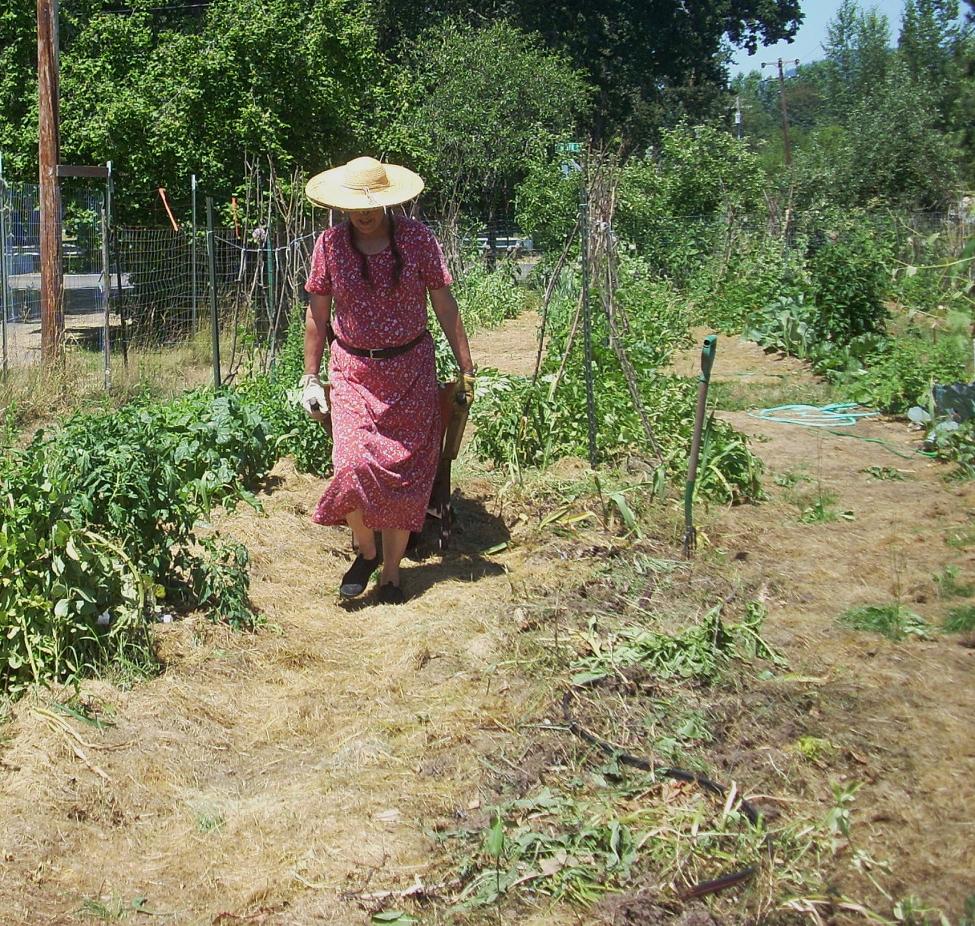
This year, Christmas fell into what around here is called a "blue hole," that is, it was a sunny day, producing shirt-sleeve weather which I felt I might as well enjoy as not. For awhile, sitting on a bench in the sun with the row of Douglas firs to my back was pretty enchanting, at least as long as the tea lasted. But, as often happens, the beauty of the view consisted in part in knowing what things ought to be done. The guests hadn't arrived yet, and I had done my indoors part in preparing for them, so I set down my cup and wandered up to the barn. Lots of straw here, full of the stuff that straw fills up with when it is called "bedding." Time to get that down to the garden. I went for the wheelbarrow, found its tire flat, rooted around in the garage for a tire pump, found one, pumped up the tire, collected a hay fork, and mucked out the barn. This made nine wheelbarrow loads.
I do enjoy putting the gardens to bed for the winter. There are hoses to be drained and rolled up, tomato cages to stack and file away, tools to organize, pots to sort, disposing of those too badly cracked to save another year, and passing Canada geese to be listened to as they go over their itinerary for the trip south.
This year the warmth has stayed very late indeed. The grass is growing, and smells of spring when cut. The daisies have sent up several December blooms, and Beloved's nasturtiums, calendulas, and miniature hollyhocks have done the same. We still have cosmos, though these are finally on their way out. I have gone round to check the lilacs and the trees, and the filberts are perilously close to bud-break. The green spikes of elephant garlic, which I usually see in February, are already a foot high. There are flies, and bees, and the air is full of songbird noises such as one might hear on a June morning. So much warmth is lovely but it is also disturbing.
El Nino? Global warming? A few years ago the creek went almost a hundred feet wide, hauling tons of our soil away to the Pacific, and shifting our well-house on its foundation. Several people in our area died that night in mudslides. This, too, I'm told, was a sign of global warming, a type of immense storm front known as the "Pineapple Express," rolling up from the waters off Hawaii, dumping six, seven, eight inches of rain at a time in various canyons of the Cascade Range, overwhelming the might and pride of the region's vast network of flood-control dams and levees.
Global warming, I've read somewhere, doesn't especially produce hot, sunny summers. It produces cloud cover, an increase in precipitation, an increase in wind, and records: record tornadoes, record hurricanes, record blizzards: spikes of hot and cold, fast and slow, all over the record books and the insurance company ledgers.
News anchors will rehearse the "the most" this, and "the biggest" that. And the most and the biggest of anything to do with weather will get our attention when we're out in it, or even when it comes knocking at our door.
I once tenanted a house built of oak, half-timbered in the Tudor style. A storm came in the night and threw a two-hundred-year-old oak tree against that house, oak bone against bones of oak. The house stood the blow, and the tree rolled down the steep pitch of the roof's edge, shredding slates and pitching them over a quarter of an acre.
I awoke in time to see an enormous branch punch through the bedroom window, pass within inches of my face, and withdraw again as suddenly as it had come, leaving the empty window to fill with night and a moaning wind. If we are causing an increase in events of this kind, it's time to seriously consider our actions.
It's my understanding that while climate swings are unavoidable, there is evidence that the current one, if not caused by human activity, is influenced by it. The principal ingredient of that influence is the increase in what are called greenhouse gases, and the major component of these is carbon in the form of carbon dioxide: one carbon atom and two oxygen atoms per molecule, to the tune of millions of tons of these molecules in the atmosphere.
Carbon dioxide is in fact a principal ingredient of life; plants have to have it, in order get hold of their primary building block, which is carbon. They throw away the oxygen, which is how we animals get our free oxygen molecules to breathe. When plants die and rot, or when they burn, which is a normal and frequent event in nature, they release nearly all their carbon back into the atmosphere. So one might ask: how is it carbon dioxide is a problem? Can there be too much of it if all the plants return it to the atmosphere all the time anyway, in a natural cycle?
A way to understand the problem is to use a banking metaphor. We make a certain amount of money a year, and we spend most of it to maintain our lifestyle.
We have a checking account.
All the money in the checking account will be spent eventually; but there must be a minimum balance today or we'll start bouncing checks.
Perhaps we also have a savings account, and we use its funds to cover our checks, to prevent our overdrafts from ruining our credit.
If we've been abusing the checking account's minimum balance, and if we use up the money in the savings account, we won't be able to support our current lifestyle.
Where the carbon went is into limestone and fossil fuels.
At the bottoms of the seas and peat bogs of the world, for perhaps billions of years, carbon has been taken out of circulation that would ordinarily have been exhaled into the atmosphere in the normal rot cycle. Most of this went into the limestone, but a lot of it is crude oil and natural gas, a buried and compressed soup of molecules with long names, nearly all of which contain carbon atoms. There are billions of tons of carbon in this savings account.
Our checking account of energy is sunshine and the flows of energy that are directly the product of sunshine: wind, water, wood, animals, farms, gardens, alcohol, natural rubber, hydrogen. Direct deposit.
Our savings account is the stuff from beneath the earth: coal, diesel, fuel oil, gasoline, synthetic lubricants, synthetic rubbers, and plastics: vinyl, polyethylene, nylon, polyurethane. Capital.
We spend this account at a furious rate, because we cannot live as we wish to live on our income from the sun. There are too many of us, with our real needs, and of us there are too many with artificially inflated needs.
We are perhaps at a point where bankruptcy is inevitable; where our tenure on earth has become untenable and we may soon be forced to give up the lease. Other tenants will come: perhaps the cockroaches, and perhaps this will be a good thing.
But I do love my children, and I feel I should have something to offer them. This is not about their holiday wish list, it's about seeking to stabilize my finances, my planetary-bank-account finances, on their behalf. I wish to offer them a tenable hold on our lease.
I well understand this is a project fraught with hypocrisy.
I'm a middle-class American, and Americans, about five percent of the world's people, are producing over forty per cent of the drain on the savings account. I'm going to drive in to work tomorrow, and there will be only one of me in the car. Circumstances have dictated this.
But, there are things that can be done, small gestures which, multiplied by millions of slightly changed lives, will slow the pace at which we're running toward bankruptcy, and give our children a bit more time for making more satisfactory changes. None of this need involve chaining yourself to a tree and screaming at some poor logger; just a few things here and there to keep the kids alive, on the off chance that there's more to this universe with people in it than without. Now, you've heard all this before, but let's just go down the checklist one more time:
First, consider the automobile. What's the mileage? Carry more gas (petrol to some of us) at a time, to prevent evaporation loss, get regular tune-ups, check the tire inflation. Trade down in size to better mileage: there are vehicles that do fifty miles per gallon, and this is more significant to your kids' future than the prestige that big one gets you. Get more passengers, and carpool. Be a passenger. Leave the car home and ride the bus, the train, the subway, the ferry, the monorail, the light rail, the taxi, or the bicycle. No light rail? No bike lanes? Write and call the local planners and city fathers; lobby relentlessly. Push hybrid; push electric. Sell the $*#!!! thing. While you're at it, sell the motor home, the motorboat, the plane, the skimobile, the jet ski, the go cart, and the dirt bike. You don't need 'em; if you do find you need one once in a while, don't buy, rent. Telecommute. Lobby for a shorter work week, then spend the long weekends, the holidays, and the vacations at home (working in the garden!).
Second, consider the home. Why have a big one when a well-planned small one will do? Insulate, turn the heat down a bit, put on a sweater and a lap blanket, get rid of the air conditioner and plant shade trees on the south side and a windbreak on the north side. Make things out of rocks or used bricks instead of concrete. Use hand tools. No time? Turn off the television, you'll have more time. Look for low-wattage entertainment. Try romance. Romance can be cheap; instead of diamonds and sky-line restaurant dinners, try being a good listener. For music, play an acoustic instrument. Read. Read E. F. Schumacher. Reread E. F Schumacher. For lighting, go with sunlight through a skylight, or low-wattage fluorescent or LED. Paint the walls and roof white; you won't need as many watts. Replace the hot water heater, refrigerator and the freezer if they predate the energy-saving models. Oe even do without; most people in the world do so. Install a ground cloth in the crawl space. Sort, reuse, sew, mend, repair, recycle, compost. For the furnishings, when possible make your own or buy locally made. Tear up the lawn and put in ground cover, fruit and nut trees, and fruiting perennials, on a schedule that will prevent your having to buy a new gasoline lawnmower when the present one gives out.
Third, consider the food. Cigarettes? I won't even tell you, you know better. Drink less alcohol and more water. Eat less meat and more fiber. Eat less prepared food and more fresh produce. Cook less, check out raw. Use double boilers and steamers and avoid frying. Don't send out for pizza; pizza sends for you, and what it wants from your arteries you should want to keep. Audrey Hepburn said the most effective diet is to share your food with the poor. Clean out the cabinets and put the stuff in the food drive bin. Find out who's offering organic produce in your area. Find out if what they're offering is really organic. Find out what "organic" is first, if you don't know, and don't depend on the television to tell you. Patronize local organic cooperatives, merchants and farmers. Raise your own food. Avoid those patented hybrid seeds from large corporations; patronize farmers, merchants and cooperatives providing heirloom varieties. Use hand tools. Garden organically. Plant fruit and nut trees. Preserve your own produce. No time? We already talked about that.
Fourth, look at your clothes. Buy less frequently, go for longer lasting, and think cotton and wool and natural dyes. Most clothing now comes directly from the planetary savings account, and "polyester" should become an embarrassing word in your wardrobe. When possible, make your own or buy locally made.
Fifth, think about your work. Are you working to get your kids out of planetary debt or deeper into it? What are your living expenses? If you're a couple, consider cutting those expenses until only one of you has to work or both of you can work half time. Give the earned time to increased quality of life for the children, or, if you've wisely refrained from contributing to the disastrous population curve, to your friends and neighbors. If you're in the mining, manufacture, distribution, transportation, sales, advertising, or application of planetary-savings-account items, from autos to herbicides, re-career as soon as you feasibly can. Think small. We're not talking communism here, just common accountability, with the following: the outlawing of for-profit corporations, with retention of nonprofits, cooperatives, partnerships and sole ownerships as the only legal entities for commerce, would all by itself go a long way to fixing the drain on your kids' planetary savings. Think about that when you're looking for work. Or looking to buy, for that matter. Or about to vote.
Sixth, and I'll stop here, what about that vote? If you don't have the vote, be careful who might be reading this over your shoulder, and start working on what it will take to get the vote. For this, your life will not be too cheap a sacrifice for your childrens' future. If you have the vote, think about what you're allowed to vote on. Is it just big political party versus big political party? Or nuclear versus solar? Roads versus light rail? Agribusiness versus sustainable farming? Clear cuts versus forest maintenance? Or to put it more simply, corporate greed versus life? If your vote can't access reality, if it isn't patching the holes in the planetary savings account, change that. Campaign finance reform would be a place to begin. Get the vote, keep the vote, use the vote; get the real issues up for a vote; inform the electorate. Perhaps you won't see results on this in your lifetime. But consider the alternative.
Whew! OK, I know, I haven't done maybe a hundredth of that stuff. But I chip away at it here and there. I'm aware, particularly and painfully, of the cost of the infrastructure that maintains the glorified suburb that in our neighborhood passes for country. It takes six times as much of the planetary savings account to establish a rural home as it does for a comparable urban row house. I've elected to be a creature of privilege, and I don't care to look too deeply into what the mirror says about that. But in some things I can give back something of what I have taken. One way is to learn from the past, to gain pre-fossil-fuels skills, and to apply them, redesigning this acre of the landscape to produce food, shade, and windbreak in ways that do more good and less harm than was done here previously, and to share the knowledge gained, as best I can, with others who also care to learn.
,,,
It was a good year in the house, and a reasonably good year in the garden. But I'm also grateful for the times I was able to spend at the high mountain lakes. The high point of my year, I think, was, as is so often true for me, at the height of summer. So I'll return to that memory for a moment, to round out this memoir.
While I was in the boat, the sun set, and as I knew a full moon was coming, I stood out from shore to the middle, and watched the last brilliant solar rays deepen in color, turning the tops of the Douglas firs and mountain hemlocks first golden, then red, and then almost purple.
Planets and stars winked into view, and I found myself surrounded by bats, more than a dozen jittery shadows that flicked across the star field in tight circles. They seemed interested in my fly rod, which stood up in the bow, supported by the gunwale of the cockpit, and would zoom toward it and away, missing my face by a few feet each time. I could feel the breath of their wings.
A small something briefly touched the shaft of my kayak paddle and fell into the water, but struggled back into the air unseen. I thought at first it might be a bat, which seemed odd, as they don't, in my experience, land on or thump into such things.
Then a small night bird, dressed in cream and gray like a swallow, landed on the front deck of the kayak before me, smoothed its feathers a bit, then sputtered off into the darkness. Mystery solved: the paddle had been mistaken for a branch, but its inorganic smoothness had defeated two tiny sets of claws.
It was then that the yellow moon rose, so hugely majestic that it seemed to me to invade the companionable darkness we creatures had peopled. I retired to my campsite, landing with the aid of a flashlight, and, lighting a candle in my tent, read Kingsolver while, outside, the unobserved bats and birds carried on their moonlit escapades.
In the morning, I took to the boat again to chase the first available sunlight and warm my bones; then, when day had reached camp, set about emptying the fire pit, which was filled with unappealing trash, especially broken glass. I've never really been one to pick up after others, even in the woods, but this time I took a personal interest and wound up 'policing' the entire site. My pack was already heavy and I had four hundred feet of elevation gain ahead of me, but I had been getting stronger of late and knew it would not be any trouble.
I once spent some time with a teacher of Zen and asked him about beer cans in the wilderness. "If I see it and it offends me, I pick it up, but I've been disturbed by the offense I've taken. But in Zen, it seems I should simply observe it and not be offended, but that seems to reduce my motivation for picking it up. And it does seem that Zen takes some of the activism out of those whom I've seen practicing Zen."
The teacher said, "Well, we should just either pick it up or not. It depends on the flow."
I must have seemed puzzled by this.
He added, "Observation is its own reward, but that neither adds to nor takes away from right action. We can think of some good reasons to pick up the can; trash is harmful to wildlife, and so on. And a natural setting, once cleaned up, is more conducive to contemplation for others. But there is no need to think about all that; you may have a tendency to speculate about whoever 'threw away' the can, and such thoughts lead to unnecessary problems. Right action begins in seeing the can without looking into its past. The can itself has had no motivation or intent and we cannot know exactly how it got there."
I tossed the contents of the wilderness firepit into our kitchen trash can and dropped the lid. Looking out the window, I could see that Jasper Mountain was wearing its winter coat, dusty green patches of second-growth fir trees alternating with the brown of frost-burned mountain meadows. This time, I thought, I might be able to see the mountain without too much fear of becoming bogged down in thoughts of who has done what to it.
It will outlast us.
That's the key to peace, I told myself. Clarity of mind comes when you deal in the things before you.
If it seems there are not enough trees, plant one. If there are a lot of cans around and you'd like them picked up, pick up one.
This can be extrapolated, if you have the energy, to planting schools and clearing minefields, or writing a check for those who do. But remember, while planting and picking, to look up.
The mountain will be there.


.JPG)