Monday, August 19, 2013

Right singularity


I've been covering, in my idiosyncratic way, the eight points of the eightfold path promulgated by Gotama when he snapped out of his long bout of meditation, determined to save the world. We've arrived at the last one, and it's a doozy.

Meditation is said, when undertaken correctly (whatever that might be), to get you the whole enchilada.

Well, it does. But it's generally offered embedded in pietistic hooraw: that "various levels or modes" thing can easily, and I suspect very often, be the money clause: "This stuff takes years, kid. Support me the whole time and I might get you there."   

I like and recommend meditation's ability to show, experimentally, such reality as we're equipped (as brains with sampling systems -- eyes, ears, etc.) to appreciate. And it takes some appreciation of what's what for there to be some justification for the other seven aspects of the path.

But it would be a mistake to go sit with the idea of "attaining" some kind of holiness. Attempting to become someone special (which is patently impossible) is exactly what Gotama would have you not do -- it would be the very illusion he returned to his friends to warn against.

So let's do a simple intellectual exercise. 'K?

You can imagine animals and plants arising from the biosphere, not as anything separate from the biosphere, the planet, the galaxy, the universe, but as aspects of all of the above -- it's all one thing, taking a variety of shapes, like thoughts in a mind. Yes?

But, wait -- are you an observer, outside of this image, or are you in it? The center of the universe, or an aspect of the universal?

I think we have to understand ourselves as, in our individuality, provisional beings at best, an aspect of the universal, to go on from here to the twelve principles that have been adumbrated as those of Permaculture. As foraging and farming and trading beings (which we have to be to live) we intervene with the plants and animals around us for our own benefit. How we do so may matter: what if they are our equals? What if it's important to show some respect? Hmm?

We know we have been destructive. How do we become less destructive, or are there even ways in which we can be constructive? If we are going to undertake to change the world for the "better," it's awfully important that the results be, umm, for the better.

'Cuz if we don't have good evidence for what we're doing, better we shoulda stayed on that couch, watching the commercials.


The field of boundless emptiness is what exists from the very begin­ning. You must purify, cure, grind down, or brush away all the ten­dencies you have fabricated into apparent habits. Then you can reside in the clear circle of brightness.

  -- Hongzhi, tr. Leighton


(To be continued)

Sunday, August 18, 2013

Focus, focus!


Action, to be correct action, must spring from focus. If we react mainly to provocation, or take action aimlessly, our contribution will be correspondingly small. If we visualize a worthwhile project, and concentrate on it day and night, our impact will be the greater.

First we ascertain that our vision is "worthwhile." Then, whether we mean to create a one-acre food forest or manage a great nation's food system, we must focus on the task at hand and give it our all.

We can see, as we work through these principles, how each of them is a facet of a single principle. It becomes clear to us that right desire and right focus are practically the same. Right focus and right avocation, or livelihood, are also the same. The path is described as having eight parts so that we can absorb the lesson in manageable chunks.

Dogen uses the words "die sitting, die standing" to indicate the urgency we should bring to taking our path seriously. That doesn't mean don't have a sense of fun or play. It does mean not frittering away our minds endlessly on secondary, illusive matters -- a major trap for us in these times. 


Benefit others, which simultaneously gives abundant benefit to the self.

-- Dogen, Tenzo Kyokun, tr. Leighton and Okumura


(To be continued) 

Monday, August 12, 2013

Work well


From right doing, right work naturally flows. It is understandable if one has had to keep working at a fast-food place to help support one's children, but one must also keep an eye out for a better livelihood, as fast-food places poison the population.

In general few jobs meet this principle, as the world system has grown toward wage slavery to enrich those already rich, to most of whom the prospect of such enrichment doing harm to the population is of little or no concern.

It can be helpful to learn a craft or trade that may provide safe and nutritious food, clean water, goods or services that are as free as possible of harm through exploitation -- or debt, which is exploitation at one remove (including the system whereby corporate entities prioritize shareholders rather than the good of society and the biosphere).

It can be objected that looking into the probable effects of work is attachment to outcomes. Not necessarily. The spirit of one's commitment to the eightfold way is to acquire a certain level of skill in not doing harm, not to acquire praise or reward for so doing. Remain in the now and just do well.


I may be white-haired and nothing but bones 
but I’m versed in the work of daily survival 
in fall I pound thistles in a wooden mortar
in spring I dry vine buds in a wicker tray
I buy Solomon’s seal from a peddler down below
for seaweed I rely on a monk from across the sea
but who would have guessed at seventy-seven
I would dig a pond for lotus roots and water chestnuts


-- Stonehouse, tr. Red Pine


(To be continued)

Monday, August 5, 2013

Ethics are not your beliefs, they are what you do


Key to understanding why there are eight parts to the long- established Buddhist way and twelve principles to the more recent Permaculture way is this concept of "right doing."

If we are alive, we do some things. But perhaps some of them are thoughtless things. Then it behooves us to think this through. To do well, it may help to have (and keep to) a plan. (If we are uncomfortable calling what we do by the names given here, we may use other names. The important thing is the action.)

The Buddhist way may in general practice be reduced to the Golden Rule: do not do to others what you would not have done to yourself.

The Permaculture principles are thought to be an expression of three ethics, caring for the earth, caring for people, and fairness -- which is really but one ethic, and may also in general practice be reduced to the Golden Rule.

Everything unfolds from the observation that there is one observable reality, regardless of how it may be described, and that therefore in some sense there is no one or nothing from which we can be divided. Care for the earth is people care and is sharing.

So we can try this experimentally. See, feel, say (or refrain from saying), do, earn, strive, think, and manifest caring and sharing. We may find that it works, and that our cynicism has been a hindrance. Why should we ever be bored a single moment in an awakened life dedicated to right doing? It's not really harder than wrong doing.


Being mindful of generosity is a gate to what the Dharma illumines, for due to that we do not expect rewards. 

-- Dogen, 108 dharma gates, tr. Nearman


(To be continued)

Thursday, August 1, 2013

Right saying

 https://3.bp.blogspot.com/-NTyHcX4NcBM/UkBWT6mfsNI/AAAAAAAAIJk/RwKh0UJNIS0/s1600/2705167745_d8dcbec156_z.jpg

The world is coming to be defined by competing slanders and obfuscations. Clarity, honesty, openness and nurture are revolutionary. What really needs to be said? Are you the one to say it? How, when and where will it be most helpful? There are those who break silence only when it will be like a sunrise, and we know to treasure them.


As for the qualities of which you may know, 'These qualities lead to dispassion, not to passion; to being unfettered, not to being fettered; to shedding, not to accumulating; to modesty, not to self-aggrandizement; to contentment, not to discontent; to seclusion, not to entanglement; to aroused persistence, not to laziness; to being unburdensome, not to being burdensome': You may categorically hold, 'This is the Dhamma, this is the Vinaya, this is the Teacher's instruction.

-- Buddha to Mahapajapati, Gotami Sutta, tr. Thanissaro Bhikkhu


(To be continued)


Tuesday, July 30, 2013

Right desire


Desire is sometimes given a bad rap by good and thoughtful people. That's because it is conflated with acquisitiveness. We often wish to accrue money, fame, a lover, electronic toys, a car. But surely it is not wrong to desire universal health and happiness. So, right desire can be the motivator toward living a principled and clarified life. 

We see by this how far from these good things we can be led by advertising, propaganda, and selected "news" -- which may be but advertising and propaganda put forth by the unprincipled for the sake of a greedful and almost universally hurtful agenda. 

On a warm day we may desire to walk together to the lake or to sit under a tree and look across the river toward the mountain; in cold rain we may desire to sit by a fire with tea. These are good things; yet by wishing as much for others we find the springboard toward right action.


I said, “What does Zen Master Fenggan do when he is here?”
The monk said, “He pounds rice and offers it to the assembly of monks. At night he enjoys himself singing.”

-- Luqui Yin, tr. Tanahashi


(To be continued)


Saturday, July 20, 2013

Right seeing

https://4.bp.blogspot.com/-nwXta53L1F8/Uj-fOpyMXBI/AAAAAAAAIIs/Gg42AS10C34/s1600/003+(4).JPG 

We begin by seeing our mistake. Separateness in the here and now is illusory, and our mental pictures of the past or future, laced with a desire to have things our own way, are also illusory. The universe with all that is in it is one thing. This is why it is right to resist the spreading of poisons in agriculture, the land, the skies, the sea, and in our cities, and to resist the spreading of fear (oppression) and of war (oppression also). 

The cause of the spreading of poisons, fear and war is the lack of accountability due to greed, and the correction of this sickness is accountability -- accepting responsibility for both the visible and invisible costs of our actions, and adjusting those actions accordingly, so that we may act with clarity and justice. Capitalism is (or certainly has become) systematized avoidance of justice. We can do better than this. 


Clearly seeing into one's nature is called practice, and the seat that puts an end to analytical thoughts is called zazen. 

-- Bassui

(To be continued) 

Tuesday, July 9, 2013

Permaculture ethics and principles in the light of Buddhism

"Earth care" is right action. Preventing soil loss, water pollution, excess atmospheric carbon, and radiological contamination are examples.

"People care" is right action. Active listening, feeding with good food, offering clean water, assisting with shelter and teaching right action are examples.

"Fair share" is right action. Living within one's means -- and finding small means sufficient opening up possibilities for others -- are examples.

These actions may be carried out in all of life, for example, within nature, architecturally, through responsible choice and use of tools, in teaching, in health care, in gift and exchange, in coming together on governance (the mutual determination of right action).

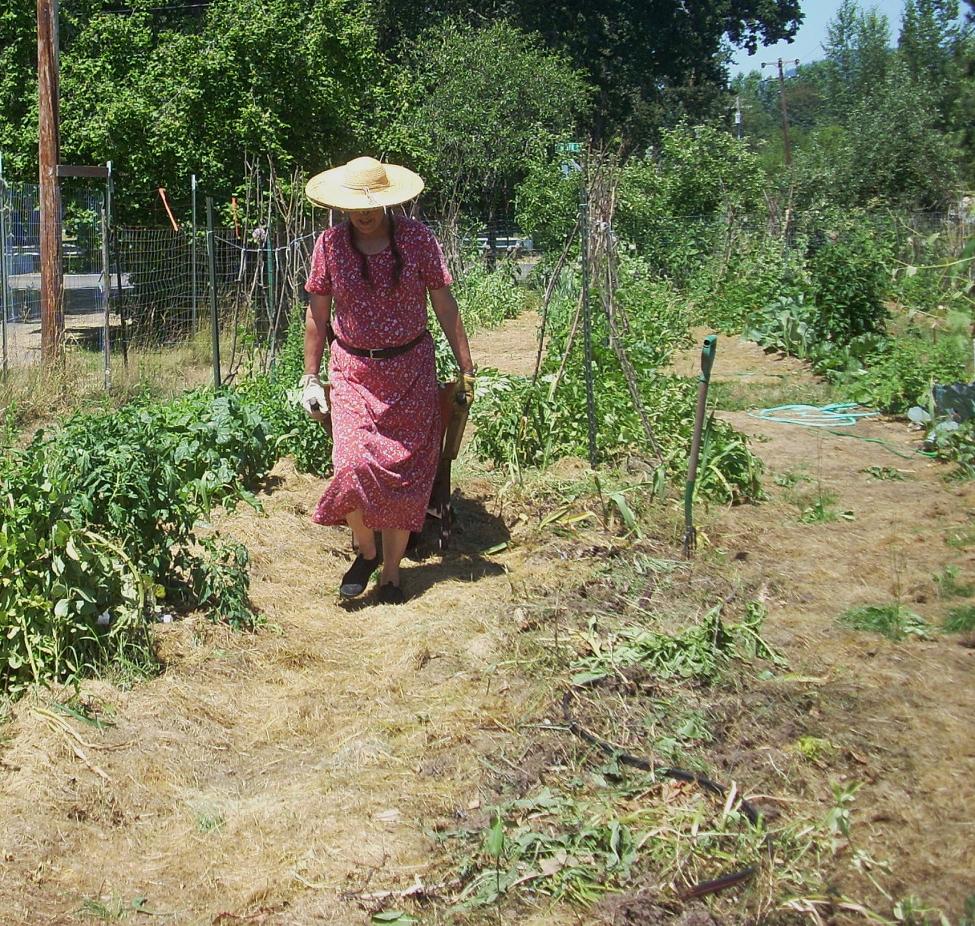
Grassroots Garden, Food for Lane County, Eugene, Oregon, USA

"Observation," as noted in the preceding post/note, is right action.

"Obtaining energy" in an ethical way (without destroying the life or livelihood of others, and without excess) is right action.

"Obtaining a yield" -- primary production (forestry, agriculture, manufacturing) in an ethical way for your livelihood (without destroying the life or livelihood of others, and without excess) is right action.

"Self-regulation" (evaluating and redirecting one's actions. Also: accepting criticism) is right action.

"Choosing to reduce, reuse, recycle, repurpose, and renew" -- over the opposites of these -- is right action.

"Eschewing wastefulness", which is closely related to the preceding principle, is right action.

"Designing from patterns to details" -- close observation and imitation of natural cycles -- is right action.

"Integrating rather than segregating processes" -- closely related to the three preceding principles -- is right action. Incorporating a chicken moat into the homestead protects the garden from the hens and from the insects and mollusks the hens eat, for example.

"Using small and slow solutions" -- mulch rather than a tractor where a mulch will do -- is right action.

"Honoring diversity in all things" -- human and in nature (which comes to the same thing) -- is right action. Consider, for example, the resiliency of mutually respected vibrant culture and the resiliency of a food forest or polycultural vegetable garden.

"Using edges and valuing the marginal" is right action. This is related to honoring diversity; from the edges in society come imagination and innovation; from the edges in the landscape come wildlife and species interaction, preventing outsized populations of "undesirable" species without chemical invention among other benefits.

"Using and responding to change" is right action. Πάντα ῥεῖ καὶ οὐδὲν μένει

All things flow. Ride the river of life.  


Unhesitatingly [the head of the farmyard] takes the lead in heavy physical labor. He cultivates the soil, sows seeds for vegetable crops, irrigates the fields when necessary, and thereby provides a steady supply of fresh vegetables and so on to the kitchen hall throughout the year.

-- Baizhang Monastic Regulations

(To be continued) 

Wednesday, June 12, 2013

Right action can be all eight spokes of the wheel


An analysis of the four truths and eightfold way of Buddhism as a unified concept which could be expressed as Right Action.

Primum non nocere, a medical directive, means, "First, do no harm."

It's rough out there.

That it's rough out there can be taken as a given. Some of us are insulated from the consequences of inappropriate action through the inequitable accumulation of resources, but the effect is temporary and I think a kind of self-harm accrues, to ourselves and our loved ones. Certainly harm comes to others.

Hence: "it's rough because we (whether ourselves or others) want things to be different than they are." We suffer when we have expectations or unrealistic intentions. Others suffer when we attempt, through action, to enforce our expectations. We take an inappropriate action.

"We can change our behavior," that is, we can learn to select appropriate actions.

So, Right Action could serve as the key concept drawing the Buddhist and Permaculture toolboxes together.

Right view could be taken as observe clearly, which is a kind of action.

Right aspiration could be taken as a kind of action, in which one connects observation to volition. Separating appropriate desires from inappropriate desires, with an intent to manifest the appropriate desires, is an internal activity, but an important one. "Cessation from all desires" is a misleading concept in this context, as it lacks the qualifier "appropriate." If one fails to desire to breathe, no right actions will follow.

Right speech is certainly an action, through the choice to say or not say, as needed. A friend often says: before speaking, ask yourself, "is it kind? Is it true? Is it necessary?"

Hence, right action. And is your action kind? Is it true (correct)? Is it necessary? These three combined are what is meant by "appropriate" as used here.

Right livelihood is right action in the sense of "obtain a yield." If benefits accrue to you and others by your actions you already have right livelihood. Do not think this is limited by or to the earning of money.

Right action must be carried out, not merely thought of. One applies one's energy to the task. So right effort is about action.

Right mindfulness, also, does not just happen. To clear away obstacles and focus, though it occurs in the mind, is an internal action without which appropriate external activity will not occur. I've expressed this dualistically, but is not all movement by living things the evidence of mind at work?

Right concentration is what occurs in meditation, i..e., the suppression of distractions so as to observe directly. So we have come full circle in this exercise, as the finding that it's rough out there is an observation. You have taken the action to find that out, to discover the cause (which can be boiled down to selfishness) and the cure (which can be boiled down to selflessness).

"Ethics" need not be taught in a university, nor commanded in a church (that's "morality," a different kind of animal). It is as simple as breathing. Want happiness? When you rise up in the morning, set your face toward the doing of right action, that is, whatever is kind, true, and necessary.


...the four noble truths include the eightfold path, which instructs us in how to live and embody dharma in every part of life through right view, right speech, right action, right livelihood, right mindfulness, and so forth. The Buddha taught the community of followers hundreds of ways to practice based on these truths. And in thousands of years of practice these skillful means have grown. We can draw upon them all in support of awakening.

-- Jack Kornfield


(to be continued)

Sunday, May 19, 2013

Buddhism and Permaculture: A pair of ethics toolboxes

This may contain: an image of a garden with plants growing out of the planter and on top of it


The following can be regarded as a compatible pair of ethics toolboxes for designing a life. 

The first is derived from Buddhism. I find its core survives Occam's razor. Its basics are: four truths, which descended from Siddhartha Gautama's contemplation of the Four Sights. And: eight ways for those truths to be manifested in your life. I tend to take this to mean the young man saw a sick person, an old person and a dying person (entropy) and prescribed, within the ontological bounds available to him, negentropic activity as its antidote.

https://1.bp.blogspot.com/-vvAfQawoj44/Sk_fhmVbdxI/AAAAAAAABJ8/N9jENzsQOag/s1600/014.JPG
Your author in skinnier days.


Truth one: it's rough out there (second law of thermodynamics). 

Truth two: it's even rougher because we (whether ourselves or others) want things to be different than they are (as if there were no such law).

Truth three: We can change our own behavior, so that things are less rough for us, at least internally (and perhaps slow some of the entropy for ourselves and others through wisdom).

Truth four is a simple method for cultivating these behavioral changes. Here is the method with its eight parts -- they are interrelated; are really aspects of one thing, but broken down for utility.

  1. Right view. See what's happening.

  2. Right aspiration. Care about the things that matter, not the things that don't. Notice the things that matter are not things (esp. as in "owning" "possessions").

  3. Right speech. When communicating with others, delete whatever would hinder them from discovering the truths and using this method. For example, hurtful snark.

  4. Right action. Do not do unto others what you would not want done to you. Heard that before?

  5. Right livelihood. Do not do for a living that which would hinder others from discovering the truths and using this method. Example: fracking engineer. Example: bankster. The best occupations are probably smallholder and the crafts that support smallholders, along with infrastructure workers and the health professions, preferably preventive care. I would include teaching, but prefer it in the form of apprenticeships over large school and university systems.

  6. Right effort. Conducting the parts of the method with due diligence.

  7. Right mindfulness. Clarity of thought concerning the truths, the method and their goal of non-harm.

  8. Right concentration. To achieve clarity of thought, discipline the mind. Simply refusing to load it up with extraneous chatter (from television or Facebook, for example) is a start. I attend virtual Soto Zen Buddhist events. Your mileage may vary.

The second toolbox is the Permaculture Design principles, as formulated by David Holmgren in Permaculture: Principles and Pathways Beyond Sustainability (2002). I find them to be, ultimately, the same box differently adumbrated.

The core ethics are generally expressed as "earth care, people care, and fair share." This could be regarded as "help others slow their entropy." So I find both Buddhism and Permaculture, as ethical systems promoting simple living and reciprocity, to be attempts to build a nonfictional applied philosophy of negentropism.

The ethics are applied in, usually, twelve kinds of activities usually called principles.

  1. Observe and Interact. By taking the time to engage with nature we can design relevant solutions.

  2. Catch and Store Energy. Developing systems to collect resources when abundant, we can use them in need.

  3. Obtain a yield – Ensure that you are getting useful rewards from your work.

  4. Apply Self Regulation and Accept Feedback – Efficient or resilient systems require noting and correcting inefficient or nonresilient practices.

  5. Use and Value Renewable Resources and Services – as opposed to non-renewable resources.

  6. Produce No Waste – “Waste not, want not.”

  7. Design From Patterns to Details – Observe patterns in nature and society. Test their appropriateness broadly, rather than losing yourself in detail.

  8. Integrate Rather Than Segregate – By putting the right things in the right place, relationships develop, creating efficiencies and resiliences.

  9. Use Small and Slow Solutions – Small is beautiful.

  10. Use and Value Diversity – “Don’t put all your eggs in one basket” -- be resilient.

  11. Use Edges and Value the Marginal – These are often the most valuable, diverse and productive elements in the system.

  12. Creatively Use and Respond to Change – We can have a positive impact on inevitable change by carefully observing and then intervening at the right time.

The principles are applied in seven "domains" that have been elucidated. These: The Natural Realm, Building(s), Tools (Technology), Education/Culture, Health (Well-Being), Economics ("as if people mattered"), Governance (participatory democracy preferred).

I'm aware that some leaders in Buddhism and Permaculture have historically and have continued to fall short of the ethics enumerated here, particularly in the treatment of women, and of the colonized by colonizers, by men in positions of authority. So what's new?  I'm going to practice as long as I see the utility of practice; that will at least be one less potential predator in the world, to the extent of my ability. Both Buddhists and Permaculturists practice as exemplars.

You are here for only a moment, less than a moment in the universe's time. Why not simply clear the mind, open the "heart," open the hands, be for and with and not against?

Natural farming, the true and original form of agriculture, is the methodless method of nature, the unmoving way of Bodhidharma. Although appearing fragile and vulnerable, it is potent for it brings victory unfought; it is a Buddhist way of farming that is boundless and yielding, and leaves the soil, the plants, and the insects to themselves. -- Masanobu Fukuoka


(To be continued)